
Bravely Standing Up to Nazis for What’s Right
FEBRUARY 25 IS THE 85TH ANNIVERSARY of a vigorous and radical public display of popular resistance to the vicious Nazi occupation of the Netherlands in 1941.
Some 300,000 citizens of Rotterdam, nearly half of the Dutch city’s population, joined in an illegal 2-day general strike to protest the wholesale human rights violations being committed against Jews and others by the Germans and their Dutch collaborators. On the strike’s second day, workers and other citizens in many other cities joined the strike. The vast majority of those who organized and joined in the strike were not members of the groups that had been victimized.
The Germans used violence and arrests to bring the strike to an end, shooting nine strikers dead, wounding more than 50 and arresting more than 200. Many of the strike’s organizers were sent to concentration camps, where most of them died.
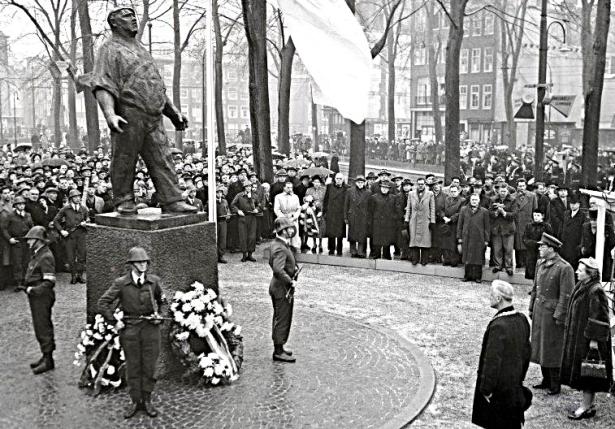
The strike was one of the only mass demonstrations against the Nazis’ genocidal treatment of Jews in Europe. It is commemorated annually on February 25 with a silent march and ceremony at De Dokwerker statue in Amsterdam. https://nvdatabase.swarthmore.edu/content/dutch-citizens-resist-nazi-occupation-1940-1945
The image shows the unveiling of De Dokwerker statue in Amsterdam, the site of the annual commemoration of the February 25 anti-Nazi general strike.
Attack on Wage Slavery Gets Rid of Tainted Meat
FEBRUARY 26 IS THE 120TH ANNIVERSARY of the publication of Upton Sinclair’s novel, ‘The Jungle’.
In 1906, when The Jungle was published in book form (it had already been serialized in the weekly magazine, Appeal To Reason), Sinclair was a dedicated Socialist who aimed to produce a novel that would attack capitalism by showing the evilness of wage slavery.
He succeeded in exposing wage slavery in the meatpacking industry, but his best-selling descriptions of maggot-filled, tubercular meat being turned into sausage was what really caught the public’s attention.
When Congress passed the Meat Inspection Act just four months after The Jungle was published, much of the credit went to Sinclair. https://en.wikipedia.org/wiki/The_Jungle
First Step Toward a Massive Victory in Canada
FEBRUARY 27 IS THE 50TH ANNIVERSARY of a meeting where a group of Canadian Eskimo leaders presented Canada’s Prime Minister with a formal claim to 250,000 square miles of land in Canada’s far north. The 1976 claim’s size amounted to one-fifth of all of Canada.
That meeting led, roughly a quarter-century later, to the creation of the Canadian Territory of Nunavut. The new territory was nearly three times the size of the land claimed in 1976, but it gave the Eskimos outright ownership to only 135,000 square miles of land, slightly more than half of what had been requested in 1976.
The detailed description of Nunavut, created in 1999, differs in many other ways from what had been claimed in 1976, but an objective comparison of the original claim and the final settlement hardly suggests that the Euro-Canadians took advantage of the Eskimos at the negotiating table. https://www.canadashistory.ca/explore/politics-law/the-creation-of-nunavut
Expressing Unpopular Views Is Not Criminal (1961)
MARCH 2 IS THE 65TH ANNIVERSARY of a totally peaceful civil rights protest outside South Carolina’s capitol building that police brought to a halt by arresting nearly 200 of the protesters on the charge of “breach of the peace.”
After the protesters were convicted in 1961, they appealed until their case reached the U.S. Supreme Court. In February 1963 the Supreme Court ruled in a precedent-setting 8-1 decision, that the protesters were innocent because the police had violated their First Amendment rights.
Here is Wikipedia’s brief description of how the case was decided:
“The 187 petitioners consisted of African-American high school and college students who peacefully assembled at the Zion Baptist Church in Columbia, South Carolina on March 2, 1961. The students marched in separate groups of roughly 15 to South Carolina State House grounds to peacefully express their grievances regarding civil rights of African-Americans. The crowd of petitioners did not engage in any violent conduct and did not threaten violence in any manner, nor did crowds gathering to witness the demonstration engage in any such behavior. Petitioners were told by police officials that they must disperse within 15 minutes or face arrest. The petitioners failed to disperse, opting to sing religious and patriotic songs instead. Petitioners were convicted of the common law crime of breach of the peace.”
“The Supreme Court held that in arresting, convicting and punishing the petitioners, South Carolina infringed on the petitioners' rights of free speech, free assembly and freedom to petition for a redress of grievances. The Court stated that these rights are guaranteed by the First Amendment and protected by the Fourteenth Amendment from invasion by the States.”
“The Supreme Court argued the arrests and convictions of 187 marchers were an attempt by South Carolina to ‘make criminal the peaceful expression of unpopular views’ [my emphasis] where the marchers' actions were an exercise of First Amendment rights ‘in their most pristine and classic form.’ The Court described the common law crime of breach of the peace as "not susceptible of exact definition.” https://scholarship.law.unc.edu/cgi/viewcontent.cgi?article=6180&context=nclr
‘Serfdom Is a Keg of Gunpowder’ (1861)
MARCH 3 IS THE 165TH ANNIVERSARY of the emancipation of some 23 million Russian serfs–38 percent of the population–by the czar’s royal edict.
The emancipation of Russia’s serfs was brought about to a large extent in reaction to violence and the threat of violence by the country’s impoverished peasants. For more than a century before the czar decreed the serfs’ emancipation, peasant attacks on landlords and their property had been a persistent feature of rural life. The rebellions were usually isolated assaults or incidents of arson, but collectively they constituted an ever-present threat. As the head of the czar’s police put it, “Serfdom is a keg of gunpowder under the state.”
Six years before his 1861 emancipation decree, the czar made his motivation clear when he told a large gathering of nobles “My intention is to abolish serfdom ... It is better to abolish serfdom from above, than to wait for that time when it starts to abolish itself from below. I ask you to think about the best way to carry this out.” http://www.econ.yale.edu/~egcenter/GelbachFinkelPaper.pdf
For more People's History, visit
https://www.facebook.com/jonathan.bennett.7771/
Spread the word