
I'm very sensitive. I’m afraid of seeing the video,” Sarah Sherman tells me in the days after federal agents killed a second protester in Minneapolis, Minnesota. Sherman, a stand-up comedian whose over-the-top body horror under the stage name Sarah Squirm has earned her a spot in the cast of Saturday Night Live (SNL) and, recently, her own HBO special, has no interest in seeing a real-life snuff film.
When conservative commentator Charlie Kirk was shot and killed a few months prior, friends had casually sent Sherman links to the footage. “They were like, ‘Did you see the video?’ because, you know, I like gore. And I was like, ‘You’ve gotten me all wrong.’” Sherman, wearing a hat emblazoned with the logo of the death metal band Cannibal Corpse, shakes her head. “I make sparkly candy cartoon gore. It’s funny because it’s not real.”
I recall the last time I felt the need to avert my eyes from a moving image. It was a few days earlier, at home, streaming Sherman’s stand-up special Sarah Squirm: Live + In the Flesh, which ends with an unrelenting montage of gross-out visuals designed for maximum psychic confrontation with the human terror of embodiment.
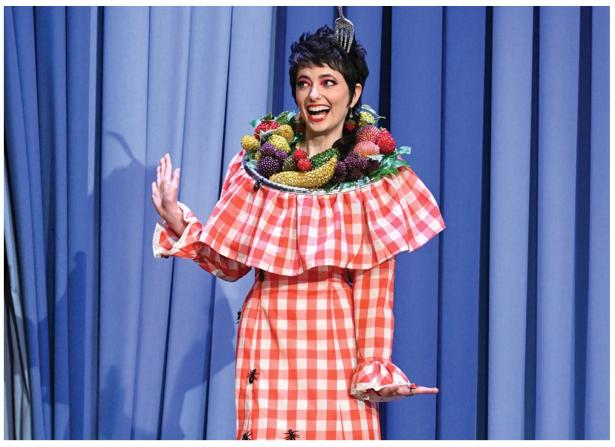
Throughout the special, Sherman dons a brightly colored costume that looks like something a children’s television host would wear, helping her to achieve total sensory overload alongside the stage gore. Sherman, now having ditched the clown suit for more typical Brooklynite attire, tells me it’s her own corporeal anxieties that make her sensitive to the comedic potential of squeamishness. “My fixation on body stuff that’s supposed to be on the inside being on the outside comes from my neurotic Jewish hypochondria,” she explains.
But just because Sherman’s not watching the videos of Renée Good’s and Alex Pretti’s killings doesn’t mean she isn’t paying attention. “There’s no archetype in the cultural consciousness for who these people are,” she says of Donald Trump’s MAGA-enhanced Immigration and Customs Enforcement (ICE) agency, its ranks now swelling with poorly trained and ideologically motivated recruits who are currently knocking skulls on the president’s behalf.
Sherman recently attended a dinner party at the home of her friend Brace Belden, cohost of the podcast TrueAnon, where she met journalist Seth Harp, whose book The Fort Bragg Cartel uncovers an elite special forces unit within the US military that operates more like a criminal gang. ICE in 2026, Sherman says, is the Department of Homeland Security’s version of the same, a “clandestine ethnic cleansing service” that “acts with impunity and without law.” Even ICE’s uniforms combine personal and standardized garments and gear, Sherman observes, placing them outside the ordinary chain of command and signaling that the usual rules don’t apply to them.
Sherman isn’t quite sure how to satirize these guys, but she thinks it’s important to try. They wear masks, she says, not only to conceal their identities but to project danger and instill fear. Even before the first Minneapolis protest killing, she was trying to find a way to knock them down a peg in the SNL writers’ room. “I wrote in the script that I was playing an ICE guy, and I had these giant prosthetic roided-out fake arms and a huge vein in my red forehead,” she says, “but it never made it past the table read.”
After the second killing in Minneapolis, SNL decided to skewer Border Patrol chief Gregory Bovino on air. Sherman describes watching the cold open with a lump of fear in her throat, worried the punches might not land. “I thought the beat was doing a good job making fun of him. But like, when is it just too fresh?”
Toeing the line between gag reflex and belly laughter with kaleidoscopic horrorscapes of eyeballs, intestines, teeth, and pus is, in Sherman’s estimation, a lot simpler than parodying those carrying out real acts of brutality with total state impunity.
Long Island Heretic
When Sherman, now thirty-two, was growing up on Long Island, it was taken for granted that she would go on a Birthright trip — a free, curated propaganda tour of Israel for young Jews, pitched as a ten‑day heritage trip and rite of passage. “I didn’t want to, but I didn’t understand why,” she says. “I thought it was creepy, but I didn’t have a cohesive political worldview. I was just a bratty nonconformist. It’s funny, when you have a semirebellious attitude as a kid, it does serve you in life.”
A conservative suburb of New York City with a large Jewish population, Long Island has steadfastly supported Israel’s assault on Gaza since 2023, even as popular approval has crumbled elsewhere in the state. “There’s a really ferocious, well-funded campaign to force American Jews to have a regional identity with a country that they’ve never been to or lived in,” Sherman says. She describes a conflict of interest between assimilationism and Zionism. “Growing up, all the girls would get keratin hair straightening treatments and nose jobs but then have really intense political affiliations with Israel. There was a cognitive dissonance.”
For many in Sherman’s hometown milieu, uncritical backing of Israel is a sacred principle — and it was her rejection of this principle, not the visceral grotesquerie of her boundary-pushing comedy, that ultimately got her in trouble back home.
Sherman, a member of the Democratic Socialists of America (DSA) for more than half a decade, was vocal about her support for Zohran Mamdani’s mayoral campaign. This was hardly a departure for her — a few years prior, Sherman had knocked on a thousand doors for Bernie Sanders. But after joining the SNL cast in 2021, her political activity drew new scrutiny. “My parents were catching a lot of flak on Long Island for my outward support, because there was a really successful Zionist campaign against Mamdani,” she says. “All these people were telling them, ‘Look, your daughter’s a self-hating Jew.’”
The community hectoring backfired. Support for Israel had been a fault line in her family for years, one Sherman had mostly stopped trying to bridge. “They were hitting up my mom and saying, ‘What is she doing?’ And my mom literally said to me that she thought, ‘Well, I know my daughter’s not an idiot.’” With Zionists’ unreasonableness now on display, the ideology was up for reevaluation. Sherman reflects with gratitude on her long refusal to participate in a ritual of estrangement over political differences, once demanded in some progressive circles. “My parents are much hipper now,” she says with satisfaction.
“I believe in a free Palestine,” Sherman says in her HBO special. “Of course I do — I’m Jewish, and it’s free.” Joking aside, Sherman is worried about rising antisemitism in the long shadow of Gaza. “I basically didn’t think antisemitism was a thing until recently,” she says. “And I’ve done shows in Ohio where I said I was Jewish onstage and someone screamed ‘Auschwitz’ at me. Or people have asked me if I have money in my basement.” But there was a random, schizoid quality to these exchanges. Now the hardening identitarianism of the New Right is weakening the Republican Party’s fealty to Israel — but instead of a critique of imperialism or ethnic nationalism, the Right is starting to murmur ominously about “the Jews.”
It shocks and aggrieves Sherman that, in a climate where open fascist Nick Fuentes engages in Holocaust apologia on Tucker Carlson’s popular podcast and J. D. Vance gives him a pass, where Florida GOP gubernatorial candidate James Fishback screams at a campaign event about schoolchildren being force-fed “goyslop,” and where the world’s richest man, Elon Musk, regularly signals neo-Nazi sympathies on the misinformation and hate-amplification platform he owns, it’s the Left that still gets stuck with the charge of antisemitism.
On SNL last year, Sherman played an Italian woman from Long Island who was spiraling over the rise of Mamdani. “Even though she doesn’t live in New York City, she still has an opinion about it, and she’s afraid he’s gonna enact ‘sharia lore.’ People online were like, ‘Oh my god, she’s doing a Jewish stereotype,’ even though I was playing an Italian. ‘Oh my god, she’s so antisemitic,’” Sherman says in disbelief. “People, I’m literally just Jewish.”
Children of Bernie
Sherman’s involvement in the Mamdani campaign served another purpose: snapping her out of the malaise that had set in after Sanders’s loss in 2020. “I’m proud to say that, just like every other dumb bitch on the planet, Bernie changed my life,” Sherman says.
After decamping from Chicago’s alt-comedy scene to Los Angeles in 2019, Sherman and her boyfriend joined the local DSA chapter. DSA Los Angeles “would put out statistics listing the top twelve canvassers in LA County that week, and it was always me and my boyfriend, going nuts.” Sherman formed close friendships with other Bernie canvassers. “It was life-changing to just be around a community of people who believe in basic decency,” she says. “And then you’re going to neighborhoods in LA that you don’t normally hang out in, and you’re talking to people face-to-face about how to build a better society.”
The Bernie Sanders campaign had been an antidote to alienation. Then it all ground to a screeching halt. As COVID-19 spread and lockdown orders went into effect, Sherman and the other Bernie canvassers went from having the most frequent and diverse in-person interactions of their lives to the fewest, nearly overnight. “God couldn’t have written a sadder joke,” she says.
Sherman made it to a few of the George Floyd protests that summer, but her hypochondria kept her at the margins. The next year, she got the SNL call and moved back to New York. Her comedy career was ascendant, but SNL — whatever else it is — is a demanding job, and it left her little time for political engagement. She missed the electricity and camaraderie of the Bernie campaign days. “I was disenchanted,” she says. “And then DSA people were like, ‘Hey, can you help with this Zohran thing?’”
SNL made Sherman’s old canvassing schedule impossible. Instead she made guest appearances on digital phone banks, did stand-up at campaign rallies, and generally showed up anywhere she was asked. Refreshingly, Mamdani’s team never tried to censor or edit her routine. “I’d be like, ‘Can I say this joke about full-frontal nudity?’ And they’re like, ‘Yeah.’ That’s part of what people loved about them. I think there’s a political sensitivity oftentimes,” Sherman says. The Mamdani campaign, by contrast, “spoke to the highest level of people’s intelligence. They talked the way people talk.”
When Mamdani won the primary and then the general election to become mayor of New York City, Sherman was floored. “There’s still a part of me that’s embarrassed to admit that I was surprised by him winning, just because I felt so heartbroken from the past,” she says. “I think his win was so important because it was like, maybe we haven’t totally given up hope.”
Holding Out for a Cure
Sherman is quick to distinguish between New York City’s good fortune and the unfolding disaster of national politics during Trump’s second term. Our conversation drifts back to Minneapolis, where protesters are still blowing whistles into the masked faces of ICE officers in subzero weather, registering their dissent from the agency’s campaign of mass kidnapping and brutalization.
Sherman wonders aloud how anyone can still support ICE, given what we’ve seen, much less cheer them on as they maraud through the city asking for papers, whisking ordinary people off to distant prison camps, using children as bait to entrap their immigrant parents, dragging elderly people out of their houses in their underwear, and shooting people of conscience who stand in their way.
Lately, I confess, I’ve been wavering on the most idealistic principle of democratic socialist politics: that an appeal to people’s basic material interests can cut through ideological distortions and transcend artificial lines of difference. I worry that may have been truer in 2016, when Bernie Sanders first introduced our generation to the revolutionary concept, than it is now, after a decade of misinformation, polarization, cult brainwashing, and seemingly irreparable institutional breakdown.
By way of a reply, Sherman asks if I’ve seen 28 Years Later: The Bone Temple, the latest in the popular zombie film franchise. In the 28 movies, she explains, people “catch this disease that turns you into a violent zombie, and you immediately start ripping everyone’s heads off and acting crazy.” The pandemic rampages through society transforming ordinary people into crazed lunatics consumed by the compulsion to hurt and kill.
Sherman warns of spoilers before describing how a postapocalyptic doctor in the newest installment undertakes to treat a feral zombie. “He’s basically at the end of the world trying to preserve humanity in the face of total annihilation,” she says. “And he takes the alpha zombie, this red-eyed, violent dude who’s totally evil at the beginning of the movie, and he cures him of his disease.”
“There was still a trace of humanity under there, dude.” Sherman, lost in thoughts of zombie rehabilitation, looks caught off guard by her own emotion. “I just cried through the whole movie.”
[Meagan Day is a senior editor at Jacobin.]
Jacobin‘s special spring issue, “Teen Jacobin,” is out now. Follow this link to get a discounted subscription to our beautiful print quarterly.
Spread the word