
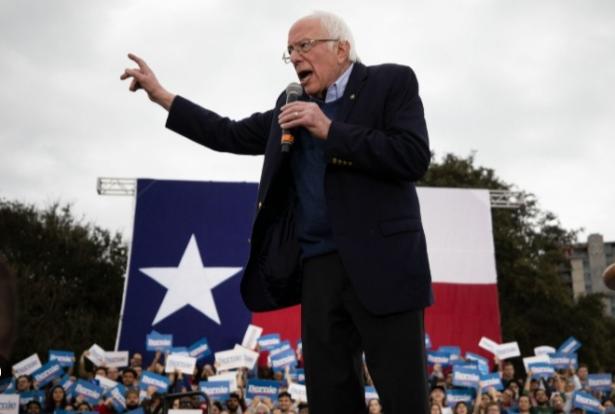
On Tuesday, former President Barack Obama took a break from negotiating Netflix deals and came to Texas to grab tacos with his party’s Senate candidate, James Talarico, and gubernatorial hopeful, Gina Hinojosa. Meanwhile, the state party announced that Bernie Sanders, the octogenarian Brooklyn Dodgers fan and famed “ultracommie,” would keynote its convention in Corpus Christi this summer. It became, for a moment, harder to sustain the traditional refrain of the committed Texas Democrat that the national party has forgotten about “us.”
In truth, it’s historically Texas Democrats who have tried to push away the national ones. An Obama visit and Sanders speech would have been unthinkable anytime in the past decade-plus. In 2014, Texas Democrats were planning their state convention during a year when they hoped—erroneously—that the political celebrity of state Senator Wendy Davis would help them take the governor’s office. The party had begun the process of reaching out to national figures including Vice President Joe Biden, New York Senator Kirsten Gillibrand, and former Secretary of State Hillary Clinton. But I was told by party officials at the time that the Davis campaign had put a kibosh on the whole search. It wanted to direct the public’s attention away from the Obama administration and the national party, both unpopular in Texas, and tell a specifically Texan story, seeking to impress upon voters that the nominee was nonideological, practical, and not too feminist.
When Texas Democrats met in Dallas, there would be no celebs, apart from the bands convened by state Representative Trey Martinez Fischer in an upstairs ballroom. Some Democrats thought this was a mistake. In hindsight, it clearly didn’t matter very much. The race never got that close, and in November Davis lost by about twenty points.
This year, though, there’s reason to believe that at least some of the statewide races will be much closer. What does it mean that Texas Democrats are embracing national figures who historically haven’t been very popular in Texas?
Republicans are arguing that it’s a sign that Texas Democrats are getting lost in the sauce. Dave Carney, top Greg Abbott strategist and proud New Englander, gleefully retweeted Democrats throughout the week. “Best news this week!” he wrote when the party announced that Sanders would come to the convention. Abbott’s campaign account, which has lately adopted an unfortunately Zoomer-esque style on social media, started posting images of Joseph Stalin. When the Talarico campaign thanked Obama for coming, Carney echoed them: “Ditto please come back.”
The pushback was not always particularly coherent. John Cornyn adviser Matt Mackowiak ripped into Talarico for ordering a “vegan” breakfast taco—the pretty traditional potato, egg, and cheese, which, it has to be noted, contains animal products. A conservative movement that had more vim and vigor, as it has had in the past, might more naturally come upon the better attack on offer here: Talarico didn’t want to offend Obama, a secret Muslim, by ordering bacon.
Democrats, in response to this and other gleeful predictions of backlash, often pointed out that Obama and Sanders are two of the most popular politicians in the country. This seems to be true. YouGov, the polling firm, keeps a list. Obama has 54 percent approval, which puts him at the top. Former California Governor Arnold Schwarzenegger, famous for other things, is tied. Sanders sits in third, with 49 percent approval. (The first Republican on the list who didn’t star in Kindergarten Cop is the late Charlie Kirk, who comes in at eleventh with a pretty underwhelming 36 percent.) The trio’s approval ratings are helped by the fact that each is out of the running for the presidency. In Sanders’s case, it also helps that he is not seen as a dyed-in-the-wool Democratic partisan. (He’s an independent senator from Vermont.)
But these are national numbers, of course. The last time the Texas Politics Project conducted state polling on Sanders was in February 2020, when just 36 percent of Texans had a somewhat or very favorable opinion of him and 52 percent didn’t, with 42 percent saying they had a “very unfavorable” feeling. As for Obama, while some Americans who didn’t vote for him may remember him more fondly now—in the glow of our nostalgia for . . . 2015?—the most salient data point would be that he lost presidential elections here by 12 and 16 points in 2008 and 2012, respectively.
Obama’s trip to Austin—featuring a relatively low-profile sojourn to a taco place—would seem to be less of an indicator of a strategic shift than the decision to invite Sanders is. Back in 2018, the last time Texas Democrats had a pretty good shot at winning the top prize, when Beto O’Rourke was challenging Ted Cruz for the Senate, Sanders came to Texas in March to support progressive candidates in primaries but was not invited to the convention, which was once again a Texas-focused affair.
It would have been strange if the party had invited either Sanders or Clinton that year, given that everyone was still traumatized by the 2016 primary. But there was an additional consideration. In Trump’s first term, the party hoped to make gains among a particular kind of suburban voter—especially the higher-income, higher-educated woman—who might have traditionally voted Republican but was repulsed by the president. This kind of voter was more likely to be a fan of the status quo that the president seemed to have wiped away. That voter was probably not a Bernie bro—though their downwardly mobile children might have been.
Democrats succeeded in targeting this voter, flipping a number of suburban state and national districts and coming within 2.6 points of knocking off Cruz, fueled by hundreds of thousands of voters who cast ballots for O’Rourke for Senate and Abbott for governor. The results unsettled Texas politics for some years, until Republicans were able to draw new, safer maps in 2021 and the hated Biden replaced the Donald.
Democrats hope to win this kind of voter again now that Trump is back in office and his approval rating is in the toilet, so Sanders might have again been persona non grata. But something else happened between 2018 and now—the party lost a lot of ground in South Texas and among traditional constituencies that proved Trump-curious. Every vote it lost in these communities made the hill to win a statewide election a little steeper and put some congressional seats in South Texas in play.
Curiously, Trump gained the most in parts of the state that Sanders won in the 2020 Texas Democratic primary. That year, Biden won about 35 percent of the state’s Democratic voters and Sanders won 30 percent. Sanders dominated in South Texas, El Paso, and the Interstate 35 corridor between San Antonio and the suburbs north of Austin. He would almost certainly not have won Texas in the general, of course, and he probably would have performed worse here than Biden did. But he turned out voters in parts of the state that, with hindsight, we know were becoming alienated from the Democratic Party.
Biden’s performance in South Texas in 2020 and Kamala Harris’s in 2024 caused much alarm among Texas Democrats. But there are signs that that weakness was a problem of the Biden era, not an inherent weakness of the Democratic Party. Polls suggest that Latino Trump voters everywhere are defecting back, or at least painfully regret their vote. Bernie supporters packed one of Sanders’s “Fighting Oligarchy” rallies last year in McAllen, where folks came out to hear the senator rail against “the system,” which is more or less the same thing Trump voters in the Rio Grande Valley like about their man. If the party wants to make doubly sure it performs in the Valley this November, Sanders can probably help.
But the biggest difference between 2014 and 2026, of course, is that Texas Democrats don’t have to feebly strategize around a lame-duck Democratic president. This midterm election is going to be about one thing: Trump. His national approval ratings are appalling, and headed south. According to Nate Silver’s polling average, just 38.5 percent of Americans have a favorable opinion of Trump, while about 58 percent view him unfavorably, with a whopping 48 percent having a “strongly” unfavorable opinion. In Texas, Trump’s numbers are merely bad—45 percent favorable to 50 unfavorable, the Texas Politics Project found in April—but consider what six more months of war, inflation, and energy shocks might do.
Republicans all around the state are sounding alarms about a kind of malaise that seems to have descended on the party’s voters. GOP polling firm Ragnar Research recently published an eyebrow-raising report on some 4,200 traditional GOP voters contacted by the firm in the run-up to the March primary who declined to participate in surveys, seemingly out of a feeling of alienation from their party. Many went on to stay home, and 13 percent switched to vote in the Democratic primary. “Our findings indicate an exhaustion issue with Republican voters, due to a lack of enthusiasm,” the report read, “and in extreme cases, the direction of the Republican party and the current administration.” This seems to indicate the possibility the party faces an even deeper defection problem than it faced in 2018. That’s bad news for it.
One of the ironies, then, of Republicans gloating about Sanders’s and Obama’s visits is that they’re shackled with a much more divisive and difficult national leader, and there appears to be no internal dissension about him at all among elected party leaders. If Trump wanted to speak at the Texas GOP convention this year, it’s just about unthinkable that Abbott would deny him, as Davis nixed a Clinton speech. Right now Republicans who’ll face a general election in November are flooding the airwaves with assurances about how they love the president and the president loves them.
The man who has styled himself “MAGA Mayes Middleton” is the likely GOP nominee for Texas attorney general. Abbott and Ken Paxton, who is running for Senate, have sucked up to Trump for years, of course. Paxton’s runoff opponent, Cornyn, appears to see Trump as his last lifeline to stay in office: He recently introduced a bill in Congress to rename U.S. 287 Interstate 47, the “Trump Interstate,” which, whether you like or dislike the president, is undeniably a pretty sad little gambit.
But what happens to the Texas GOP if, six months down the road, the administration is generally considered to be in a state of collapse even worse than the Bush administration’s in 2006 and 2008? If that happens, Xi Jinping could come to campaign for Texas Democrats, ordering tempeh and soyrizo breakfast tacos, and it would be unlikely to make a difference.
Christopher Hooks is a former senior editor at Texas Monthly. Raised in Austin, he has been writing about Texas since 2013, for publications including the Atlantic, Gawker, GQ, Rolling Stone, the Los Angeles Times, the New York Times, the Texas Observer, and the Washington Post. For Texas Monthly, he has written about redevelopment battles in El Paso; a congressional race in Amarillo; a wet/dry election in Texarkana; a Black Lives Matter rally in Vidor; and a water sommelier in Harlingen. He is probably currently somewhere between those five points.
For half a century, Texas Monthly has chronicled life in the Lone Star State, exploring its politics and personalities, barbecue and business, true crime and tacos, honky-tonks and hiking. We hope you enjoy the archive of classic Texas Monthly stories on this site, as well as the half dozen new ones we add every day. We present those stories on every platform where our audience might enjoy them, from this website to our printed magazine, podcasts, videos, books, and live events. Our combined monthly audience is more than 34.6 million and growing rapidly.
We don’t report “the news.” You can get that lots of places. Instead, our journalists strive to bring you vivid storytelling about the scenes and characters and hidden forces behind the news, whether the topic is migration or an emerging musician. We also offer expert advice on the state’s best restaurants, swimming holes, and other attractions. If you’re new to Texas Monthly, we hope you’ll like what you see and want more. We offer several easy and affordable ways to subscribe.
Spread the word