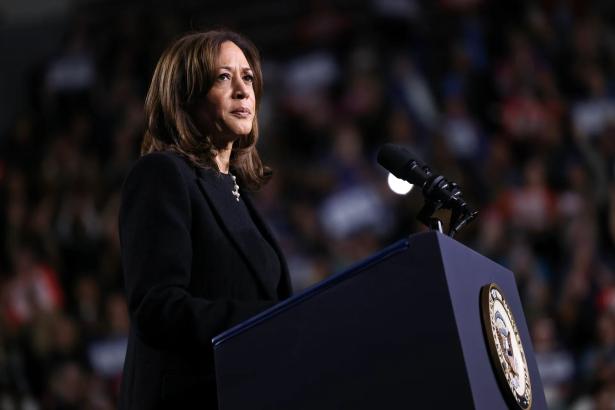
Kamala Harris at a campaign rally on November 04, 2024 in Allentown, Pennsylvania | Michael M. Santiago/Getty Images
The patron saint of the 2024 Democratic National Convention was Fannie Lou Hamer—recalcitrant sharecropper turned agitator and, like the Democratic presidential nominee, a black woman. Hamer worked on the plantation of W.D. Marlow near Ruleville, Mississippi—laboring in the fields, cleaning the Marlow manse, and keeping the family’s records. All this, estimates Hamer biographer Kate Clifford Larson, earned her “between $600 and $800 a year, less than half of what white farm families earned in 1948.”
This was by design—the mandate of Mississippi’s ruling class was assured through the reduction of the state’s black residents to near slavery. Hamer took her revenge: She wore the Marlows’ fine clothes while they were away. She stole their perfume. She bathed in their tub. She used the family’s spoons and then watched them eat behind her. It was said that Hamer “didn’t have real good sense,” that she was “uppity,” and filled with “gripes.” But, as Larson recounts, Hamer’s own analysis hinted at something deeper—“I was rebelling in the only way that I could rebel.”
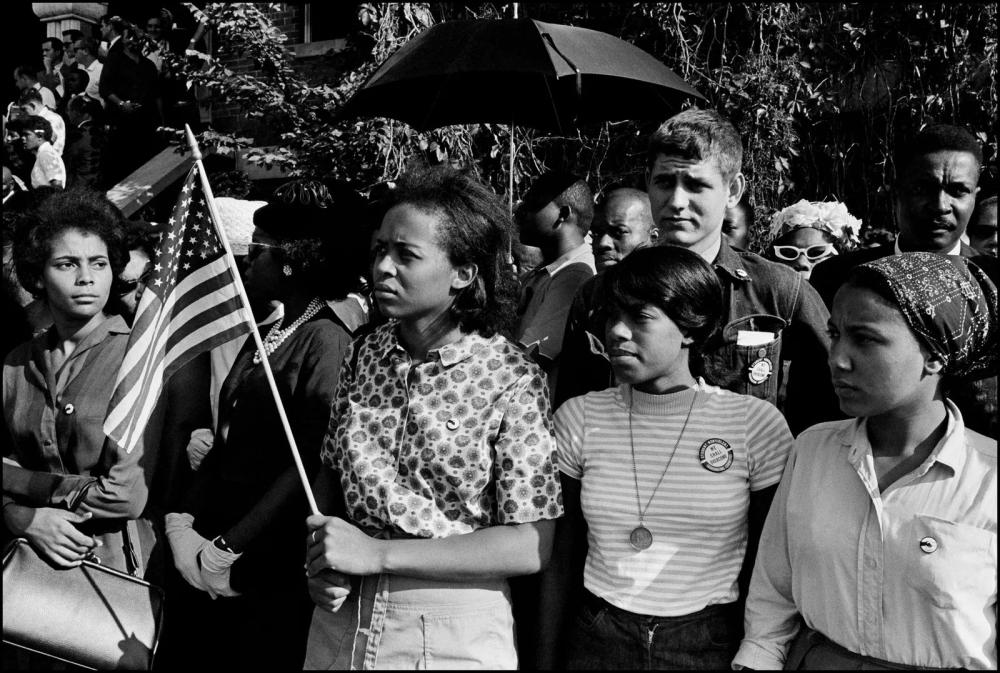
IN THE TRADITION Student Nonviolent Coordinating Committee workers at the funeral of four girls killed in the bombing of the 16th Street Baptist Church in Birmingham, Alabama, in 1963. Danny Lyon/Magnum
In 1962, the rebellion was joined. That was the summer that a bevy of civil rights workers descended on Hamer’s Sunflower County seeking volunteers to help register blacks to vote. Hamer signed up and, through her courage, charisma, and oratory, quickly drew ardent disciples and ruthless adversaries. In 1963, Hamer was arrested, jailed, and at the behest of her white captors, beaten with a blackjack by two African American inmates. She emerged from captivity grievously injured but recalcitrant as ever
.A year later Hamer cofounded the Mississippi Freedom Democratic Party, aiming to displace the segregated delegation to that year’s Democratic convention. This was a problem. Lyndon B. Johnson feared that Hamer’s protest would cost him Mississippi, or perhaps the entire Deep South. When Hamer testified at the convention, it was televised nationally. A flustered Johnson quickly called an impromptu press conference to knock “that illiterate woman,” as he would reportedly call Hamer, off the air. The evening news broadcast Hamer’s testimony anyway.
“If the Freedom Democratic Party is not seated now, I question America,” Hamer told the convention. “Is this America? The land of the free and the home of the brave, where we have to sleep with our telephones off of the hook because our lives be threatened daily.” Hamer died in 1977. But she has become a hero, particularly to black women, who see in her an ancient tradition of politics that extends back to their arrival on these shores. That same political tradition, 60 years later, delivered Kamala Harris to the top of the ticket.
In 2020, when many saw in Joe Biden a floundering candidate, a loose coalition of black women activists saw an opportunity. The coalition included, among others, voting rights activist Melanie Campbell, 2024 Democratic National Convention committee chair Minyon Moore, and investor and strategist Jotaka Eaddy. They organized and applied pressure. They demanded a black woman on the ticket. They got it. They demanded a black woman on the Supreme Court. They got it. They demanded a black woman at the Federal Reserve. They got that too. And they got even more. By the end of 2024, Biden had appointed a record number of black women to the federal bench and cut black unemployment and black poverty levels to record lows. He’d passed a temporary expansion of the Child Tax Credit, which in its single year of operation reduced black child poverty rates by half. This was an enviable string of political victories. And when Biden withdrew from the campaign and endorsed Harris, the most tantalizing victory of all was at hand. Now the same coalition of black women who could credibly claim the first fulfillment of a black agenda in recent memory pressed their advantage.
During the pandemic, Eaddy created the Google group Win With Black Women, which began convening Sundays via Zoom.
It became a central organizing node, and the night Harris received Biden’s endorsement, Win With Black Women drew some 44,000 attendees. “We didn’t hang up until 1 a.m.,” recalls Eaddy. “It was a reminder of what was possible, it was a reminder of our power, and it was a reminder of the connection to a struggle, a fight, and quite frankly, that baton that our ancestors had handed to us that we were collectively holding.”
No ancestor loomed larger over the convention’s proceedings in Chicago than Hamer. Democratic National Committee chair Jaime Harrison invoked her familiar phrase, “We are sick and tired of being sick and tired.” The 2024 Mississippi Democratic delegation expressed their pride in representing “heroes such as Fannie Lou Hamer.” Maxine Waters praised Hamer and noted she was one of Harris’s “heroes.” In this, fatefully, Harris and the black women who propelled her to the top of the ticket were not alone.
Ten months earlier, on October 7, Hamas and other allied forces crossed out of Gaza and killed approximately 1,200 people, 800 of whom were civilians. In response, Israel launched a total war against the people of Gaza. In the first 30 days of this assault, Israel killed at least 4,100 children—roughly eight times as many children as Russia killed in 21 months during its war of conquest in Ukraine. It was as if each morning the IDF gathered up five classrooms of students and then erased them. “We are fighting human animals,” Israeli defense minister Yoav Gallant asserted, “and are acting accordingly.”
The arsenal for this war against children, against “human animals,” was the United States of America. According to a report by the Stockholm International Peace Research Institute, America supplied 69 percent of Israel’s major conventional arms imports between 2019 and 2023 and approved some $20 billion in arms sales to Israel in the weeks leading up to the Democratic National Convention. And the man who held the keys to that arsenal just happened to be one of the most progressive presidents black America has ever known.
Now another coalition—a group of young Democrats at the fringes of the party—looked for a way to bring Gaza to the center of the convention. They organized the Uncommitted National Movement—urging voters to check or write in “uncommitted” on the primary ballot and thus earn delegates of this selfsame line who would then have a presence at the DNC. “We tried our best to replicate Fannie Lou Hamer and the Bus Freedom movement when they went to the DNC,” says Uncommitted cochair Layla Elabed. “We literally looked at them and said, ‘Okay, how do we apply those lessons and practices to Uncommitted?’ ”

Spread the word