
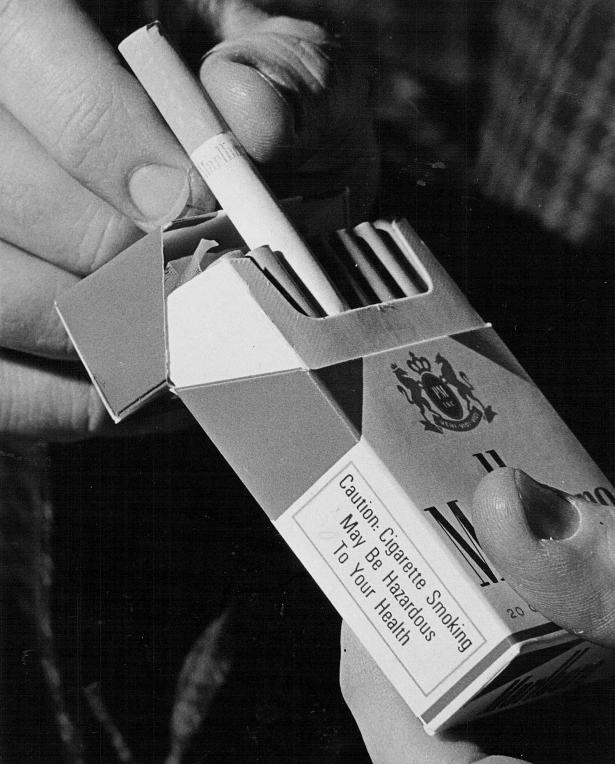
A Long-Delayed Warning at Long Last (1964)
JUNE 24 IS THE 62ND ANNIVERSARY of the U.S. government’s first effort to warn all cigarette smokers that smoking was bad for their health. Public health advocates cheered, even though many added, “What’s taking them so long?”, while tobacco industry apologists denied that the danger of cigarettes had been proved.
The impatience of the public health advocates was understable, given that the U.S. Public Health Service had issued a statement that “cigarette smoking is one of the causative factors in lung cancer” in 1957 and then in January 1964 made headlines with "Smoking and Health: Report of the Advisory Committee to the Surgeon General", which found that smoking caused chronic bronchitis, emphysema, heart disease, and lung cancer.
The government agency mandating the warning in 1964 was the Federal Trade Commission and not the Public Health Service or the Department of Health, Education and Welfare. For more than two decades the FTC had been using its authority over advertising to prevent tobacco companies from making unverifiable claims about health benefits of tobacco consumption, but it had never previously mandated the companies to disclose that smoking was in fact dangerous or deadly.
The new FTC rule was going to leave the exact language of warning up to the tobacco companies, but FTC required it state “clearly and prominently” that cigarette smoking “may cause death from cancer and other diseases.”
Before the FTC regulation could go into effect, Congress decided to prescribe the text of a health warning, much to the relief of the tobacco companies. The July 1965 Federal Cigarette Labeling and Advertising Act, required that this much less alarming language “Caution: Cigarette Smoking May Be Hazardous to Your Health” printed on cigarette packages, omitting any mention of death or cancer.
It was the world's first mandatory tobacco warning label, but public-health advocates were sharply critical of the law, because it so understated the hazard, did not include any requirement that the health warning be included in cigarette advertising and specifically took away the FTC’s existing authority to require such a warning in advertising. https://www.govinfo.gov/content/pkg/GPO-SMOKINGANDHEALTH/pdf/GPO-SMOKINGANDHEALTH.pdf
U.S. Thumbs Nose at International Court of Justice (1986)
JUNE 27 IS THE 40TH ANNIVERSARY of the International Court of Justice’s decision that the Reagan administration's vicious proxy war against Nicaragua was "in breach of its obligations under customary international law not to use force against another State", "not to intervene in its affairs", "not to violate its sovereignty", and "not to interrupt peaceful maritime commerce," which is a polite way to say the U.S. was committing war crimes as a matter of policy.
The Court's decision was final, but it couldn't be enforced without the agreement of the UN Security Council. The vote in the Security Council was 11-1 in favor of international law, but the one vote against international law (cast by Vernon Walters, who knew a lot about war crimes as the former deputy director of the CIA) was, of course, a veto. https://en.wikipedia.org/wiki/Nicaragua_v._United_States
A Champion in More Ways than One (1971)
JUNE 28 IS THE 55TH ANNIVERSARY of the U.S. Supreme Court’s 8-0 1971 decision to throw out Muhammed Ali’s 1967 conviction for refusing induction into the Army.
The Court declared that the U.S. Department of Justice had been wrong to reject Ali’s assertion he was a conscientious objector. The Justice Department’s error meant Ali should never have been drafted in the first place, so he could not be guilty of refusing induction.
The decision meant that Ali would never need to serve his 5-year sentence, but it could not restore to Ali the four years he had been ineligible to box professionally, because he had been declared ineligible by the New York State Athletic Commission.
After Ali was able to return to competitive boxing, he reclaimed the heavyweight title in October 1974. He lost the title in February 1978 but won it back in September. He retired from boxing in July 1979. https://progressive.org/magazine/the-legacy-of-muhammad-ali-dyson/
A Braver, Saner, Truer Rebel (1916)
JUNE 29 IS THE 110TH ANNIVERSARY of the final address of Irish nationalist Roger Casement to the British court that had found him guilty of high treason, sabotage and espionage for his role in the Easter Rising, which had taken place in Dublin in April 1916.
Here is part of what Casement told the court: “Self-government is our right, a thing born in us at birth; a thing no more to be doled out to us or withheld from us by another people than the right to life itself—than the right to feel the sun or smell the flowers or to love our kind. It is only from the convict these things are withheld for crime committed and proven—and Ireland that has wronged no man, that has injured no land, that has sought no dominion, over others—Ireland is treated to-day among the nations of the world as if she were a convicted criminal.
“If it be treason to fight against such an unnatural fate as this, then I am proud to be a rebel, and shall cling to my ‘rebellion’ with the last drop of my blood. If there be no right of rebellion against a state of things that no savage tribe would endure without resistance, then I am sure that it is better for man to fight and die without right than to live in such a state of right as this. Where all your rights become only an accumulated wrong; where men must beg with bated breath for leave to subsist in their own land, to think their own thoughts, to sing their own songs, to garner the fruits of their own labours—and even while they beg, to see things inexorably withdrawn from them—then surely it is a braver, a saner and a truer thing, to be a rebel in act and deed against such circumstances as these than tamely to accept it as the natural lot of men.”
Roger Casement was executed by hanging on August 3, 1916. https://www.dib.ie/biography/casement-sir-roger-david-a1532
Holding the Line Against Trump Administration Sexism (1966)
JUNE 30 IS THE 60TH ANNIVERSARY of the meeting that resulted in the founding of the National Organization for Women.
Today, as the largest organization of advocates for women’s rights in the U.S., NOW is faced with the need to resist multiple attacks on women by the Trump administration and its allies.
Those attacks include –
- Undoing protections for both federal workers and federal contract workers from workplace discrimination;
- Effectively dismantling the Office of Federal Contract Compliance Programs;
- Doing away with efforts to implement equitable hiring practices and Diversity, Equity, and Inclusion programs;
- Firing National Labor Relations Board board member Gwynne Wilcox and NLRB General Counsel Jennifer Abruzzo;
- Firing two female Commissioners of the Equal Employment Opportunity Commission and the Commission’s General Counsel Karla Gilbride; and
- Undercutting enforcement of the Pregnant Workers Fairness Act and threatening to eliminate the U.S. Labor Department’s Women’s Bureau. https://nwlc.org/resource/trumps-war-on-working-women/
For more People's History, visit
https://www.facebook.com/jonathan.bennett.7771/
Spread the word