
labor As Labor Celebrates Minnesota’s Resistance Against ICE, Federal Indictments Raise the Stakes
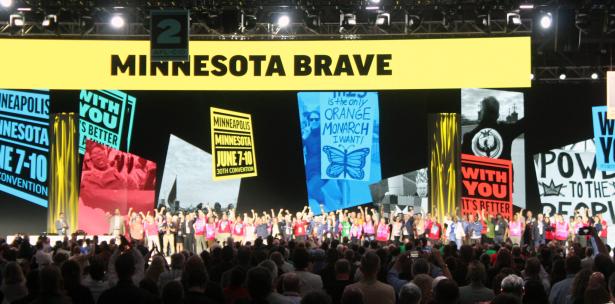
There was a remarkable juxtaposition between the celebration of Minnesota’s labor movement at the national AFL-CIO convention in Minneapolis and another attack from the Trump administration that included the indictments and arrests of several trade unionists from Minnesota.
The AFL-CIO—the largest labor federation in the U.S., representing 15 million workers—hosted its 30th quadrennial constitutional convention from June 7 to 10 in Minneapolis, where the organization gathered to elect leaders, pass resolutions, hold conversations on priorities, and celebrate wins. Just six days later, 15 people involved in anti-ICE resistance from Minnesota were targeted in federal indictments, arrested, and charged with criminal conspiracy to harm a federal officer. Several of them were trade unionists and active members in their unions, and the indictment mentioned participation in assemblies of workers held at the United Labor Centre in Minneapolis as evidence that the activists participated in a criminal conspiracy.
The AFL-CIO opened the convention by recognizing Minnesota’s labor movement for its role in the strategic, coordinated response to Operation Metro Surge, an immigration crackdown that led to the arrests and deportations of thousands of immigrants, as well as federal immigration agents killing of Renée Good and AFGE Local 3669 member Alex Pretti. Many union leaders and members have led and participated in mutual aid and rapid response networks, as well as January 23rd’s economic shutdown. At the convention, dozens of members of Minnesota’s labor movement were invited on stage as the AFL-CIO gave them a human rights award.
Workday Magazine spoke with Minnesota unionists who say now is the time to translate that recognition into concrete support. “The thing we need most right now is a united defense of the 15 community members who are being unfairly charged, many of whom are committed union activists,” says grocery store worker and UFCW Local 663 executive board member Paul Kirk-Davidoff.
“If we’re to see continued support from the heavy hitters in the labor sphere, we’ll need more than acknowledgments alone,” says Omari Hoover, president of AFSCME Local 2822 representing public workers in Hennepin County. “Restructuring of programming and reallocation of finances that are currently geared towards maintaining Washington, D.C.’s status quo–proven to be vehemently anti-immigrant across the parties of the American duopoly–would provide necessary and concrete steps towards ensuring citizens and our immigrant neighbors remain protected in cities and at borders across the United States.”
Approximately 1500 delegates, including union presidents, vice presidents, executive board members, and rank-and-filers from 65 affiliate unions and hundreds of area labor councils, descended upon the Minneapolis Convention Center for five days of microtrainings and talks, booths and exhibits and merchandise, and events such as a reception at the U.S. Bank stadium and a pilgrimage to George Floyd Square.
On the first day of the delegate meetings, President Liz Shuler and Secretary-Treasurer Fred Redmond, running unopposed, were reelected to their positions along with a slate of over 50 union leaders representing various labor bodies. The elections and resolutions proposed at the meetings passed unanimously.
In a panel on Minnesota’s labor movement response to the surge, SEIU Local 26 President Greg Nammacher said that organizers estimate 15,000 union members marched on January 23, and walked out of the workplace even though they were under contracts. “Some risked losing their charter over this action, they made that decision because children were being dragged out of schools,” he said. “Because unions led the way, 350,000 Minnesotans didn’t go to work that day. This is our role as organized labor. We control the point of production. We must take risks that previously did not make sense in order to prevent our country from falling into a dictatorship.”
In an interview with Workday Magazine, AFL-CIO Secretary-Treasurer Fred Redmond praised the response, saying, “the only way that you can push back on authoritarianism from the federal government is to do what Minnesota did.”
“What they did in Minnesota really set an example of what we need to do in the rest of the country,” continued Redmond. “We have the infrastructure to do that all over the country. We have a state AFL-CIO in every state, and approximately 468 area labor councils. We have the infrastructure to emanate what they did in Minnesota.”
June marks one year since David Huerta, president of SEIU-USWW, was arrested and detained while responding to an ICE raid on a workplace in Los Angeles. “We knew they were coming, and we were ready to respond,” he said on stage in an interview with Evelyn DeJesus, executive vice president of AFT. “As much as their attack on us was by design, our resistance was by design as well.”
Huerta said the mass mobilizations on May Day were a “flex,” and called for the AFL-CIO to commit to a platform of immigrant rights. “This body here has to commit itself to fixing a broken immigration system and demanding a pathway to citizenship for all the immigrants working out there right now,” he said.
Before the AFL-CIO gave her the first “Sí Se Puede” award for courage, Dolores Huerta, cofounder of the National Farm Workers Association, celebrated Minnesotans’ resistance to ICE in a speech to delegates. “We have to congratulate them on the level of organizing they did, neighborhood by neighborhood,” Huerta said. “We know we still have a battle ahead of us, we know there are so many people put into detention centers. We know that people are dying in those detention centers. We can make sure no union dollars are invested in any detention center anywhere. We cannot let this horror continue.”
Farm Labor Organizing Committee Executive Director Baldemar Velásquez spoke on the struggles of immigrant workers, who still do not have the right to unionize in the agriculture sector. “We’re responsible for many of them being displaced in the first place with our trade agreements and foreign policies,” he said in support of the resolution on immigration reform, which ended up passing. “The current administration, if they can pardon the January 6 rioters, if they can give them their due process, why can’t they release the captives in our detention centers that have done nothing but being here without authorization?”
President of UFCW 1189 Adam Evenstad represents Minnesotan workers in retail, healthcare, meat packing, manufacturing, food processing and cannabis. In an interview with Workday Magazine, he talked about the impact that immigration policies have had on members, including the termination of temporary protected status and humanitarian parole for immigrant workers at Long Prairie Packing, owned by American Foods Group.
“Roughly half of the workers at Long Prairie were of Haitian descent,” says Evenstad. “They’re asking, how do we survive in this country that we were allowed to be here, work here, we followed the rules, and now all of a sudden we’re not, because of a policy change? They are strong and powerful. If we run into trouble they’ll be standing with us. We need that solidarity.”
In Colorado, almost 4,000 meatpacking workers at the JBS Greeley plant went on the industry’s first strike in 40 years earlier in March, winning wage increases and policies on personal protective equipment. “The safety of our food depends on the safety of the workers who process it,” said UFCW Local 1473 President Jake Bailey in support of a resolution on health and safety standards. The Trump administration is seeking to remove line speed regulations, a rule that had previously been thrown out due to worker concerns. “The administration’s move risks taking us back to the days of Upton Sinclair’s The Jungle, an era where terrible working conditions in meatpacking plants left workers sick and injured at alarming rates,” said Bailey. “Meatpacking workers have fought for decades to bring our food supply chain to where it is today, and we will fight to ensure their safety on the job.”
In Minnesota, UFCW Local 1189, along with several other unions, are part of the Immigrant Defense Network, a network of more than 90 immigrant, labor, legal, faith, and community groups dedicated to protecting and advancing immigrant communities in Minnesota. “The Minnesota labor movement has helped the national labor movement shift on a lot of this. It feels good to be a part of helping shift that narrative nationwide,” said Diana Tastad-Damer, Secretary-Treasurer of UFCW 1189, in an interview at the AFL-CIO convention with Workday Magazine.
The indictments were jarring for a Minnesota labor movement that has already faced abductions of its members and federal raids on workplaces and neighborhoods. In a statement released Thursday after the arrests, more than 50 unions and community groups said they remain committed to defending the 15 and to fighting continued abuse from the Trump administration. Among other charges, the 15 indicted are being charged with “conspiracy to impede or injure a federal officer.” Yet at a June 16 press conference, Daniel Rosen, the U.S. attorney for the District of Minnesota, could not provide details of any alleged injuries.
When Workday Magazine reached out to AFL-CIO President Liz Shuler for comment on the indictment, her press person directed us to a statement from Minnesota AFL-CIO President Bernie Burnham released June 16. That statement says, “Instead of holding federal agents accountable for shooting and killing Renée Good and our union brother Alex Pretti, the Trump administration continues to weaponize the Justice Department to settle political scores and intimidate American citizens for being good neighbors and exercising their constitutional rights. Any charges should be based on credible evidence and established facts, not speculation or political pressure from the White House.”
Amie Stager is the Associate Editor for Workday Magazine.
Workday Magazine holds the powerful to account while bringing the perspectives of everyday workers, and the organizations that defend their rights, to focus. We emphasize long-form investigative journalism to unearth the concealed and buried. Our publication is based in Minnesota and covers the greater Midwest, along with international issues that affect workers, like climate change and U.S. militarism.
Spread the word