
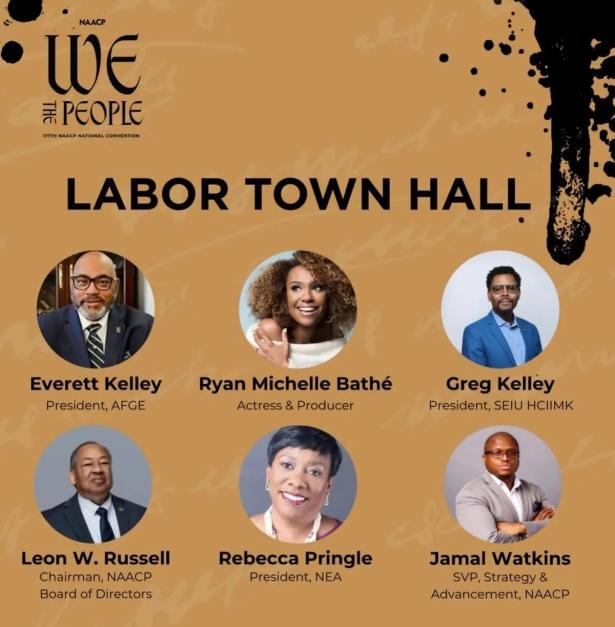
Civil rights leaders and major U.S. labor unions announced a strategic partnership to mobilize voters and protect workers' rights during the National NAACP Convention in Chicago on July 20, 2026. Thousands of delegates convened at McCormick Place under the convention theme "We The People."
Addressing the convention delegates, Chicago Mayor Brandon Johnson emphasized the role of public participation in sustaining democratic systems.
"It is not just simply a phrase in the constitution. It's a reminder that democracy has always depended on the people and our willingness to fight for it, to protect it and to expand it," said Brandon Johnson, Mayor of Chicago.
he 117-year-old civil rights organization is experiencing demographic growth and increased involvement among younger members and diverse racial groups. Reverend Michael Nabors highlighted this changing demographic within regional branches.
"What I find to be particularly interesting is that, uh, the numbers of folks joining are definitely interracial; so we have as many white and others joining as African Americans and Blacks," said Michael Nabors, Reverend at NAACP Evanston North Shore.
Local members attributed the spike in community involvement to escalating socio-political challenges occurring across the nation.
"I think the need is increased at this particular point just based on what's happening at the national level. Same thing that's happening at the national level is actually happening at the local level, folks are having issues. Folks are having problems," said Garland Pruitt, Representative from Oklahoma City.
Longtime civil rights advocates noted the influx of younger generations taking action to maintain the organization's legacy.
"I'm glad that they're stepping up and saying, 'Hey, we gotta do something.' You know? So they're keeping it alive. They keeping the dream, as we say, alive," said Janet Mason, Representative from Hawaii.
Digital platforms have become a pivotal tool for youth engagement in public advocacy.
"You've seen students take into social media in various ways...to amplify [ social issues ] and bring awareness to them," said Calvin Bell, Ph.D. student at Northwestern University.
Family involvement remains strong as members focus on long-term systemic progress for future generations.
"I'm fighting for the rights and the life and the future of my grandchildren. You know, they deserve to be able to get a good job despite DEI and all that stuff. And also, being in America, they deserve to be free," said Wesley Scully, President of the Michigan City branch.
During a specialized labor session, national civil rights leaders called for deeper integration between union locals and NAACP chapters beyond standard collective bargaining. NAACP Executive Director Derrick Johnson stressed the need to counter economic policies that threaten working-class communities of color.
"Let's keep our eyes on the same prize," said Derrick Johnson, Executive Director of the NAACP.
He noted that modern challenges require broader institutional coordination.
"For instance, now they are even using your pension dollars against you," said Derrick Johnson, Executive Director of the NAACP.
Technological changes and shifting corporate tactics also require updated strategies.
"And as things evolve technologically, we have to evolve, too," said Derrick Johnson, Executive Director of the NAACP.
NAACP Board Chairman Leon Russell echoed the demand for immediate joint organizing and grassroots outreach, targeting an estimated six million non-voters through a $20 million campaign.
"We can talk all we want here about workers' rights, but we have to stop talking and start organizing," said Leon Russell, Board Chairman of the NAACP.
Russell stressed that organizational connections must be established at every level.
"And we have to make sure our (NAACP) branches are connected to local union leaders," said Leon Russell, Board Chairman of the NAACP.
Reaching disenfranchised populations remains a central objective for the alliance moving forward.
"We have got to encourage the six million who are not voting and who don't think about voting," said Leon Russell, Board Chairman of the NAACP.
He warned that rollbacks on federal protections directly impact vulnerable populations.
"They don't understand that an attack on diversity, equity, and inclusion is an attack on them. They don't understand that an attack on health care, is an attack on them," said Leon Russell, Board Chairman of the NAACP.
He added that foundational civil rights achievements face renewed risk.
"All of the gains we made in the 1940s, 1950s and 1960s," said Leon Russell, Board Chairman of the NAACP.
Union representatives noted that recent political actions cutting voter access stem from the electoral impact of marginalized communities.
"They're taking away things that threaten them. If voting was not a threat to them, they wouldn't take things away," said Unnamed Union Leader, Local Union Official.
To build solidarity among low-wage workers, union organizers presented strategies such as aligning contract expiration dates across industries.
"At 48 hotels and one casino," said Julia Lewis, Shop Steward at UNITE HERE Local 1.
She explained the primary goal of their ongoing labor discussions.
"We're attempting to negotiate them into restoring the staffing levels," said Julia Lewis, Shop Steward at UNITE HERE Local 1.
The five-day convention, sponsored by major national unions including the AFL-CIO, SEIU, and UAW, conclude[d] Wednesday at McCormick Place.
Spread the word