
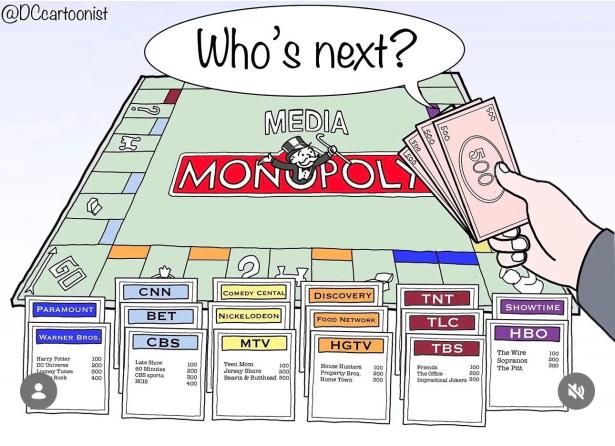
- Media Monopoly: The Great Capitulation
- Why ‘NAZA’ is the Most Controversial Documentary
- Social Media vs Democracy
- The Cooperative Alternative
- Data Centers and the Midterms
- The Rise and Fall of Tech Worker Power
- Book Publishing Turns to AI
- The Real Trump Derangement Syndrome
- Regulating Flock
- AI Bubble: The Latest
Media Monopoly: The Great Capitulation
By Harold Meyerson, The American Prospect
A sizable chunk of California’s Democratic establishment, led by Gov. Gavin Newsom, greased the skids that enabled the father-son duo of Larry and David Ellison—charter members of President Trump’s billionaire brigade—to gain control of a commanding share of America’s culture and news industries.
Why ‘NAZA’ is the Most Controversial Documentary
By Sebastian Ben Daniel (John Brown), +972
The scandal of “NAZA,” is not that it tells Israelis something they had no way of knowing. It is that it attacks the privilege of not knowing. It takes the language of code, intelligence, and procedure and places the bodies back inside it. That is why the fury surrounding the film belongs to the story the film tells.
Social Media vs Democracy
Fountain of Falsehoods By Chris Walker, Truthout
Digital Rights By Lizzie O’Shea, Links
By Eli Zeger, Dissent
The most exciting trend in American online media is collective ownership. In a wave of new media cooperatives, the same journalists and editors who are drafting, filing, and publishing articles are also in charge of balancing budgets, hiring new staffers, and deciding who, if anyone, gets to advertise on their websites.
By Alex Brown, Stateline
In the course of a single election cycle, the backlash against data centers has grown from an issue at local planning commission and city council meetings to become a flashpoint in state and federal races across the country. Analysts say the opposition to data centers has come from Republican and Democratic voters alike.
The Rise and Fall of Tech Worker Power
By JS Tan and Clarissa Redwine, Boston Review
The very class solidarity developed through the countless tech worker protests, open letters, and walkouts helped provoke its own gravest threat: a unified tech elite hell-bent on stamping out the movement.
By Adam Morgan, Wired
In headline after headline this year, American book publishers have appeared to be fighting back against generative AI. But behind the scenes, at least three of the Big Five US book publishers have been quietly incorporating AI tools into their publishing processes without public disclosures or author consent.
The Real Trump Derangement Syndrome
By Jennifer Rubin, The Contrarian
Billionaire-owned media has essentially covered up a national crisis. Responsible coverage would highlight Trump’s mental unfitness daily, provide ample extracts of rants, and play them back to Republicans’ faces. Conscientious journalists, at the very least, could stop calling unhinged rants “speeches” and vitriolic outbursts “answers to interview questions.”
By Michael Ludwig, Truthout
Republicans and Democrats in Congress have introduced competing legislation to rein in the government’s use of Flock cameras and other automated license plate readers (ALPRs) following widespread abuses by police and intense public backlash to the powerful surveillance technology.
By Dean Baker, Center for Economic and Policy Research
Last week Amazon revealed plans to sell off $8 billion in chips to a newly created special purpose vehicle (SPV). Amazon will then lease back the chips from the SPV. This one should raise all sorts of red flags.
Spread the word