
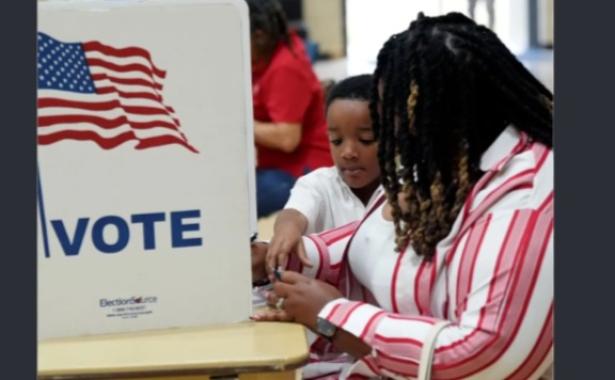
As of Thursday evening, Mississippi Democrat Scott Colom leads Republican Sen. Cindy Hyde-Smith by about 1,800 votes out of roughly 952,000 cast, according to the Associated Press, with thousands of mail-in and affidavit ballots still being processed.
If Colom wins, he will be the first Democratic Senate candidate elected from the state since 1982, and the first Black man to represent the state in the U.S. Senate since 1901.
Few handicappers, if any, expected that outcome. Most major forecasters rated the race Likely or Safe Republican. Trump carried Mississippi by 22 points two years ago.
Why is the state so close? Two things happened that helped Democrats in the South this year. First, white Mississippians, who backed Trump by 67 points in 2024, voted far less Republican this time around. And second, turnout surged among Black voters; they made up 33% of Mississippi’s electorate this year, up from 30% in 2024, according to estimates from the New York Times.
And that turnout boost among Black voters could be the deciding factor in Colom’s win. According to calculations by Strength In Numbers, with 2024’s electorate and this year’s vote choices, Republican Hyde-Smith would have won by about 4 percentage points.
The same pattern shows up across the Deep South. In this week’s chart of the week, let’s look at Black voter turnout in 2026 relative to 2024.
Voter turnout was much higher in majority-Black counties
The maps below show the total number of ballots cast in 2026 in the five states that make up the heart of the Deep South. This year’s ballots are divided at a county level by the number of ballots those counties cast in the 2024 presidential election.
I have highlighted counties where Black residents make up 50% or more of the population in the first map; in the second, I show those where they make up a minority. Greener counties represent those with higher turnout relative to 2024, while counties that are light blue/purple have lower turnout.
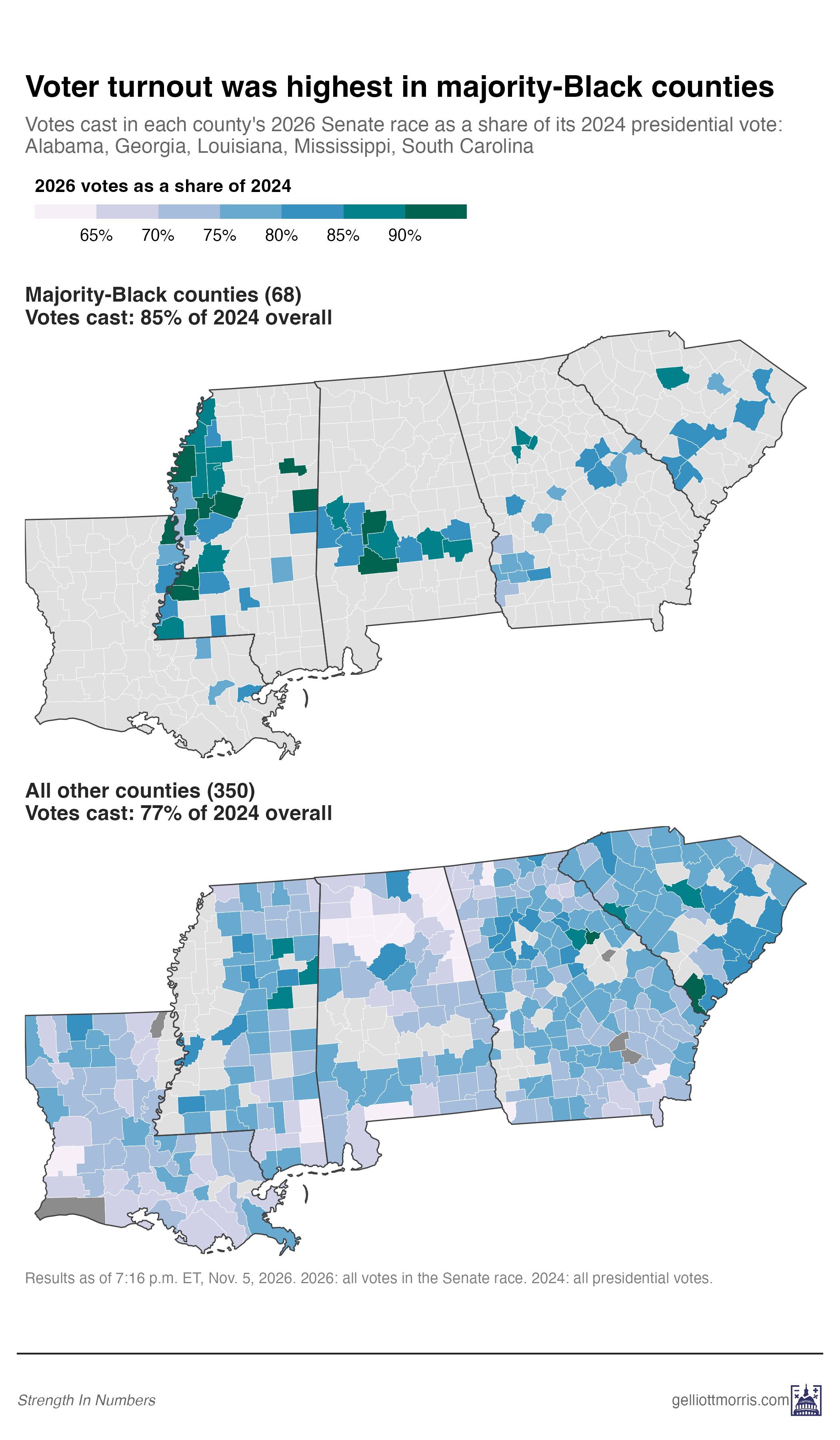
You can see that, for the most part, the more Black people who live in a county, the higher its turnout was. But the color differences might be modest in comparison across groups of states, so the plot below breaks out the same data, but swaps out the mapping component for a “bee-swarm” chart.
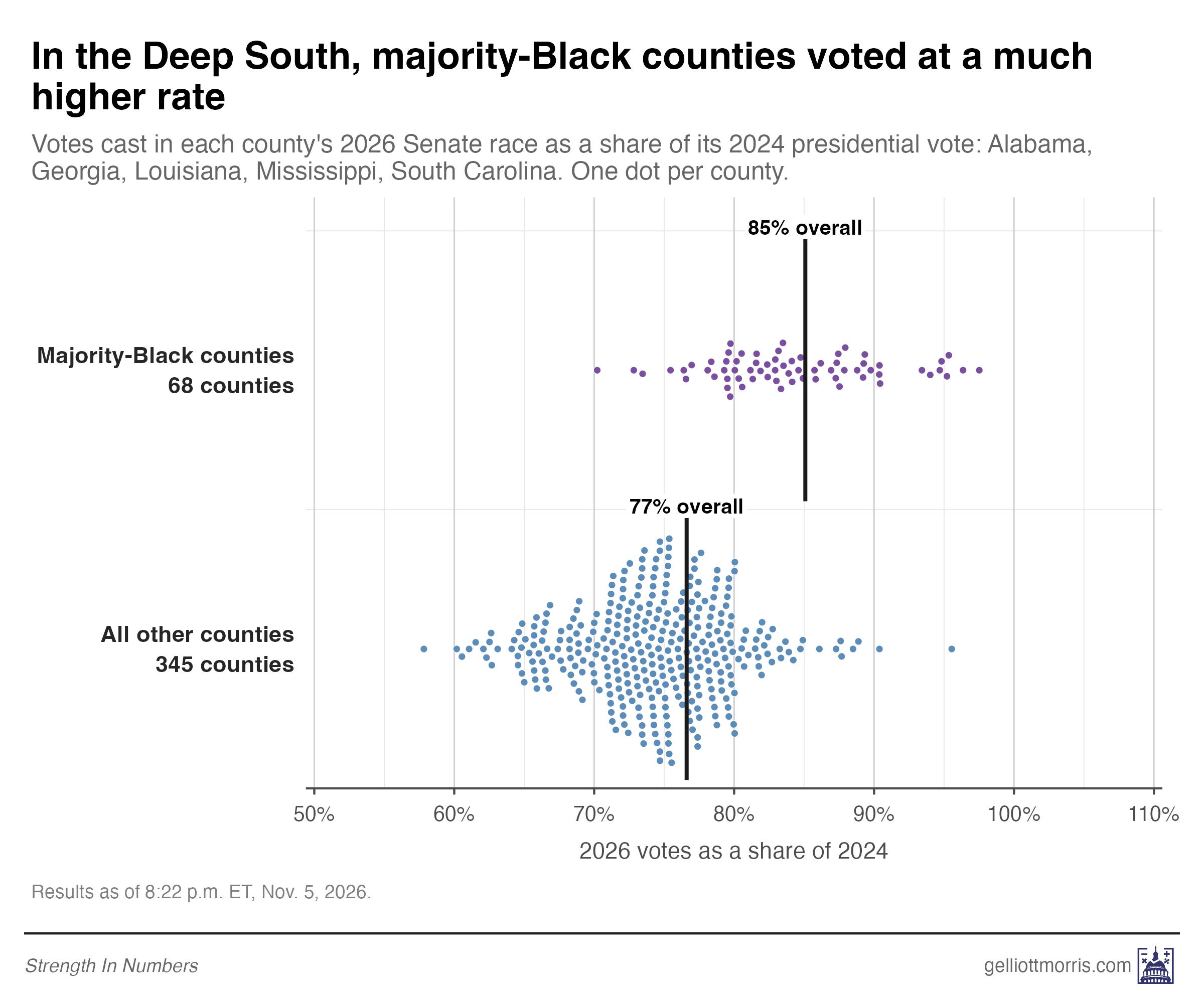
Here you can see the Black-majority counties quite clearly. The proportion of ballots cast relative to 2024 in the Black Belt—a multi-state region with a large Black population, so named for its dark, fertile soil—was about 8 percentage points higher than in other counties in the Deep South, where the population is whiter.
But there’s also a direct relationship between the share of a county that is Black and its turnout relative to 2024. The chart below shows the relationship between the percent of a county that is Black (on the horizontal axis) and its turnout relative to 2024 (on the vertical axis).
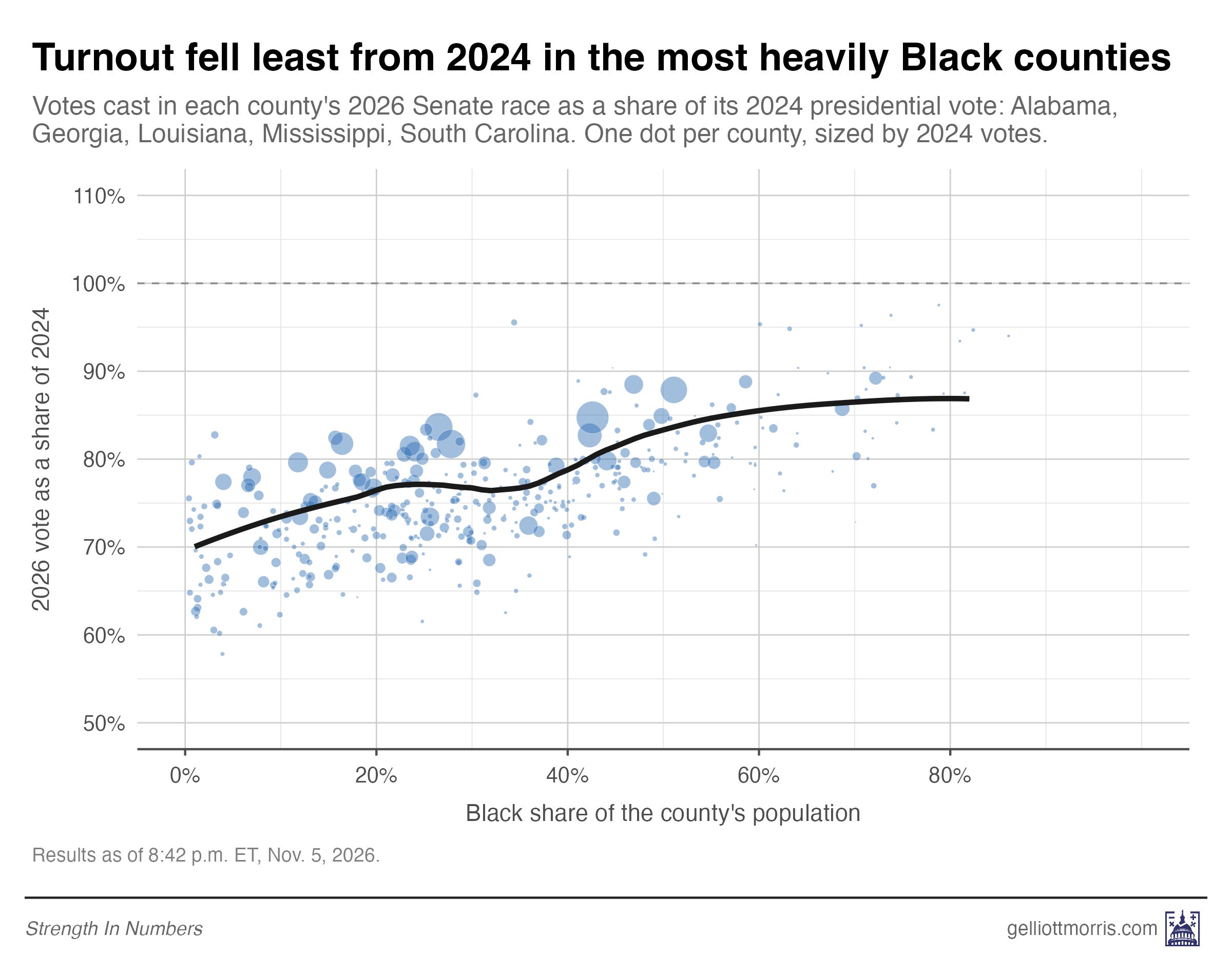
In the counties in the Deep South where Black voters make up 0% of the population, the number of ballots cast for 2026 House races was about 70% of the number of ballots cast in the 2024 presidential election in the same counties. But in the counties with the largest share of Black residents — around 80 to 85% on the top end — turnout was about 90% of 2024 numbers.
We can use this chart to estimate the voter turnout rate both for Black voters and for other voters in the South. According to Strength In Numbers’ estimates, Black voters turned out at about 96% of presidential-year levels in the Deep South, compared to about 71% for white and other voters.
It is unsurprising then that Black share of the electorate in all five of these states has grown since 2024, generally by 3 or 4 points.
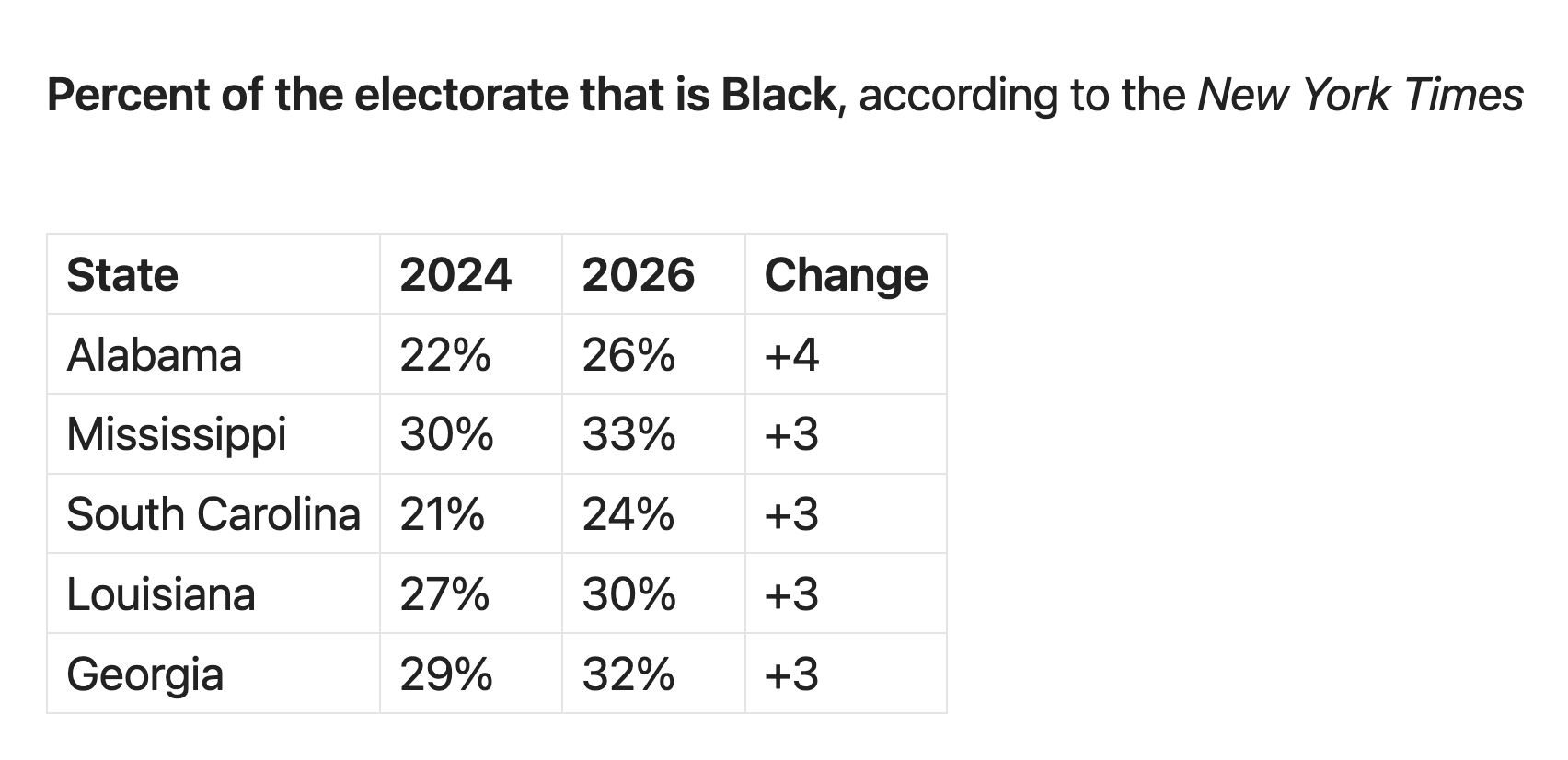
One inference we can draw is that turnout among irregular voters has risen dramatically for Black Southerners. Remember that the comparison here is to a presidential electorate. Black turnout usually sags in midterm years, and in 2022, it fell sharply. This year it nearly beat a presidential year. The Times’ 2024 estimates put Black Mississippians at 36% of eligible voters but just 30% of those who actually cast a ballot. This year, the difference was half as large.
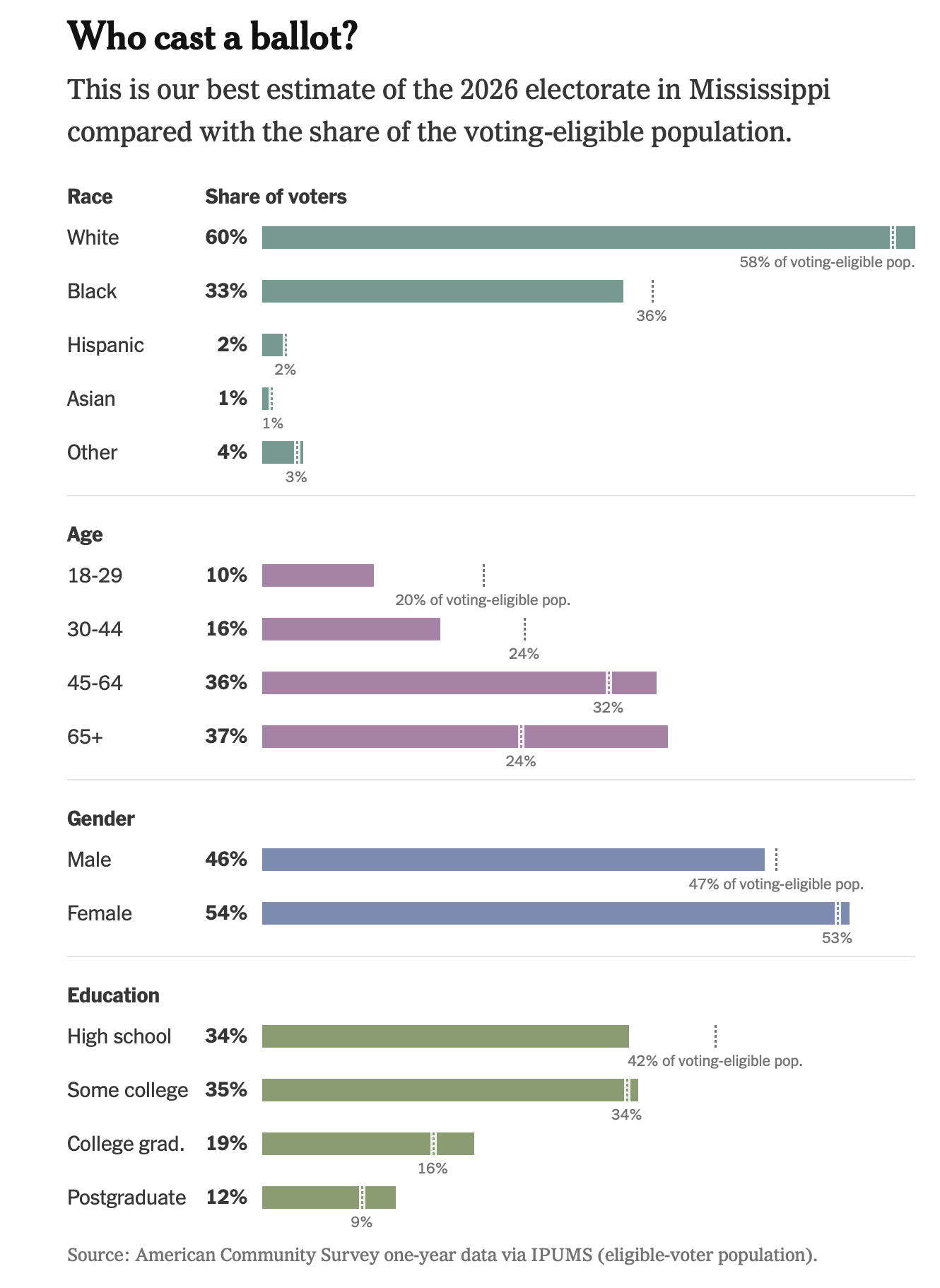
Across the South, the electorate was significantly more diverse than in 2024. (Before Election Day, I used early voting data to predict this.)
This has contributed not just to a possible — perhaps even likely — Senate victory in Mississippi, but to Democrats doing well across the South. Democrat Annie Andrews beat (appointed) South Carolina Sen. Darline Graham by about 4.5 points, 51.3% to 46.8%, in a state Trump carried by 18 points just two years ago.
Without the surge in Black voter turnout, Andrews would have won by under a point.
Democratic Rep. Shomari Figures was able to hold on to his seat in Alabama’s 2nd Congressional District this year, despite GOP lawmakers diluting the Black vote after the Supreme Court gave their blessing to Republicans to gerrymander Black voters and Democrats in Louisiana v. Callais in April.
In 2024, under a court-drawn map, Alabama’s 2nd District was 48.7% Black by voting-age population. Figures won it with 54.6% of the vote. For 2026, Republicans cut the district’s Black voting-age population to 39.9%.
Yet Figures still won 53.8% of the vote. Because of a relative increase in Black participation, Republicans cut the district’s Black voting-age population by nearly 9 points, but Figures’ vote share fell by less than 1 point.
Figures’ Republican opponent, Rhett Marques, pointed to the huge increase in turnout in Montgomery in his concession speech, noting, “Montgomery County came out in a large number, and we couldn’t overcome it.”
Montgomery County cast nearly 80,000 ballots in this year’s race for governor, according to preliminary tallies; four years ago, it cast under 58,000. That’s a 38% increase. Across the 14 counties that sit entirely inside Figures’ district, Democratic straight-ticket ballots nearly doubled from 2022 (from about 50,000 to 90,000), while Republican straight-ticket ballots rose just 8%, according to the conservative site Yellowhammer News.
While Democrat Doug Jones fell short in his bid for governor, the GOP lost ground nonetheless. Republican Tommy Tuberville won 44.7% of the vote in those 14 counties, down from outgoing Gov. Kay Ivey’s 61% in 2022.
A “Callais backlash”?
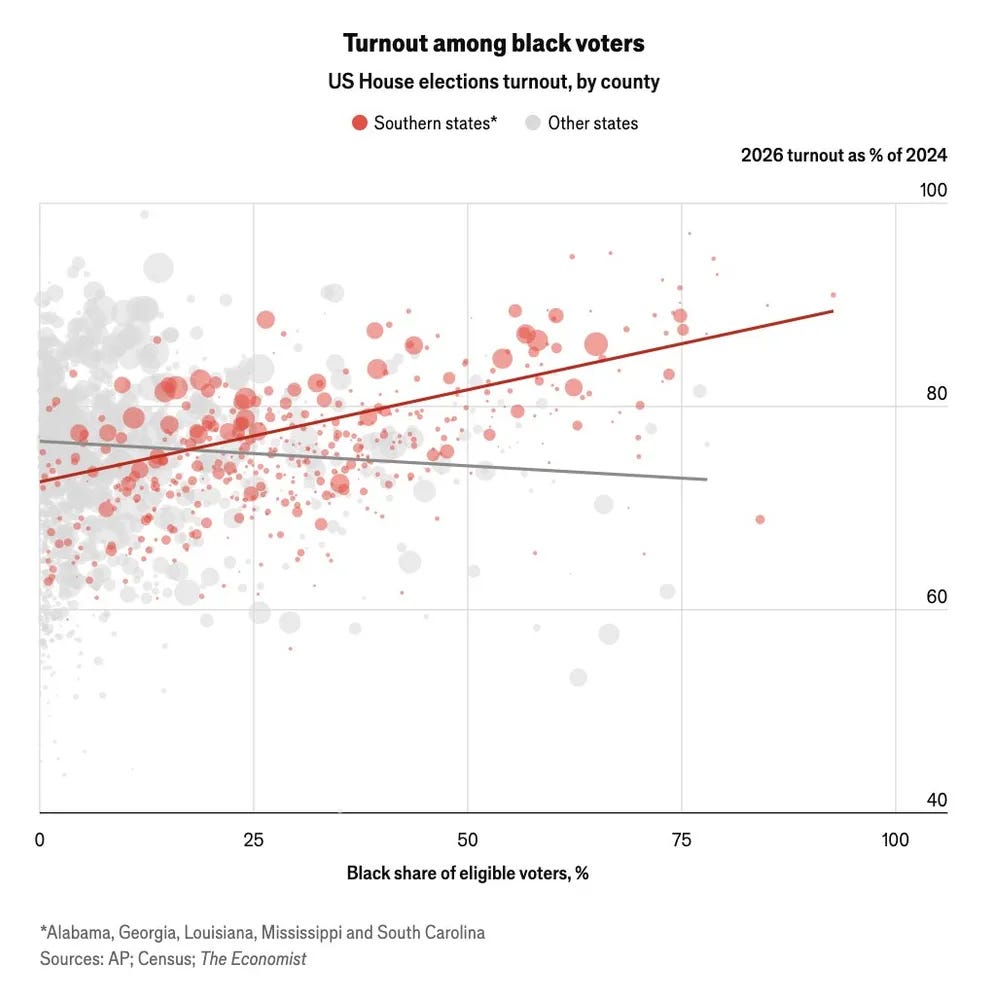
Interestingly, outside the South, the surge in Black voter turnout disappears. There was no similar increase in the Black share of the electorate in Michigan, Illinois, or New York, for example.
Owen Winter, a data journalist at The Economist (my former employer), posted the chart below, which shows 2026 House turnout as a share of 2024 turnout compared to each county’s share of Black eligible voters. In Alabama, Georgia, Louisiana, Mississippi, and South Carolina, the line slopes steeply upward, from the low 70s in the whitest counties to nearly 90% in those with the largest share of Black residents. But outside the South that line is flat — or if anything, slightly negative.
We could see some of this coming in the early vote. Before the election, I found that the proportion of Black early voters in Harris County, Texas, had grown 43% since 2022, and in North Carolina’s voter file, Black voters went from casting 18.7% of early and mail ballots in 2022 to 21.1% this year.
So why is this?
One obvious difference between Southern states and those elsewhere is the long fight over Black representation. When the Supreme Court all but gutted Section 2 of the Voting Rights Act in Louisiana v. Callais earlier this year, Republicans moved to redraw — in some cases, completely eliminate — districts designed to give Black voters the chance to elect their preferred candidates.
Alabama went back to a map its legislature drew in 2023, which a federal court had previously found diluted Black votes. In Tennessee, Republicans carved up a majority-Black district in Memphis that had been in place for more than four decades and gave it a white majority.
The response has been called a “Blacklash.” As Jonathan Martin reported for Politico, Democratic pollster Terrance Woodbury asked Black voters in a focus group how much power they thought their vote had “to make a difference.” The number who agreed increased markedly after the Callais decision.
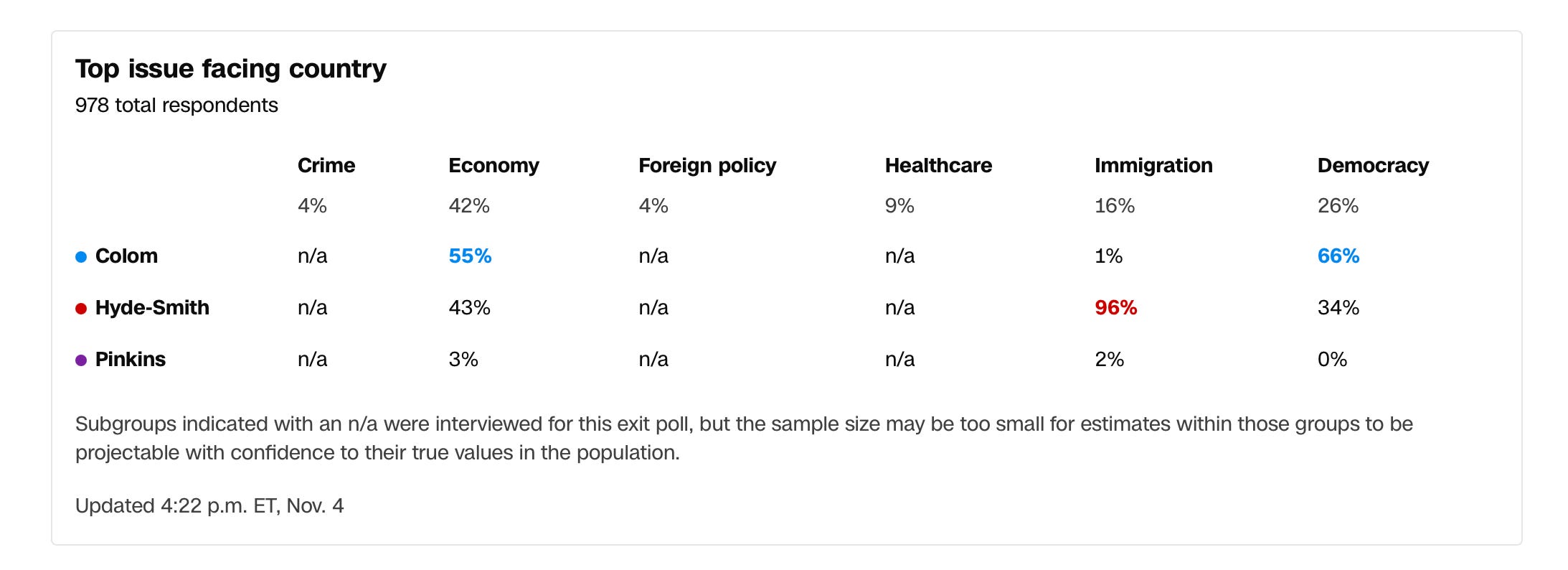
According to estimates from the Voter Poll — the survey previously known as the “exit poll” — democracy ranked as the second most important issue to Mississippi voters this year. Voters who said democracy was the top issue facing the country went 66-34 for Colom over Hyde-Smith.
So here’s my read on this:
The story of the 2026 midterms in the South is not just that Democrats did better than expected. It’s that Republicans spent the months before the election trying to cheat Black voters out of their votes, and Black voters responded by casting more of them.
In Mississippi, that surge may have been enough to elect the state’s first Democratic senator in more than four decades. In Alabama, it helped Shomari Figures survive a redistricting effort that stripped nearly 9 points off the Black voting-age share of his district. And in South Carolina, it helped deliver another Democratic Senate victory.
We can’t know exactly how much of this turnout surge was a direct response to the Supreme Court’s decision in Callais. But the geographic pattern is striking. Black turnout didn’t surge everywhere in America — it surged only in the Deep South, where the fight over Black representation was most immediate, and where Republican lawmakers had moved most aggressively to weaken it.
And as this table from The Downballot shows, Republicans’ efforts to rig congressional maps in their favor failed spectacularly. They had hoped to flip 15 seats in their favor by redrawing maps, yet they’ll be lucky to gain three.
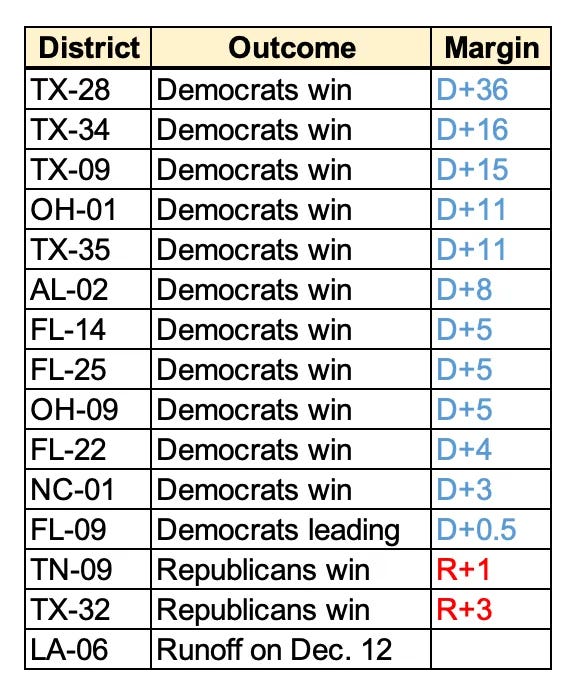
Republicans may have had the power to redraw the maps, but Black voters still had the power to hold them accountable. In 2026, they turned out in extraordinary numbers, overcoming some of the barriers Republicans had erected to weaken their political influence. Republicans should learn a lesson from this: There is an electoral cost to vote-rigging. There is no downside to standing up to authoritarianism.
Strength In Numbers is a data-driven news website covering U.S. politics, elections, and public opinion. The mission here is simple: to help you be smarter about politics and the news using empirical analysis based on hard data — not speculation, conventional wisdom, or “vibes.” Get a free or paid subscription.
Spread the word