
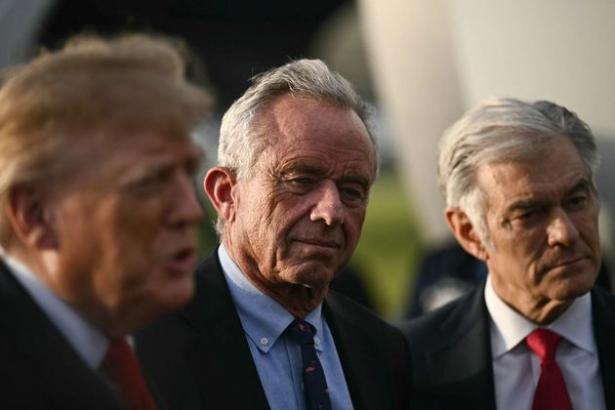
This week, eight public health officials who advise an arm of the United Nations will consider whether the U.S. can still say it’s eliminated measles.
For Health Secretary Robert F. Kennedy Jr., the longtime vaccine skeptic who’s helmed America’s response to the thousands of cases that have erupted since last year, it will be a legacy-defining decision.
The Pan American Health Organization’s answer would seem obvious, with measles ripping through Pennsylvania, New York in a state of emergency and more than 7,000 infections reported nationwide since January 2025. But the officials will have to determine that a single chain of transmission has continued for at least a year to take away measles-elimination status.
If not, Kennedy will get more time as he attempts to show that his agency can curb the spread of measles, a disease that can only be contained when the vaccination rate is at least 95%, even as he seeks to downsize the childhood vaccine schedule, discourage school vaccination mandates and promote his discredited belief that vaccines cause far more injuries than the government has acknowledged.
The potential loss of measles elimination status comes as Kennedy’s Make America Healthy Again movement is fighting to maintain its political relevancy, and its favored position inside the Trump administration, after sweeping Republican losses during the midterm elections. Losing the status could also weigh Kennedy himself down, whether he wants to keep working for Trump, as he says, or whether he decides to revisit the presidential ambitions he put aside two years ago to take the health secretary job.
“It is hard to believe the White House is not already weighing whether continued defense of Secretary Kennedy’s approach and the ongoing fallout from related policy changes makes sense for another two years,” said Jerome Adams, surgeon general during Trump’s first administration, who has called for Kennedy to be removed from his post due to his handling of public health.
“For any future political aspirations he has? Yes, it will matter,” said a former official from Trump’s first administration, granted anonymity to speak candidly, who worked at the agency in charge of combating infectious disease, the Centers for Disease Control and Prevention. Kennedy, before becoming secretary, repeatedly condemned the CDC.
America was once the world leader in containing measles, having won its elimination status in 2000 and secured it with a vaccination rate close to the 95% required to maintain herd immunity. But the world’s most contagious disease began spreading globally again after vaccination rates declined during the Covid pandemic.
Measles vaccination rates have continued to decline since Kennedy took over the health department. Coverage in kindergarteners is now only 92.4%.
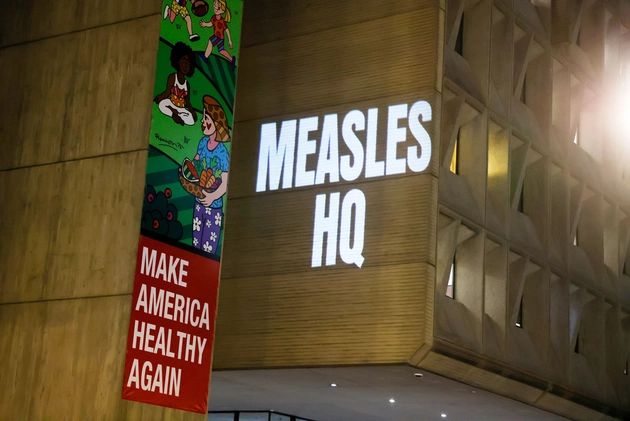
Advocacy group Protect Our Care shines a projection that says "Measles HQ" on the U.S. Department of Health and Human Services building in January. | Paul Morigi/Getty Images for Protect Our Care
Kennedy’s Health Department says it’s doing all that it can.
Under Kennedy and CDC Director Erica Schwartz, the government “has mounted an aggressive response to measles outbreaks across the country,” HHS spokesperson Emily Hilliard said in a statement, noting the agency deployed experts to help states battle outbreaks and put $100 million in additional funding toward the effort.The two leaders recommend vaccination “as the most effective way to prevent measles,” Hilliard said.
But this summer, as measles cases rose, President Donald Trump signed an executive order urging drugmakers to break up the combination shot that provides protection against measles, mumps and rubella, suggesting it was “quite lethal.” The order also directed the attorney general to go after states that don’t allow religious exemptions to vaccines.
Public health advocates say the administration’s mixed messaging on vaccine safety and the insistence that shots are a “personal” choice are making the situation worse.
“We’ve never been in a situation where the head of a prominent government health agency was a science denier,” said James Colgrove, a professor at Columbia University’s Mailman School of Public Health, referring to Kennedy.
Known for its telltale rash and flu-like symptoms, measles causes complications in about 30% of those infected. Pneumonia and encephalitis — swelling of the brain — can be fatal. Before a measles vaccine became available in 1963, the disease killed more than 2 million people a year worldwide, many of them children, according to the World Health Organization. It can also blind, end pregnancies and damage the immune system.
One person with measles will spread it to 12 to 18 others absent vaccination or prior infection.
Kennedy has said repeatedly that the rise in cases started before he took office. He’s blamed former Trump Covid adviser Anthony Fauci and other public health leaders who pushed Covid vaccination during the pandemic for weakening trust in the government, and by extension in a measles vaccine that provides lifelong protection.
“The vaccination levels dropped during Covid because people stopped trusting the American government,” Kennedy told lawmakers this spring when questioned about declining rates.
Kennedy’s occasional endorsements of measles shots, starting with an outbreak in a Texas Mennonite community last year, haven’t come with aggressive promotional campaigns encouraging parents to get their kids vaccinated.
Rather, he’s insisted that vaccination is a “personal” choice and continued his decades-long effort to prove that vaccines aren’t as safe as the government claims, most recently establishing a new government research center at the National Institutes of Health to study vaccine injuries.
Kennedy has also claimed that the U.S. is doing a better job combating measles than other countries.
But in Europe, which has also struggled with measles outbreaks in recent years, caseloads are falling. The European Economic Area reported fewer than 8,000 cases last year, down from more than 35,000 cases the year prior. Cases have continued to fall this year. Some of that drop is thanks to acquired immunity among those who were sickened by the disease during the 2024 surge, but it also dovetails with European countries adopting more aggressive tactics, similar to ones America long used to encourage vaccination.
In Germany, the measles vaccine has been mandated for kids, health care workers and teachers since 2020, with stiff fines for those who don’t comply. In Spain, which is trying to earn back the measles-elimination status it lost in January, political leaders show an “unambiguous willingness” to support vaccination, according to Quique Bassat, general and scientific director of the Barcelona Institute of Global Health.
In Europe, there’s largely an alignment between countries that vaccination “is absolutely the right thing to do for your child,” said Ben Kasstan-Dabush, assistant professor of Global Health at the London School of Hygiene & Tropical Medicine, adding that vaccine access challenges, rather than conflicting messages from political leaders, often dampen vaccine uptake in European countries.
“In the U.S., there’s no consensus message, and that’s really a problem.”
Nowhere is the Trump administration’s approach proving less fruitful than in central Pennsylvania, home to the country’s largest Amish settlement.
Vaccination rates in the religious community are significantly lower than the general public, meaning measles spread rapidly through Mifflin and Lancaster counties this summer and fall, topping 1,487 cases in the state by early November.
Many Amish people don’t have health insurance and aren’t connected to the traditional medical system. They travel by horse and buggy, meaning a 12-mile trip to the doctor could take more than an hour.
To reach them, Katherine Mascia, a pediatrician and director of clinical services at the Central Pennsylvania Clinic, which has close ties to the Amish community, has begun counseling patients with measles over the phone and partnering with the local state health center to offer “vaccine days,” where patients can come into the clinic for free measles shots.
But Mascia fears Pennsylvania’s case burden is far worse than the state’s data suggests. Pennsylvania reported six deaths this year, a higher-than-expected count for a wealthy country like the U.S., where measles typically kills one or two people for every 1,000 infections.
The death count implies that the actual case burden could be somewhere between 3,000 and 6,000, at least twice the official count.
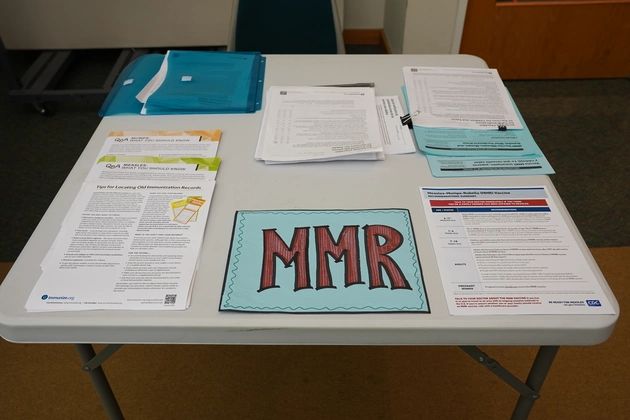
Nowhere is the Trump administration's approach to containing measles proving less fruitful than in central Pennsylvania. | Matt Rourke/AP
Anecdotal reports paint a similarly dire picture. Doctors are seeing more infections among pregnant people, according to the Pennsylvania health department, and babies being born with measles, a condition historically so rare that doctors don’t have good data on how to treat it.
As the public health crisis unfolded in August, the Amish community became the center of a high-profile political battle between Kennedy and Josh Shapiro, the state’s Democratic governor.
In response to the state reporting that two people in Pennsylvania had died of measles, Kennedy suggested Shapiro had fabricated the deaths for political gain and Shapiro accused Kennedy of spreading misinformation that dampened vaccination rates and fueled the state’s outbreak.
While the outbreak in Pennsylvania appears to be slowing following a surge in vaccination, outbreaks in New York state and Wisconsin are swiftly growing, with 210 and 477 cases reported this year, respectively. Since the beginning of 2025, the U.S. has reported more than 90 outbreaks involving three or more related cases.
Many larger outbreaks over the past two years, including in Pennsylvania, Texas and South Carolina started in religious communities with low vaccination rates, but some spread beyond those close-knit groups.
While signing his executive order this summer, the president suggested there might be a link between the vaccine and rising autism diagnoses in the U.S., despite decades of scientific research contradicting that theory. The White House presented no evidence to support Trump’s claim and vaccine safety experts dispute it.
The order also directed the attorney general to challenge states that don’t allow non-medical exemptions to school vaccine mandates, like California, Connecticut, Maine and New York.
So far, Attorney General Todd Blanche has not acted on the directive. But Aaron Siri, an attorney and close Kennedy ally who dedicated his career to challenging vaccine mandates, is part of a legal team suing West Virginia for not allowing personal or religious exemptions to school vaccine mandates.
The outcome of the case, which is slated to go before the West Virginia Supreme Court, could have implications for the rest of the country.
Despite administration officials’ mixed messaging, some states have maintained strict mandates. Others have begun loosening requirements, with nine states enacting policy changes since 2025 that are more permissive of non-medical exemptions, according to the health policy research organization KFF.
“We always prided ourselves on essentially having the best control in the world, or close to that,” Jane Seward, a former top official at the CDC, who spent a decade at the agency under George W. Bush and Barack Obama, told POLITICO.
Now “we’re on a path to have endemic transmission re-established and see more and more measles cases.”
Marie Zahout contributed to this report.
Sophie Gardner covers the Centers for Disease Control and Prevention and authors the POLITICO Pulse newsletter.
Sophie's coverage centers around the Centers for Disease Control and Prevention, with a focus on covering the federal response to infectious diseases and outbreaks.
As the Trump administration's overhaul of the Department of Health and Human is reshaping how the CDC addresses and provides guidance on public health threats, she aims to provide coverage that illuminates what the changes both mean on the ground and inside the CDC headquarters.
Sophie has been on POLITICO's health team since May 2024. Before that, she was a digital producer at POLITICO, and wrote the Women Rule newsletter. She graduated from the University of Massachusetts, Amherst, in 2022.
Claudia Chiappa is a health reporter at Politico Europe.
In her current role, she covers various aspects of EU health policy, with a particular focus on global health, access to medicines and medical devices, mental health, and sexual and reproductive health. Prior to joining Politico, she worked for Providence Business News in Providence, Rhode Island, covering health care and real estate from a business perspective. She studied communication studies and political science at Coe College, in Iowa, and has a master’s degree in journalism from Boston University.
‘I Never Understood Wind’: Midterms Spark Hope for Renewables after Trump’s Hostility
Jillian Ambrose
The Guardian
Future brightens for US developers in particular after election when voters rejected Trump’s war on clean energy
November 5, 2026
Spread the word