
Nepal Isn’t Asking for Charity. It’s Calling in a Debt.
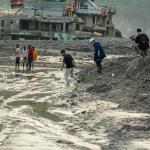
hen a piece of Himalayan glacier broke loose above the Bhotekoshi River in August, it sent a wall of water, ice, and rock hurtling at alarming speeds through Nepal’s northern districts in mere minutes. More than 1,400 people are now confirmed dead, and more than 4,000 remain unaccounted for. Entire villages were destroyed. Nepal’s government estimates damage at $2.7 billion and reconstruction at $4.7 billion, a staggering sum for a country whose entire budget averages $14 billion annually.
Nepal did little to nothing to cause the warming, melting, and extreme precipitation plaguing its glaciers. In the weeks after the disaster, Nepal’s government filed a formal claim to the Fund for responding to Loss and Damage (FLRD), a financial mechanism operated by the United Nations. The claim demands wealthy countries make good on a climate promise they made in 2022 to finance the recovery of vulnerable communities from climate-related damage. The country hasn’t had luck yet, but advocates hope the upcoming U.N. climate conference—the thirty-first annual Conference of the Parties, or COP31—will pressure the fund’s board to uphold the agreement.
The FRLD was created in 2023 at the COP27 climate negotiations to fund climate-driven disaster recovery initiatives in the wake of the devastating 2022 floods in Pakistan, which killed or injured 15,000, displaced nearly eight million people, and destroyed or damaged millions of homes and acres of agricultural land. But its creation took decades. Demands for compensation for climate-caused losses and damages by developing countries date back to the United Nations’s earliest climate talks, including a 1991 proposal for such a fund by the South Pacific archipelago nation of Vanuatu and the Alliance of Small Island States.
The fund, whose board is hosted by the Philippines and its secretariat run by the World Bank, operates as a grant- and project-based financing mechanism. Climate-vulnerable developing countries can apply for access to the fund’s resources, which come primarily from governments, but also allow private sector partnerships and innovative financing mechanisms.
Three years into its existence, the FRLD has yet to approve a single funding request tied to a specific disaster. Faced with its first real test, the fund, built to respond to climate-fueled disasters, showed it is unprepared to respond quickly. That’s in part because only about a third of the roughly $822 million pledged by developed countries to the fund since 2023 has actually been transferred. The fund’s own rules cap initial disbursements at $20 million per project—roughly half a percent of Nepal’s low-end damage estimate—regardless of how fast the board moves.
At the end of August, Nepali officials wrote to the board of the FRLD requesting financial support in the wake of the catastrophic floods, invoking the very language of climate justice the fund was built to honor. But the FRLD’s current funding window closed in June.
“We are genuinely suffering from the adverse effects of climate change,” states the letter, which was obtained by The Kathmandu Post. “Time is of the essence. A prompt response would help protect affected populations, restore essential services, prevent further suffering and demonstrate that the fund can translate international solidarity into timely support for vulnerable countries and communities when it is most urgently needed.”
The Nepali government argues that a country that has contributed so little to global climate emissions should not have to bear the scale and cost of what is equivalent to a “Himalayan tsunami” alone. “Nepal’s greenhouse gas emissions are virtually negligible,” Foreign Minister Shisir Khanal said in an interview with The Kathmandu Post. “Yet, we are paying the ultimate price for a global crisis we did not create. The rapid melting of glaciers and these catastrophic mountain tsunamis are direct consequences of global climate change.”
Before the floods in August, Nepal was already reportedly poised to receive $20 million from the fund for an application filed for unrelated energy, health, and food-security projects under the fund’s previous grant window. More than 100 countries are in line behind Nepal.
On September 9, the FRLD’s co-chairs wrote back to Kathmandu with “deepest sympathies” and “unwavering solidarity,” pledging to work with the board to address the request “as rapidly as possible.” Their promise, though, does not commit to any specifics in terms of timing or dollar amounts.
More than a dozen board members from Asia, Africa, Latin America, and small island states pushed for an emergency session to vote on Nepal’s requests. In a letter addressed to the board, its co-chairs, and executive director, they wrote, “This event constitutes precisely the kind of climate-related extreme weather events the Fund was established to address . . . . The scale of loss of life, displacement, and destruction of energy, transport, and economic infrastructure warrants the Board’s urgent consideration of how the Fund’s existing instruments should be mobilized to support Nepal’s government and affected communities.”
On October 18, the board’s co-chairs announced a special meeting for October 22.
One board member, South African negotiator Richard Sherman, has suggested the board could realistically designate another $20 million for Nepal’s current claim during the emergency meeting, while noting that it would be largely symbolic against the scale of the damage.
Nepal’s request came just two months before COP31 opens in Antalya, Turkiye, where United Nations climate negotiators will meet to continue hammering out the best ways to implement and fund the commitments of the Paris Agreement. For years, debates, particularly around climate-related damages, have been largely speculative—delegates have fought over projections and estimations.
Nepal has turned that speculative exercise into a real test: How does a fund respond to a sudden onset disaster, the very climate impacts it was intended to address, when it has no fast-track funding authority?
No amount of money can erase what Nepal has lost, or what will take years to rebuild. Nepali communities are not helplessly waiting in the wings expecting aid to fall from the sky. They have crowdfunded nearly $90 million for response, making the case that this disaster was climate-driven. They have built a technical case that strikes at the core of the fund’s modus operandi.
If the loss and damage fund cannot move for Nepal—which has endured more than 1,400 deaths and thousands more missing, and has a formal claim on the table and a board that acknowledges the need to consider its urgent request—it is hard to imagine the scenario in which it moves for anyone. Nepal has done its part. The fund and the governments who built it must now do theirs.
In its appeal to the FRLD board, Nepal’s government directly asked the board to act before its next meeting in December, noting that time was of the essence. Whether the fund and its donors will honor this claim is now an open question with consequences that extend far beyond Nepal.
Shannon Gibson is the director of the Gibson Climate Justice Lab and professor of environmental studies & international relations at the University of Southern California. She has attended United Nations climate negotiations (COPs) since 2009.
Since 1909, The Progressive has aimed to amplify voices of dissent and those under-represented in the mainstream, with a goal of championing grassroots progressive politics. Our bedrock values are nonviolence and freedom of speech. Based in Madison, Wisconsin, we publish on national politics, culture, and events including U.S. foreign policy; we also focus on issues of particular importance to the heartland.