
‘I Am a Political Prisoner’: Mahmoud Khalil’s Letter From Jail
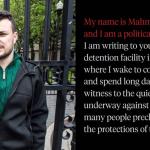
My name is Mahmoud Khalil and I am a political prisoner. I am writing to you from a detention facility in
Louisiana where I wake to cold mornings and spend long days bearing witness to the quiet injustices
underway against a great many people precluded from the protections of the law.
Who has the right to have rights? It is certainly not the humans crowded into the cells here. It isn’t the
Senegalese man I met who has been deprived of his liberty for a year, his legal situation in limbo and his
family an ocean away. It isn’t the 21-year-old detainee I met, who stepped foot in this country at age nine,
only to be deported without so much as a hearing.
Justice escapes the contours of this nation’s immigration facilities.
On March 8, I was taken by DHS agents who refused to provide a warrant, and accosted my wife and me
as we returned from dinner. By now, the footage of that night has been made public. Before I knew what
was happening, agents handcuffed and forced me into an unmarked car. At that moment, my only concern
was for Noor’s safety. I had no idea if she would be taken too, since the agents had threatened to arrest her
for not leaving my side. DHS would not tell me anything for hours — I did not know the cause of my
arrest or if I was facing immediate deportation. At 26 Federal Plaza, I slept on the cold floor. In the early
morning hours, agents transported me to another facility in Elizabeth, New Jersey. There, I slept on the
ground and was refused a blanket despite my request.
My arrest was a direct consequence of exercising my right to free speech as I advocated for a free
Palestine and an end to the genocide in Gaza, which resumed in full force Monday night. With January’s
ceasefire now broken, parents in Gaza are once again cradling too-small shrouds, and families are forced
to weigh starvation and displacement against bombs. It is our moral imperative to persist in the struggle
for their complete freedom.
I was born in a Palestinian refugee camp in Syria to a family which has been displaced from their land
since the 1948 Nakba. I spent my youth in proximity to yet distant from my homeland. But being
Palestinian is an experience that transcends borders. I see in my circumstances similarities to Israel’s use
of administrative detention — imprisonment without trial or charge — to strip Palestinians of their rights.
I think of our friend Omar Khatib, who was incarcerated without charge or trial by Israel as he returned
home from travel. I think of Gaza hospital director and pediatrician Dr. Hussam Abu Safiya, who was
taken captive by the Israeli military on December 27 and remains in an Israeli torture camp today. For
Palestinians, imprisonment without due process is commonplace.
I have always believed that my duty is not only to liberate myself from the oppressor, but also to liberate
my oppressors from their hatred and fear. My unjust detention is indicative of the anti-Palestinian racism
that both the Biden and Trump administrations have demonstrated over the past 16 months as the U.S. has
continued to supply Israel with weapons to kill Palestinians and prevented international intervention. For
decades, anti-Palestinian racism has driven efforts to expand U.S. laws and practices that are used to
violently repress Palestinians, Arab Americans, and other communities. That is precisely why I am being
targeted.
While I await legal decisions that hold the futures of my wife and child in the balance, those who enabled
my targeting remain comfortably at Columbia University. Presidents Shafik, Armstrong, and Dean
Yarhi-Milo laid the groundwork for the U.S. government to target me by arbitrarily disciplining
pro-Palestinian students and allowing viral doxing campaigns — based on racism and disinformation —
to go unchecked.
Columbia targeted me for my activism, creating a new authoritarian disciplinary office to bypass due
process and silence students criticizing Israel. Columbia surrendered to federal pressure by disclosing
student records to Congress and yielding to the Trump administration's latest threats. My arrest, the
expulsion or suspension of at least 22 Columbia students — some stripped of their B.A. degrees just
weeks before graduation — and the expulsion of SWC President Grant Miner on the eve of contract
negotiations, are clear examples.
If anything, my detention is a testament to the strength of the student movement in shifting public opinion
toward Palestinian liberation. Students have long been at the forefront of change — leading the charge
against the Vietnam War, standing on the frontlines of the civil rights movement, and driving the struggle
against apartheid in South Africa. Today, too, even if the public has yet to fully grasp it, it is students who
steer us toward truth and justice.
The Trump administration is targeting me as part of a broader strategy to suppress dissent. Visa-holders,
green-card carriers, and citizens alike will all be targeted for their political beliefs. In the weeks ahead,
students, advocates, and elected officials must unite to defend the right to protest for Palestine. At stake
are not just our voices, but the fundamental civil liberties of all.
Knowing fully that this moment transcends my individual circumstances, I hope nonetheless to be free to
witness the birth of my first-born child.