
Alex Pretti, a VA Nurse, Was Murdered by a Member of His Own Union

The day after VA nurse Alex Pretti was executed in broad daylight on the streets of Minneapolis, his local union at the Minneapolis Veterans Affairs Medical Center, the American Federation of Government Employees (AFGE), issued an emotional statement of support and solidarity for the slain trade unionist.
“We have received confirmation that a Member of AFGE Local 3669, Alex Pretti, was the man killed during the incident,” the union posted on its website. “Video of the incident is circulating on Social Media and the Department of Homeland Security has publicly stated that the victim was brandishing a weapon at Officers. However, based on the video currently available, that claim is not clearly established.” It added:
Alex died while protecting a woman and exercising his First and Second Amendment rights. He was dedicated to caring for veterans and treated them with decency and respect, sometimes in their final moments – which is the exact opposite of how he was treated during his. AFGE Local 3669 is disgusted by the abhorrent rhetoric of Trump administration officials following his killing. Alex was a son, a colleague, and a fellow union brother, not an ‘assassin’ or a ‘domestic terrorist.’ We are especially disappointed with VA Secretary Doug Collins, who chose to use the murder of his own employee to push partisan, political narratives.
Liz Shuler, the president of the AFL-CIO, added the national federation mourns “the senseless killing of another Minneapolis resident by Federal Agents. Alex Jeffrey Pretti was a VA Intensive Care Unit Nurse and a Member of AFGE Local 3669 - a Brother in our Union Family.” Shuler demanded that “the Trump Administration’s horrific operation - and their actions aimed at stoking violence and chaos - must end. America’s Unions join the call for ICE to immediately leave Minnesota before anyone else is hurt or killed.”
On January 27th, AFGE President Everett Kelley demanded the firing of DHS Secretary Kristi Noem and Stephen Miller, the ultimate boss of Trump’s pogrom. “Noem betrayed the public trust by slandering the good name of our union brother and calling him a ‘domestic terrorist,’” he said. “Our demand is clear: Department of Homeland Security Secretary Kristi Noem, who was responsible for carrying out the policy that led to Alex’s needless killing, and Deputy White House Chief of Staff Stephen Miller, the architect of that policy, must resign immediately. If they refuse, President Trump must dismiss them.”
The murders of Perri and Renney Nicolle Good a week earlier have galvanized Minnesota’s labor movement and unions nationwide, sparking calls for general strikes and other protests that swept the country this week. The labor newsletter Payday Report is following these actions and tracked shutdowns and strikes in more than 120 cities on Saturday alone.
But a sentence in AFGE’s initial statement has exposed a troubling aspect of the killing in Minneapolis that has largely gone unnoticed by the media and the labor movement itself: Pretti was stalked and shot down by two officers in the Border Patrol, whose members are an important, dues-paying unit of AFGE, the largest federal union in the AFL-CIO.
With DHS refusing to identify the shooter, “we are still not certain if he was a Member of AFGE,” Local 3669 said. “This is an unfolding and extremely serious matter. Until we have verified facts, it is important that we refrain from speculation or drawing conclusions.” That was a week ago, but the identity of the two CBP officers who fired the shots, according to DHS, still remains hidden, even to Minnesota attorney general Keith Ellison.
On February 1, the investigative outlet ProPublica identified the shooters as Border Patrol agent Jesus Ochoa and Customs and Border Protection officer Raymundo Gutierrez. “Ochoa is a Border Patrol agent who joined CBP in 2018. Gutierrez joined in 2014 and works for CBP’s Office of Field Operations. He is assigned to a special response team, which conducts high-risk operations like those of police SWAT units. Records show both men are from South Texas.” I’ve asked AFGE if Ochoa and Gutierrez are members of AFGE but have not heard back.
Yet it’s well-known that the National Border Patrol Council, like AFGE’s VA Council, is a solid member of the union. Its stout defense of its officers’ conduct in Minneapolis underscore the problems to the labor movement of law enforcement unions, which often act as proponents of the management of their own agencies even as they claim to represent agency workers.
The Border Patrol Council’s actions puts AFGE on notice that it has another renegade “union” on its hands after the National ICE Council, which represents nearly 8,000 Immigration and Customs employees, was allowed to split from AFGE and the AFL-CIO in 2022 after years of tension with its parent union and immigrant rights activists.
At the time, ICE Council President Chris Crane, the Republican’s favorite union leader and a frequent guest on Fox News, denounced AFGE and the AFL-CIO as “far-left organizations” that were “anti-ICE [and] anti-law enforcement.” As I report below, I had direct experience with the ICE Council from my seven years as an AFGE staffer from 2009 to 2015, and can corroborate its racist-driven policies during the Obama administration that preceded Trump’s rule.
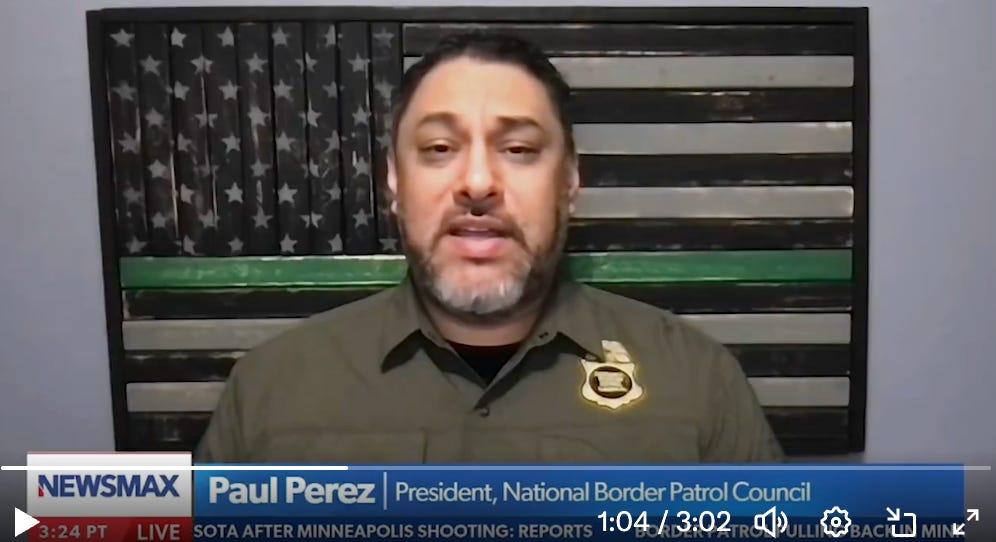
Paul Perez, President of the National Border Patrol Council, is a constant presence on Fox and its far-right competitor, Newsmax. A screenshot from a recent post on Twitter/X.
The Border Patrol Council Backs DHS 100%
With the recent carnage in Minneapolis, the Border Patrol Council’s grifting has become even worse than its counterparts at ICE. Its president, Paul Perez, has become a constant on Fox News and Newsmax, defending the actions of his members and refusing to take any responsibility for Pretti’s wrongful death. Consider this January 24th post. It follows the exact same line as Perez’s bosses at DHS and doesn’t make the slightest attempt to apologize to the Border Patrol’s union “brother” or his family. Like both Noem and Trump have done, the council blames the victim.
When a supposed ‘peaceful’ protester brings a weapon (such as a loaded handgun) and brandishes it, there are going to severe consequences and repercussions. We have pleaded with and warned the media and the politicians that their irresponsible, hate-filled and false rhetoric is going to get people unnecessarily hurt, or worse, killed when they portray our agents and officers as the aggressors. They have encouraged these reckless confrontations and attacks on our agents and officers who are performing their lawful duties and enforcing the laws that Congress has put on the books.

The Border Patrol Council’s web page looks a lot like a scene from Breaking Bad.
These statements from a member of AFGE have drawn critical notice on social media. At the same time, longtime AFGE members and staffers remember that Brandon Judd, who preceded Perez as president of the Border Patrol Council, was so beloved by President Trump for his anti-immigrant stance that he was named US ambassador to Chile in 2025 (he was confirmed by a 51-47 vote in the Senate). Like Crane of the ICE Council, Judd was a favorite witness for Republicans in the House and Senate and helped Trump formulate his tough, Gestapo-like policies to expel so-called “illegal” immigrants from the country. Throughout their time as members of AFGE, Judd and Crane defied the policies of both the federal union and the AFL-CIO.
The problem with cop unions
The divisive presence of the Border Patrol and ICE unions within the House of Labor came to a head in 2022 when the ICE Council petitioned the Federal Labor Relations Authority to disaffiliate from AFGE and the AFL-CIO. Its separation was cheered by immigrant rights activists and many trade unionists, as reported in People’s World.
Many in the labor and immigrant rights movements believe it is high time that the ICE unit be cut off from the union movement. They have argued that the racist and anti-immigrant behavior of ICE is antithetical to the purposes of the legitimate labor movement which they see as extending full rights to all workers in the nation, including those who are undocumented. Anything short of that, the AFL-CIO itself has argued, opens the door to exploitation of all workers in the country. The decision to let the local representing ICE workers leave the union should not have been “difficult” at all since ICE has and continues to terrorize poor, working-class, and immigrant workers, negating its right to have a place in the labor movement.
Despite its political differences with AFGE and the AFL-CIO the National Border Patrol Council would likely oppose any moves to force it to leave its parent union. The council makes that clear on its website in its FAQ section for members.
The National Border Patrol Council is part of AFGE, and AFGE is affiliated with AFL-CIO. If we were to attempt to sever the affiliation or even discuss it, the NBPC would lose its assets, third-party legal insurance, exclusive representative status, and be placed into trusteeship. AFGE national representatives (non-BP) would assume control of your union and your representation…Although NBPC is opposed to the shameless promotion of illegal aliens by AFGE and AFL-CIO, the NBPC must work through internal measures to change the position of AFGE and AFL-CIO or risk jeopardizing our status. In order for change to occur, the NBPC must convince the various Councils within AFGE and other Unions affiliated with AFL-CIO to oppose efforts that promote illegal immigration.
Clearly, the council does not want to weaken its strength within AFGE.
That brings up another issue: cop unions like the Border Patrol and ICE Councils have inordinate power within their federations because of their union “density” - that is, the percentage of workers in their units that belong to the union. Unlike many unions, especially those in the federal sector, police unions historically claim “wall to wall” membership - or 100 percent - when the union is designated as their exclusive representative. According to the Border Patrol website, 94 percent of Border Patrol officers belong to the union.
In contrast, many of the government units within AFGE have much lower density. While I was employed by AFGE as a privatization analyst, I worked with many locals at such agencies as the VA, US military bases, and the Social Security Administration, and found that some had membership numbers as low as 5 percent of total members eligible to join the union. That’s partly because the federal government is an open shop; even if AFGE has representational rights at a certain agency, federal employees are not required to join. But the lower the density, the less dues are paid by that local, and the less power those agency employees have within the broader structure of the federation.
I saw this for myself with the ICE Council. Because it had far more financial clout within AFGE than other councils, such as those representing VA nurses, its needs were always met, even when those needs conflicted with the union’s political stance. Take the issue of privatization. By the time President Obama was elected, the outsourcing of government jobs had reached a peak, particularly within security agencies and the Pentagon. AFGE took a strong stand against this, and hired me (in part as the author of Spies for Hire) to help locals fight federal agencies when they sought to privatize the jobs of public sector workers.
But the ICE Council was only interested when privatization affected their safety. During this time, for example, ICE and the Border Patrol shared security duties on airline flights when the agencies deported immigrants back to Mexico and Central America (these deportations reached record levels under the Obama administration). Their members complained that ICE and CBP contractors provided most of the security aboard these flights, leaving only one or two actual ICE officers to ensure safety. With the help of my AFGE department, they lobbied the agency to add more government employees.
When it came to the wholesale privatization of ICE prisons by the likes of Core Civic, Geo Group and other security companies, however, the ICE Council was not opposed: they needed all the help they could get and said they preferred that ICE build new private prisons that employed contractors. Yet these prisons were one of the hottest issues for labor and immigration rights groups, which had coalesced around demands that the US government end the expansion of privately run ICE facilities.
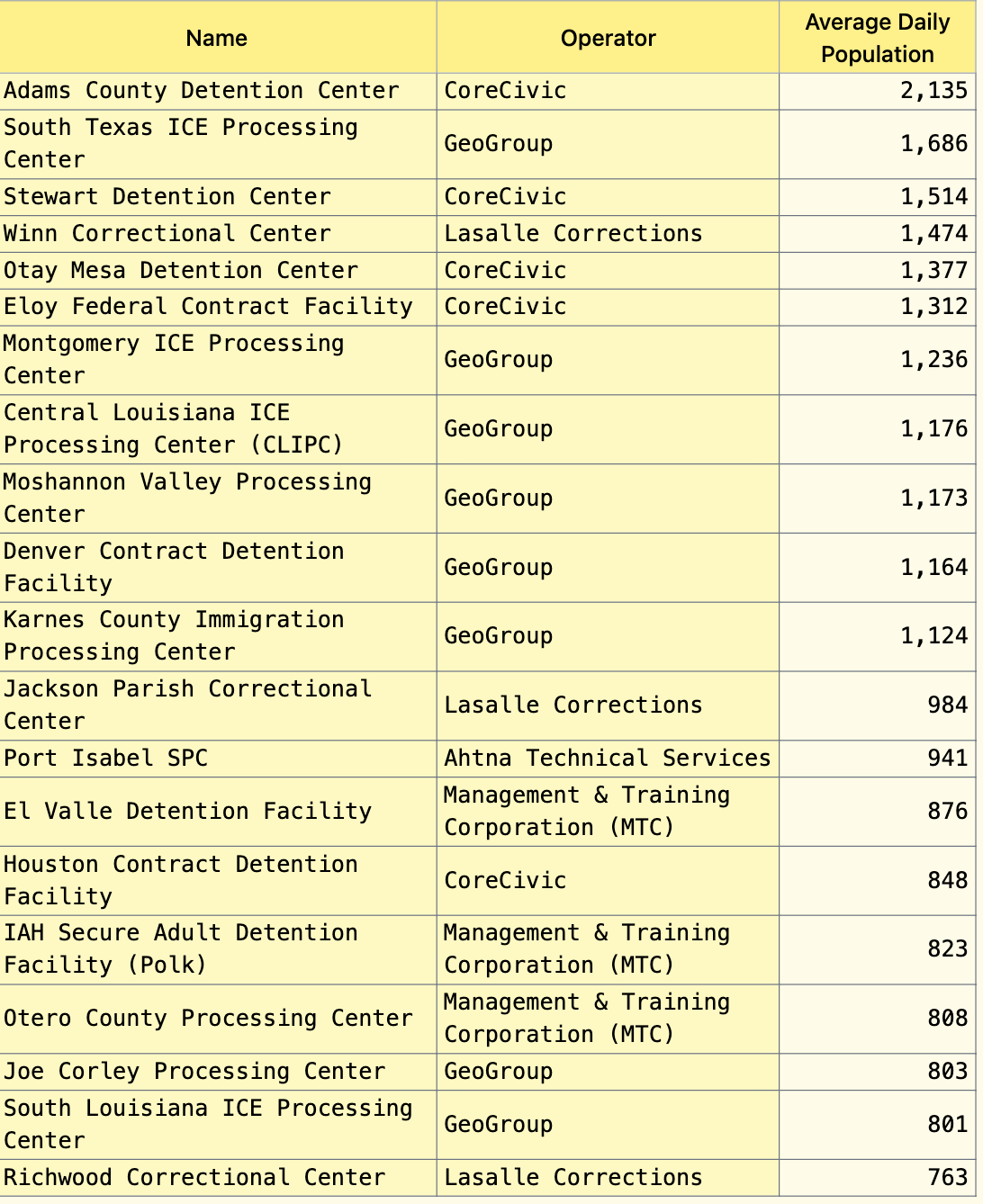
Today, over 90 percent of detained immigrants “languish in prisons that aren’t actually run by the government,” Salon reported last week. A 2025 report from Trac Immigration found that all of the 20 largest ICE detention facilities are operated by private contractors.
Top 20 Immigration and Customs Enforcement Detention Facilities, by Average Daily Population, January 6, 2025 (Trac Immigration).
The ICE Council Inside AFGE
Inside AFGE, the issue of private prisons came to a head in 2014, when I and a fellow AFGE staffer were assigned to participate in an AFL-CIO coalition of unions and immigrant rights groups focused on human rights on the southern border. When lawmakers proposed a bill to stop the construction of new private ICE prisons, the coalition endorsed it and asked members to take the endorsement back to their organizations for approval. Before briefing AFGE’s leaders on the measure, my colleague and I spoke to the ICE Council and were told in no uncertain terms that they would oppose the legislation.
I didn’t think the ICE Council’s position should prevent AFGE as a whole from endorsing the legislation; after all, the union itself was opposed to private prison and represents thousands of Latinos and others impacted by ICE detentions and expulsions. That’s what I argued when my colleague and I met with the AFGE’s president at the time, J. David Cox, himself a former VA nurse. Unfortunately, Cox was far more interested in maintaining his personal power base within the union than supporting the workers AFGE represents. Without even hearing our arguments in favor of the anti-privatization prison legislation, he decided that the union should refrain from endorsing it. Then he ordered us to leave the AFL-CIO coalition altogether.
I was stunned, and expressed my own strong reservations against abandoning the AFL-CIO and the many AFGE members I worked with to stop the outsourcing of their government jobs. After that, Cox appointed one his loyalists to lead a vicious campaign to get rid of me and other members of my department who he believed deviated from union goals. Fed up with Cox’s corruption and his underling’s heavy-handed tactics against me and other staff, I filed a complaint with the Equal Employment Opportunity Commission. About a year later, thanks to the assistance of an excellent labor lawyer I had hired, I left the union after reaching a settlement through the EEOC (my traumatic experience with AFGE triggered a near-heart attack and is a story for another day).
Ironically, it turned out that Cox himself was deviant. In 2020, he resigned from AFGE in disgrace after AFGE’s leadership was confronted with internal charges from union staff and members, all of them male, that Cox had sexually abused and harassed them, some for years. The National Executive Council then contracted with an independent legal watchdog led by a former EEOC executive to conduct an impartial investigation.
After conducting over 70 interviews with current and former staff (including me), the review concluded that the allegations against Cox were true. It made public a lengthy report that the union president had subjected numerous male staffers to inappropriate sexual behavior, unwanted physical contact, derogatory comments about religious affiliation, as well as “verbal abuse and belligerent behavior.” It also found that AFGE under Cox lacked mechanisms for reporting harassment and misconduct and had therefore “tolerated harassment and bullying.” I felt vindicated; that was exactly what my EEOC complaint had been about.
When the ICE Council requested a split from AFGE two years later, Cox was long gone and had been replaced by his former Secretary-Treasurer, Everett Kelley. Unlike Cox, Kelley recognized that the ICE Council, despite its oversized dues to AFGE and the AFL-CIO, was not worthy of a role in the union. “It is clear that the [ICE Council] remains steadfast in their desire to no longer be a part of AFGE or the broader labor movement,” Kelley said. “As a result, we have made the difficult decision to disclaim interest in this unit.” Now, with the Border Patrol Council defending its murder of a VA nurse who was part of AFGE, Kelley is certain to face pressure to expel them as well.
The Border Patrol’s Possible Expulsion Could Happen Soon
That pressure could burst out this month. Hours after I initially posted this article, I was contacted by a longtime union activist in the San Francisco Bay Area. He told me that several VA workers who are members of AFGE will attend the union’s annual legislative conference at the Hyatt-Regency Hotel in DC next week to raise the issue of kicking the Border Patrol unit out of AFGE and the AFL-CIO.
The dissidents are part the Federal Unionists Network (FUN) that was organized last year to encourage AFGE to take a tougher stand against the Trump administration’s attacks on the federal work force and his destruction of federal union rights. In their critique of the Border Patrol, they are likely to win support from Democratic lawmakers and other parts of the giant union. But their attempt to expel the unit is unlikely to move AFGE President Kelley, who recently excorciated the FUN organization at a meeting of the AFL-CIO Executive Council.
Kelley, the activists told The New York Times, has embraced “a narrow focus on the short-term hardships of its members at the expense of the larger political battle.” My activist source was equally critical: he “spends his time at AFL-CIO executive council meetings fuming more about FUN than Trump!” That may be true, but in my experience working for him, Kelley has far more courage than his predecessor Cox, and may listen to the rank-and-file if they press the issue of the Border Patrol’s union membership.
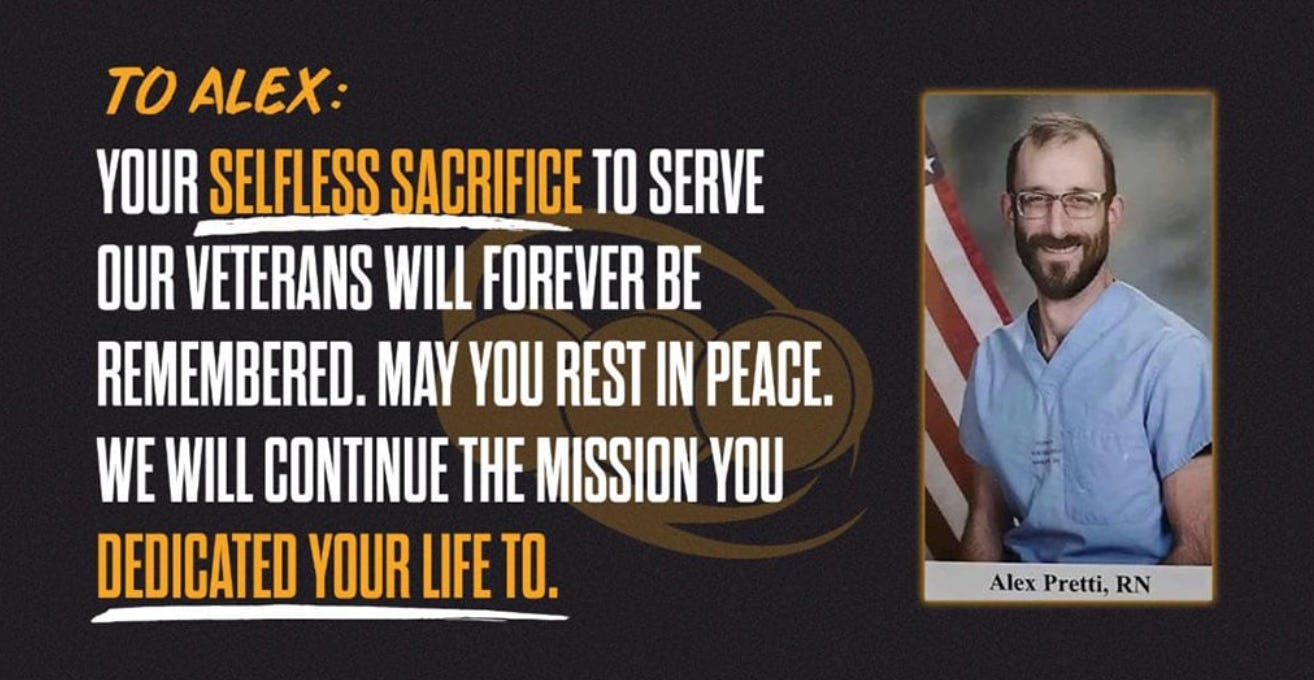
AFGE’s tribute to Alex Pretti, the VA nurse murdered by Trump’s goons.
In its lengthy article on the Federal Unionists Network, the Times interviewed Chris Dols, its co-founder. “I get why any union would be hesitant to embrace this kind of fight, especially in the face of an administration that has shown it is completely willing to pursue aggressive political and legal retaliation,” Dols said of the struggle for justice within the federal work force. “That’s why it has to come from below. That’s our entire project. How do we give voice to federal unionists who are willing to take some risks that the unions aren’t willing to?”
Indeed. The cop union that killed a member of its own federation needs to go - now.
Tim Shorrock is an independent journalist, Korea specialist, and Bob Dylan fan, back from the brink with hidden histories of Cold War DC, US military intervention in Asia, Spies for Hire, global labor, the new & old left, plus field notes from my book, DMZ Empire.
Empire Blues with Tim Shorrock is a reader-supported publication. To receive new posts and support my work, consider becoming a free or paid subscriber.