
Global Left Midweek — February 25, 2026
- International Women’s Day Call to Action
- Cuba and Venezuela
- India: Anatomy of a General Strike
- Africa’s Debt to Cuba
- A Death Triggers Fresh Hell for French Left
- Elections and Consequences
- Labor Protests in China
- The Left and the “Democracy Question”
- On Whose Shoulders We Stand
- Western Sahara, Africa’s Last Colony
__________
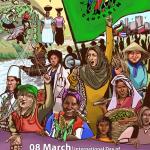
International Women’s Day Call to Action
La Via Campesina (Paris)
On this March 8, International Day of Struggle for Working Women, peasant, Indigenous, Afro-descendant, artisanal fisherwomen, pastoralists, rural workers, and diverse rural communities raise our voices in all territories of the world against imperialism, fascism, racism, and the rollbacks of historical rights, and we say enough to structural violence, dispossession, displacement, and femicides.
__________
Forty Days of Counterrevolution Luís Bonilla-Molina / Links (Sydney)
Cuba: Alone With Imperialism Rafael Hernández / On Cuba (Miami/Havana)
__________
India: Anatomy of a General Strike
Pavan Kulkarni / Peoples Dispatch (New Delhi)
Mass detentions, motorcycle rallies, protest marches and demonstrations, pickets in industrial areas forcing factories to shut down, marked the All-India General Strike on February 12 in South India’s largest state, Karnataka. Over 600,000 workers downed tools. Almost 100,000 workers, farmers, and activists participated in street actions across its 31 districts.
__________
Horace Campbell / Pambazuka News (Nairobi)
Consider ten interconnected episodes that illuminate the depth and durability of the relationship between the Cuban revolutionary process and the peoples of Africa. These episodes constitute a cumulative historical architecture, tracing a continuous thread from the ideological foundations of anti-colonial thought through to the contemporary struggle against imperial strangulation.
__________
A Death Triggers Fresh Hell for French Left
Lénaïg Bredoux and Ellen Salvi / Europe Solidaire Sans Frontières (Paris)
The death of 23-year-old fascist Quentin Deranque has led to the arrest of militants from the anti-fascist group La Jeune Garde. The radical-left La France Insoumise party allied with LJG is now facing a backlash of denunciation and repression from the center, right and far right.
__________
Elections and Consequences
Portugal Tatiana Moutinho / transform! europe (Vienna)
Bangladesh Badrul Alam / Europe Solidaire Sans Frontières
Peru Al Jazeera (Doha)
Thailand Adam Simpson / The Conversation (Melbourne)
__________
Sergey Shlyapnikov / Posle (Berlin)
The global outsourcing of production to China, as seen in the past decades, has made the country the potential epicenter of global workers’ protest. As industrialization progresses, groups of workers have emerged that are capable of self-organization and collective action. The question is if they could become a political force under the right circumstances.
__________
The Left and the “Democracy Question”
Thomas Goes / Luxemburg — Gesellschaftsanalyse und linke Praxis (Berlin)
[This is excerpted from a think piece from Germany, part of an ongoing discussion of the prospects for the German left and Die Linke party. It was electronically translated and edited by Portside. Read the whole piece in German here.]
We are living through dangerous times, a time of fascization. Neoliberals are paving the way for the neofascists. A new authoritarian social alliance is forming before our very eyes. It is being forged tentatively between radicalizing conservatives and authoritarian neoliberals on the one hand, and the AfD and its base on the other.
Democracy is being threatened and destroyed from several sides: from the neoliberal center, which pretends to defend it, and from the fascist AfD and its allies. Die Linke must [...] aim to fight consciously on the defensive in order to make a new left-wing offensive possible—not to adapt to liberalism, but to take steps toward a political shift to the left.
With this in mind, the “democracy question” should be placed at the center of left-wing party strategy. This would create a political divide between the bottom and the top, between ordinary people on the one hand and millionaires, billionaires, and fascists on the other. The initial goal is to become a magnetic counterpoint to the AfD in order to ultimately defeat it. At least, that is the basic strategic idea, which I will explain in more detail below.
Fascization and the destruction of democracy
How are neoliberalism, fascization, and the destruction of democracy connected? Following Ugo Palheta, I understand fascization to be a social process that creates conditions that make a transfer of power to fascists possible or even probable. In my opinion, important elements of fascization include the spread of ideologies of hate, gaining ground by organized and conscious fascist cadres, the normalization of fascist arguments, the mass loss of trust in traditional democratic processes, the spread of fascist attitudes, the electoral victories of fascist parties, the shift of established right-wing parties to the right, and the lack of a socialist or at least progressive alternative that convincingly promises to solve the major problems that concern the masses. As Lia Becker has shown, the policies of the ruling class to date and its future strategic decisions play a central role in fascization.
Neoliberalism contributes to this fascization in several ways. Firstly, neoliberalism is the expansion of the power of corporations and capital over the working classes and the ecological web of life – e.g. through precarious employment, the ruthless exploitation of resources in global value chains, the expansion of lobbying power, a revolving door between ministries, parliaments and companies, and austerity policies. Secondly, neoliberals are destroying liberal democracy itself. The subjugation of political decisions to corporate interests destroys faith in democracy because “democracy” does not deliver what many people want for a good life. And thirdly, authoritarian neoliberals are paving the way for neofascists: by inciting hatred, for example, against migrants and allegedly lazy unemployed people, they are feeding the idea that some people are less equal than others. Democracy, however, is based on the assumption that everyone is politically equal and of equal value.
The neofascists are capitalizing on this destruction of democracy. They thrive on despair and uncertainty, on the spreading feeling that nothing can be expected from democratic processes and parties.
Building bridges to the left
The destruction and threat to democracy is also reflected in the political attitudes of the population.
The impression that democratic rights and rules are in danger is most prevalent among the more left-leaning third of the population, as is the idea that democracy is the best way to achieve social and ecological goals and concerns. In the politically volatile sections of the population, on the other hand, many are turning away from democratic politicians because they believe they have been forgotten and abandoned by the parties. They simply no longer trust them to actually provide good healthcare, jobs, or intact school buildings in their own region. Part of the electorate become frustrated center-left voters who still vote. A larger proportion no longer votes at all. A smaller proportion belongs to the fringe of AfD voters who actually vote for fascists out of protest.
Die Linke must and can win over all of them for an effective anti-fascist policy—frustrated center-left supporters, desperate non-voters, and angry protest voters. To do so, it must address these feelings and build bridges to the left. It must therefore address the fear of the neofascists politically and at the same time grasp, fuel, and help develop the unease with “liberal democracy” and the “power of big money” into movement to the left—centrally in parliamentary work, in public relations, and in everyday extra-parliamentary work. If it fails to do so, the SPD and the Greens will displace it in the left-wing third, and the AfD will continue to appeal to swing voters and protest voters.
Strategically, it is crucial for Die Linke to occupy the field of democracy in such a way that it creates and intensifies a deep political divide between those above and below, between the exploited and the exploiters. If the party succeeds, it can act as a representative and active part of popular democracy, understood as an ensemble of ordinary working and unemployed people who oppose the millionaire and billionaire class on the one hand and the neofascists on the other. In this way, it can first become the strongest party to the left of the CDU/CSU, thus the recognized pole opposed to the AfD and the conservatives—and ultimately win over the uncorrupted protest voters who are currently voting for fascists.
This is demanding and requires a socialist concept of freedom and democracy. Freedom is the ability to make decisions that affect one's own life – and a social relationship that offers choices and opportunities for development. The aim would be, first, to address fears about the destruction of political freedoms that have already been achieved and, second, to address discontent with the political oligarchy consisting of millionaires, billionaires, and the political class associated with them. The popular democratic struggle always has to be fought on two fronts at once: against the neofascists and against the authoritarian neoliberals and the millionaire and billionaire class.
From a revolutionary-democratic perspective, the aim would be to defend and fight for freedom through equality: For social living and working conditions that make it possible to freely choose one's own life; for democratic power to decide on an equal footing with others on matters that affect our own lives and concern us all; for a coexistence that makes belonging and participation possible.
Precarious work, poverty wages, lack of health care, lobbying power, bought politicians, political blackmail with corporate relocations, misanthropic racism and anti-Semitism, the further fueling of global warming and the destruction of our natural foundations for survival, violence against LGBTQ people… from a revolutionary-democratic standpoint, these developments appear as attacks on equality, that which makes freedom possible, and on the very idea of a democratic people. It is precisely in resisting such attacks that a democratic people comes into being in the first place. [...]
The revolutionary kernel of democracy is the claim that the people, understood as the working and common sections of the population, decide their own fate: every vote counts equally and the people (demos) have the power (kratos). The propertied classes never wanted this kind of democracy. For them, democracy should be nothing more than a selection process and a set of operating instructions for representatives. In liberal democracy, democratic citizenship has been extended to an ever-larger group of people over time (more precisely, it was fought for), but their power has been very limited. Real popular power only arises through the addition of forms of direct grassroots democracy and through the extension of democracy to work and the economy. This is about radical democracy – not a commitment to the liberal order as we know it, which has rightly lost credibility.
__________
On Whose Shoulders We Stand
Mohammed Harbi 1933-2026 Muriam Haleh Davis / Jacobin (Brooklyn)
Susan George 1934-2026 Transnational Institute (Amsterdam)
Rupert Roopnaraine 1943-2026 Nigel Westmaas / Stabroek News (Georgetown)
__________
Western Sahara, Africa’s Last Colony
Saddam Alktif / Tricontinental Pan Africa
The struggle in Western Sahara is a frontline of a global imperial architecture that imposes domination through military occupation, resource extraction, and the destruction of political sovereignty across the Global South. The task falls to people’s movements – trade unions, women’s movements, student unions, socialist organs, peasant associations – to lead where governments hesitate.