The higher education organizing model is built on a lean, worker-driven strategy that prioritizes speed, scale, and rank-and-file leadership over deep staff involvement. With extremely low staff-to-worker ratios, organizers often oversee multiple large campaigns at once. The bulk of the work is carried out by voluntary organizing committees, with staff acting primarily as trainers and advisers. In this model, “leaders” on the committee are not identified and recruited by staff through traditional structure-based methods like systematic organizing conversations and action-based assessments. Instead, the leaders on the VOC are self-selected activists who step forward to be trained and take on organizing responsibilities. The organizing goal among staff and the budding VOC is to achieve 90 percent VOC coverage, meaning at least one trained activist is responsible for organizing and assessing pro-union support in nearly every work area.
Once this infrastructure is in place, campaigns move quickly in various ways: a public VOC rollout (often with names, photos, and quotes on a website), a union authorization card drive targeting 50 percent support before the entire campaign goes public with the employer, and a 65 percent card threshold to trigger an election filing.
Unlike structure-based organizing where the ultimate assessment of voter support for their union is a public action of some kind — wearing a union shirt or sticker, signing a public petition, and so on — in the higher education model, only VOC leaders are expected to be public about their union support, and they take the lead in building momentum through private actions, such as verbal assessments, vote pledges, and peer-to-peer engagement. The higher education model culminates in an intensive get-out-the-vote (GOTV) effort, often using tactics like “vote parties,” where the VOC gets commitments from their coworkers to meet up and go vote together as a group, to mobilize turnout among known supporters. In favorable terrain, this model is fast, scalable, and highly effective — but it depends on conditions where verbal assessments and activist leadership are sufficient to withstand minimal employer resistance.
This strategy works very well because of the specific context in which it is being deployed:
- Employer opposition is minimal in most cases. Universities often remain neutral or only engage in modest anti-union activity.
- The political and cultural terrain is favorable. Only one of the campaigns over the twenty-four-month period was in a red state, Alaska. The rest were won in strong blue states and one swing state, Pennsylvania. The political terrain for organizing across states can vary widely (e.g., California compared to Alabama), but campus culture is fairly consistent, and many university campuses are in bluer areas, even in red states.
- And critically, the electorate is self-selecting. On average, only 49 percent of eligible voters cast ballots in higher education union elections, and those who do are overwhelmingly pro-union.
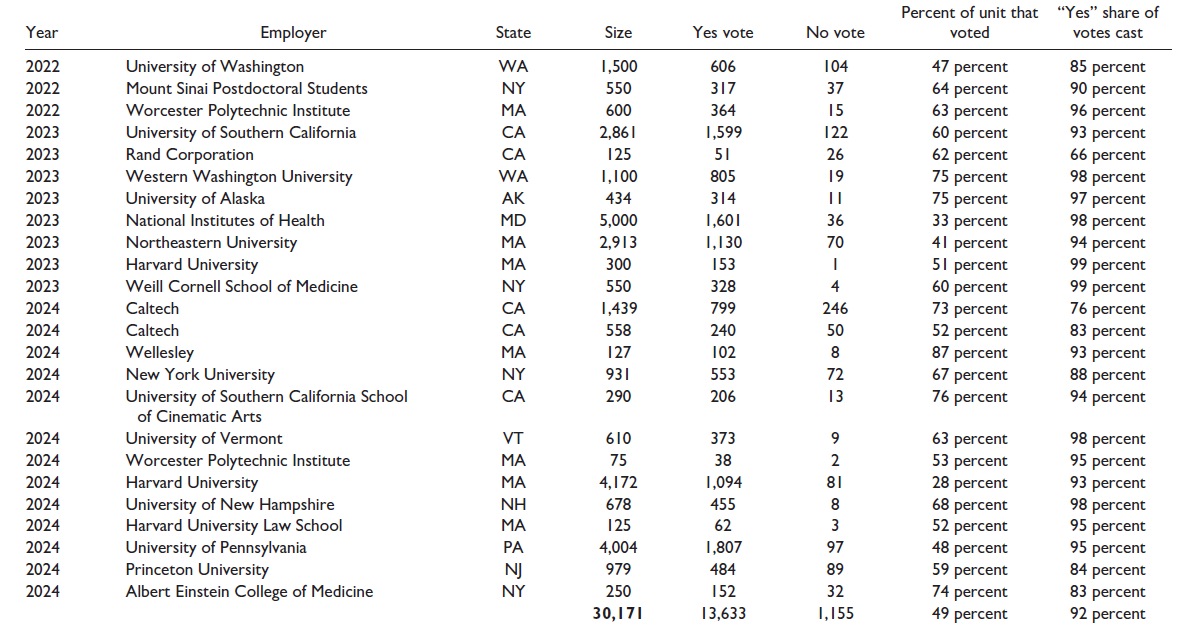
Table 1. UAW Higher Education Campaigns 2022-2024. Source: Information in this table is based on research compiled by Max Fazeli, UAW Research Department.
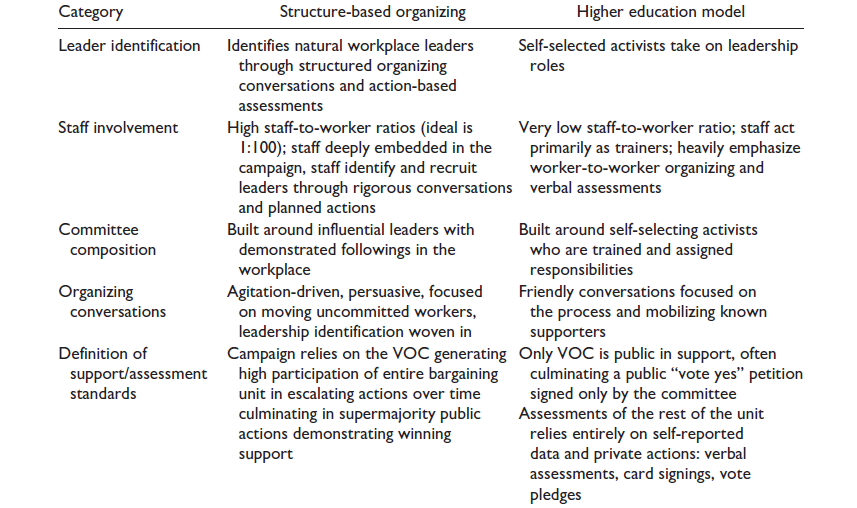
Table 2. Comparing Models and Methods. Source: Information in this table is based on research compiled by Max Fazeli, UAW Research Department.
The last point is particularly key. Higher education campaigns don’t need to persuade every worker — or even a majority of the unit. They need to identify, mobilize, and turn out the pro-union base to win. And that’s exactly what they’ve done.
The success of the higher education model reflects the underlying terrain it thrives in. Under this model, trained activists — who may or may not be very influential with their coworkers — are defined as leaders. Agitational conversations are very rare, and members of the VOC are explicitly trained to not try and persuade or win over anti-union coworkers. Only the VOC is expected to engage in public actions. The focus is on activist coverage, card drives, and fast election timelines. To a traditional structure-based organizer, a lot of this would look like “bad organizing.” In this context, it’s highly efficient and effective. In fact, running a rigorous, high-intensity organizing model in higher education would be highly inefficient and lead to even fewer successes in such a short period of time.
The higher education model works because the terrain allows it. In low-resistance environments, momentum and worker-to-worker organizing by workplace activists is enough.
But momentum organizing doesn’t always unfold on such friendly terrain. The question we then had to answer: Could this model survive when employer, political, and community opposition was far higher?
Victory at Volkswagen: Momentum + Pressure
At Volkswagen’s (VW) plant in Chattanooga, Tennessee, the UAW had a breakthrough: organizing the first foreign-owned, nonunion auto assembly plant in the South. The campaign began with momentum: inspired by the stand-up strike, Volkswagen workers reignited their campaign to win their union in earnest and drove the campaign forward with the speed and confidence that echoed the best of the higher education model.
But Tennessee is not New York or California. Employer, political, and community opposition were all present — more intense than in higher education, but far less brutal than what workers would face at Mercedes. Supervisors would float plant-closure rumors. An employer-backed anti-union committee led by salaried workers in the plant agitated against unionizing. Local and state politicians attacked the UAW and gave dire pronouncements about the future of VW if workers unionized. The company tried to maximize no votes by shutting down production lines during voting hours to encourage election turnout.
At Volkswagen, we implemented the higher education organizing model with great success. The campaign relied on a skeleton crew of staff, far short of the one organizer for every one hundred workers that is typified as the ideal for structure-based organizing. Instead, staff focused on building a massive and highly public activist organizing committee that signed up their coworkers on cards and assessed them verbally.
We also went a step further and organized a comprehensive pressure campaign to rein in VW’s union busting. Through our alliance with IG Metall, the largest and most powerful industrial union in Germany, and the UAW Global Works Council, we were able to successfully subdue management’s anti-union campaign and keep retaliation against workers in check. Every time the company launched a new attack on workers — such as publishing anti-union talking points in company newsletters that were read aloud at the start of every shift or sharing a URL in the plant that linked to an anti-union section on the company website — we worked closely with our allies in Germany to have it stopped.
Volkswagen was never neutral, but we were able to keep the company from playing from the same playbook they used in 2019, when VW management had plant-wide captive audience meetings (including an infamous captive meeting with the Tennessee governor), management explicitly threatened that the plant might close if workers unionized, and the company suddenly replaced a deeply unpopular CEO.
By December 7, 2023, we had 30 percent of the bargaining unit on cards. By the start of February, we had 50 percent on cards. We filed for an election in mid-March with 58 percent on cards. By the start of the election on April 17, we had verbally assessed an additional 12 percent as supportive, bringing our total anticipated support to 69 percent.
On April 19, 2024, all 3,613 votes at Volkswagen were counted, with 2,628 voting yes and 985 voting no — meaning that 73 percent of those who voted supported the union. Volkswagen workers won their union in a blowout.
The chart below compares our vote assessment to the actual election results, expressed as a share of all eligible voters. In a 100 percent turnout scenario, we projected that 69 percent would vote for the union and 31 percent against. Actual turnout was 84 percent, which gave additional weight to the yes votes. The final outcome was a union victory with 73 percent support among those who cast ballots.
The win at Volkswagen was hard-earned and defied the cautious tenets of structure-based organizing. It proved that a momentum-based, worker-to-worker model can succeed when paired with external leverage to effectively subdue employer opposition and keep resistance moderate.
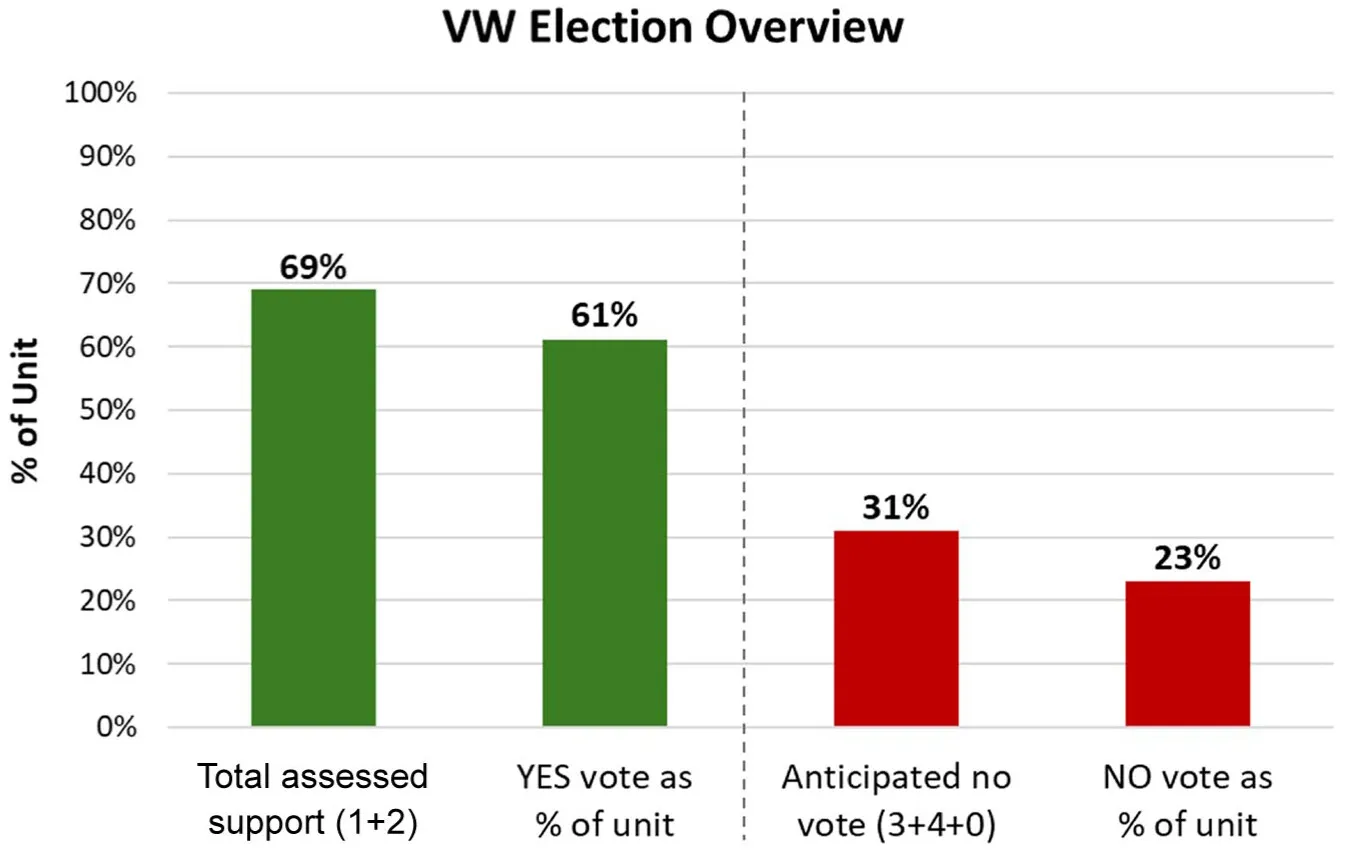
Figure 1. VW assessments and votes as percent of unit. Source: Information in this graph is based on research compiled by Max Fazeli, UAW Research Department.
Volkswagen was proof of concept, but success there created a dangerous confidence — one that would be tested when we entered one of the most hostile organizing environments in the country: Mercedes in Vance, Alabama.
Defeat at Mercedes: The Wall of Employer Opposition
At Mercedes in Alabama, workers got closer to winning their union than they ever had before. The campaign had real energy. UAW organizer Brian Shepherd met with twelve Mercedes workers on November 22, 2023. They began distributing cards the next day. By the end of December, they had signed up 1,308 of their coworkers. Two weeks into January, we announced 30 percent on cards. By the end of February, we announced 50 percent. Then we won in Volkswagen — and we hoped we could roll that tide into Alabama and deliver a back-to-back victory in the South.
We knew that the terrain would be hostile, but we wagered that momentum and worker-to-worker organizing could carry us through. Mercedes workers had organized with lightning speed. Supporters had been signing cards for months before the staff arrived. Assessments by staff and VOC showed our support holding strong at 58 percent — a combination of card signing (41 percent) and verbal assessments (17 percent) — similar to VW, and we believed that following the victory in Tennessee, a substantial percentage of the unassessed were breaking our way.
But two key differences set the Mercedes campaign apart from Volkswagen.
First, we filed for the election without a clear or accurate list of the workforce. We believed we had assessed 58 percent support across the unit — but when the Excelsior list (the voter eligibility list provided by an employer to the NLRB) came through, it was clear we were just at 41 percent. That exposed a critical gap in our internal structure and visibility.
Second, we lacked the leverage we had at Volkswagen to restrain the employer’s assault. With no pressure to hold them back, Mercedes management ran a ruthless, no-holds-barred, anti-union campaign: daily captive audience meetings, direct supervisor pressure, threat-based messaging, and some activists were targeted for discipline and even fired. Anti-union consultants blanketed the plant. And in the final weeks, the company very publicly swapped out the CEO in a blatant “give us one last shot to make things right” maneuver.
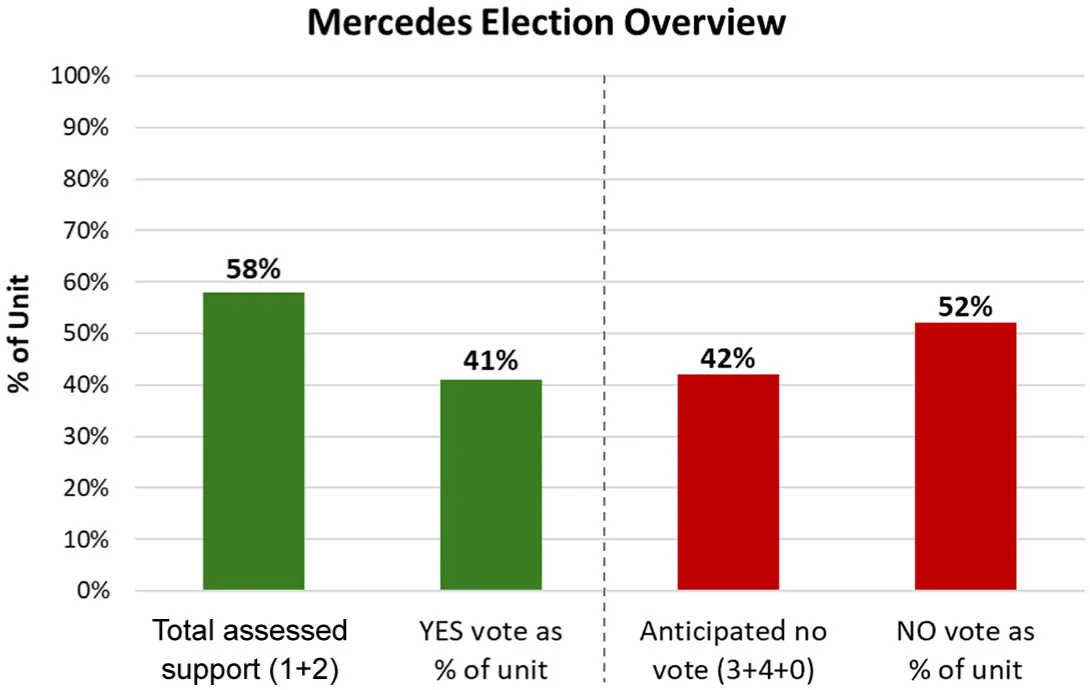
Figure 2. Mercedes assessments and votes as percent of unit. Source: Information in this graph is based on research compiled by Max Fazeli, UAW Research Department.
The Alabama political establishment and business community closed ranks with Mercedes management in their war against the workers: blanketing the air waves and local television stations with anti-union messaging, buying up billboards, and holding press conferences.
In the end, we lost the vote 2,642 to 2,045. We had lost 30 percent of our assessed support by the time ballots were cast — more than double the slippage at VW. Not because workers didn’t want the union, but because when management hit them with everything they had, they didn’t have the structure in place they needed to push through.
Our organizing model relied too heavily on verbal assessments and private conversations, with limited public action. Many workers were never asked to make a visible stand before the vote. That meant there was no way to pressure-test our actual support. The lack of a true list showed that our reach and visibility was too limited. In the end, that lack of structure translated into losing by nearly six hundred votes.
Reviewing the numbers at Volkswagen and Mercedes, several key facts stand out:
- Both campaigns saw a drop in support at the ballot box, but the scale was dramatically different. VW lost 342 yes votes from assessments to ballots — about a 12 percent drop of the total number assessed as supportive, 8 percent of the total unit assessed as supportive — in a moderate anti-union campaign. Mercedes lost 878 votes — a staggering 30 percent of the assessed support or 17 percent of the total unit — under extreme employer opposition.
- VW entered the election with 11 percent more of the unit assessed as supportive and had a much higher share of card signers rather than verbal-only commitments. In addition, 84 percent of the unit voted at VW compared to 93 percent at Mercedes. This gave the yes vote at VW greater weight and helped mask some erosion in support, while the higher turnout at Mercedes amplified every weakness in our structure and assessments.
At VW, we moved forward with filing for an election at 58 percent of assessed “yes” votes with the belief that the filing announcement would serve as another trigger event, generating energy that the VOC could capitalize on to continue growing support for their union to our goal of 70 percent support. That proved true.
At Mercedes, once we filed, the tension in the plant only grew, and support crashed under the weight of the employer campaign. None of the unassessed votes broke our way, and soft assessments flipped under pressure from management — the exact kind of result that the more cautious and methodical structure-based model accounts for.
It would have been ideal to only move forward with an election had we actually hit the 70 percent benchmark. This exposes some of the central tensions in the momentum-based, worker-to-worker model. Under the momentum model, we need a consistent stream of trigger events — such as the announcement of new stand-up strike targets and new plants hitting organizing benchmarks — to keep energy high, keep the public focused on the fight, and keep moving workers from the sidelines to action. And under the worker-to-worker organizing model, staff are just one voice in the room and shouldn’t dominate or dictate strategy. The point is to let workers lead, and there will come a time when the workers want to vote, regardless of what might be ideal or what the staff think.
The momentum model got us close at Mercedes — closer than ever before. But against extreme employer opposition, it wasn’t enough. What was needed was a deeper structure-based approach: more organizers, stronger leadership identification and recruitment and development, escalating actions culminating in supermajority displays of public support for their union, and more pressure on the employer — including global leverage like what worked at VW.
This wasn’t a failure of the workers. It was a strategic miscalculation. We underestimated the opposition — and overestimated what momentum alone could overcome.
Mapping the Terrain
These three campaigns — higher education, Volkswagen, and Mercedes — map some of the terrain of modern organizing. Each reflects a different level of employer opposition, political context, and election structure. And each demonstrates the limits of applying any single model in every setting. We didn’t win everywhere, but we gained the kind of knowledge that only struggle can teach. And we took a step toward building the strategic capacity we’ll need to win next time.
That’s the core lesson: if the labor movement is going to scale organizing in the private sector, it can’t rely on momentum or structure alone. No one method is the best fit for every situation. If labor is going to reverse terminal decline, we need strategic fluency — the ability to read the terrain by anticipating the intensity of opposition workers will face, the organizing capacity needed, and adapting our organizing approach accordingly. Dogma won’t save us. Discipline, experimentation, and the courage to fail might.
Organizing Is Not Dogma. It’s Adaptation.
Our national campaign started with questions: Could momentum and a less staff-intensive, worker-to-worker organizing model overcome serious employer opposition and succeed? Could we bend the rules of traditional structure-based organizing and still win?
We couldn’t theorize our ways to conclusions. We made the road by walking it — testing bold ideas in real campaigns, with real stakes, and learning what it takes to win at scale.
Worker-to-worker organizing can deliver rapid, large-scale wins in low-opposition environments like higher education. At Volkswagen, momentum and worker-to-worker organizing was paired with global leverage to deliver a historic breakthrough. But at Mercedes, the higher education model and no international pressure campaign left workers vulnerable to Mercedes management’s nuclear anti-union onslaught. The result wasn’t a failure of will — but a mismatch between strategy and context.
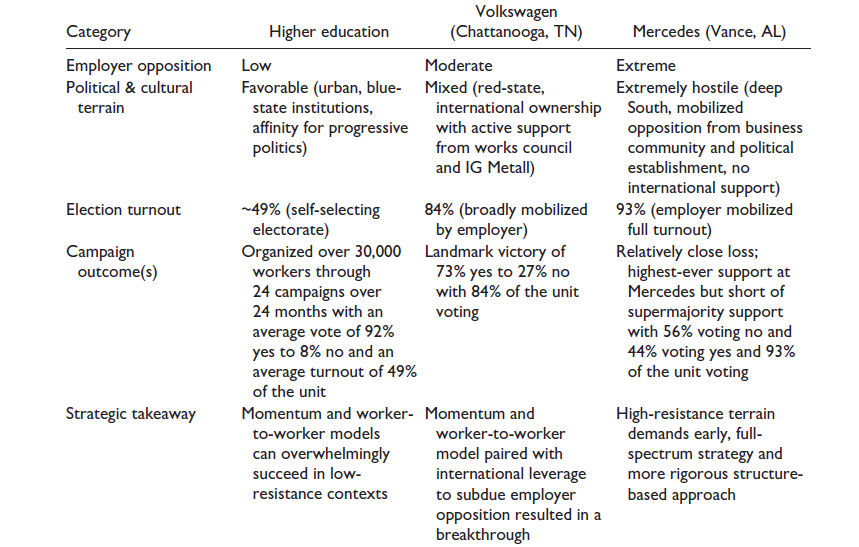
Table 3. Comparative analysis of UAW organizing campaigns. Source: Information in this table is based on research compiled by Max Fazeli, UAW Research Department.
In another article titled “Is Labor at the Point of No Return?,” I argued that it is imperative that the labor movement exponentially increase our organizing capacity and activity — or die. We didn’t win everywhere, but we gained the kind of knowledge that only struggle can teach. And we took a step toward building the strategic capacity we’ll need to win next time.
UAW president Shawn Fain has called for unions across the country to align our contract expirations to strike on May Day, 2028. That is a chance to ignite another movement moment — but on a much bigger scale. If we have the courage to dream boldly, lay the groundwork now, and take even bigger swings, we might just light a fire that transforms the labor movement for a generation.
Republished from New Labor Forum.
[Chris Brooks is a veteran labor organizer and strategist focused on building militant, member-led unions. He is a columnist at Jacobin.]