
How Infighting Led the Maya Civilization to Catastrophic Collapse
The Four Heavens: A New History of the Ancient Maya David Stuart Princeton Univ. Press (2026)
Before the 1970s, ancient Maya history was impenetrable. The civilization’s grand ceremonial buildings and striking art, created in parts of Mesoamerica during the Classic Maya period (ad 150–900) had tantalized foreign visitors since the arrival of Spanish conquistadors in the sixteenth century. But no one, including several million twentieth-century speakers of Maya languages, could read the ancient Maya hieroglyphs.
Epigrapher David Stuart embraced this challenge while still a child, living with his archaeologist parents in a small village in Mexico’s Yucatán Peninsula, where he learnt to speak the local Yucatec Maya language. He began working with Mayanist Linda Schele to understand the inscriptions of the ancient city-state of Palenque in Chiapas, on the peninsula’s western side.
At 12 years old, he presented his first paper at an international conference in Palenque in 1978. At 18, he became the youngest person to be awarded a MacArthur Fellowship. Today, he is a professor of Mesoamerican art and writing based in the United States and one of the world’s leading specialists on the ancient Maya.
In The Four Heavens, Stuart relates the history of the Maya civilization for non-specialist readers, more than two decades after the last book to attempt this demanding task. To do so, he draws on fresh archaeological discoveries and translations of Maya writings from the twenty-first century. The book’s title is a reference to Maya cosmology, which divided the sky into four ‘sides’, determined by the Sun’s daily and annual movements.
Stuart takes aim at outdated views of the Maya as “quintessential noble savages living in remote cities in the jungle” under the control of impersonal rulers and priests who were “more interested in esoteric knowledge than the concerns of the real world”. Instead, he portrays the Maya as living in a world that consisted of numerous vivid royal courts intertwined by marriages, temporary alliances and warfare, in addition to religion.
Warring dynasties
For example, in the early 1950s, leading scholar Eric Thompson “idealized” the Maya, Stuart notes, and regarded them as a theocracy: time worshippers with an immensely sophisticated calendar and a deeply spiritual outlook. In Thompson’s view, stated in 1972, their puzzling inscriptions were not “syllabic, or alphabetic, in part or in whole” — unlike Egyptian hieroglyphs, which had been deciphered in the 1820s.
Thompson might have been influenced in part by cold war politics. He rejected the pioneering 1950s theory by Russian linguist Yuri Knorosov that the ancient Maya script was partly syllabic — an idea that Knorosov had gleaned from a sketch of symbols made by a Yucatec Maya in the 1560s in a confused conversation with a Spanish friar.
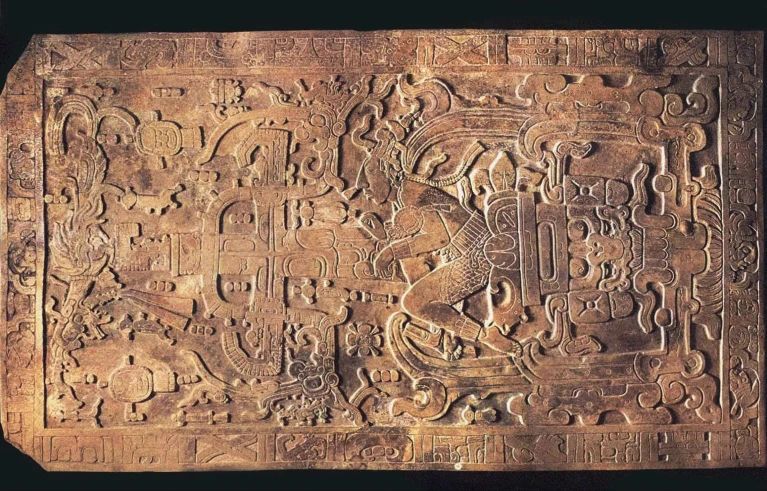
Sarcophagus lid from the tomb of Pakal.Credit: Fine Art Images/Heritage Images/Getty
From the 1980s onwards, however, the assessment of the ancient Maya civilization as mainly theocratic changed radically. By then, the Maya script was beginning to be deciphered — partly through phonetic elements. Scholars such as Michael Coe, author of The Maya (1966) and Breaking the Maya Code (1992), observed that these inscriptions showed their rulers to be obsessed with war. “The highest goal of these lineage-proud dynasts was to capture the ruler of a rival city-state in battle,” wrote Coe, “to torture and humiliate him (sometimes for years), and then subject him to decapitation following a ball game which the prisoner was always destined to lose.”
Wars and shifting political alliances are a substantial part of Stuart’s book, too, along with religion. “Maya history is a narrative of many localized ‘fits and starts’ within dynasties, usually instigated by a disruptive war,” he writes. Also prevalent in the book are the names of many Maya settlements, such as Chichén Itzá, Copán, Palenque and Yaxchilán, and rulers, such as Pakal the Great (of Palenque) and Shield Jaguar (of Yaxchilán). Some of these names will be familiar to modern visitors to Mesoamerica, but Stuart also includes many that are not as well known.
Dates are another theme, deciphered using the complex but well-understood Maya calendar. It is made up of three interlocking circular systems. The centre ring contains the numerals 1 to 13, which are then linked to two further rings of 20 named days and 19 named months. The full cycle takes 52 years to complete. Many of the dates on Maya inscriptions are surprisingly precise for records of the ancient world: for example, “a certain royal individual” died on 25 October 726, was buried in his pyramid on 28 October and his heir succeeded him to the throne on 7 January 727.
Although Stuart admits that some readers might find such details “a bit dry or tedious”, on balance the Maya synthesis of down-to-earth facts with fantastical elements in their buildings, art and hieroglyphs should intrigue us all. Interpreting these details will ensure decades more work for Mayanists.
Cosmic perspectives
Consider the sarcophagus lid of Pakal at Palenque in present-day Mexico — perhaps the most famous of all Maya inscriptions. Excavated in 1952 by archaeologist Alberto Ruz Lhuillier from the crypt of the Temple of the Inscriptions, the sarcophagus was gradually deciphered over the course of several decades.
Its calendar glyphs show that Pakal was born on 24 March 603, assumed the throne on 27 July 615 at the age of only 12 and died on 29 August 683 at the age of 80. His name translates as ‘shield’ in the ancient Maya language and is written using three distinct sets of hieroglyphs in various locations around Palenque: pictographically, as a drawing of a shield; phonetically, by spelling out the name with three symbols for the sounds ‘pa’, ‘ka’ and ‘l(a)’; and as a combination of the pictograph with the phonetic symbol for ‘l(a)’.
Accompanying the hieroglyphs is a fascinating but complex image of Pakal, which has been subject to vigorous debate. “As a poetic artwork, Pakal’s sarcophagus gives us a compelling window into Classic Maya religion and the place of dynasties within the symmetries of the cosmos,” Stuart writes.
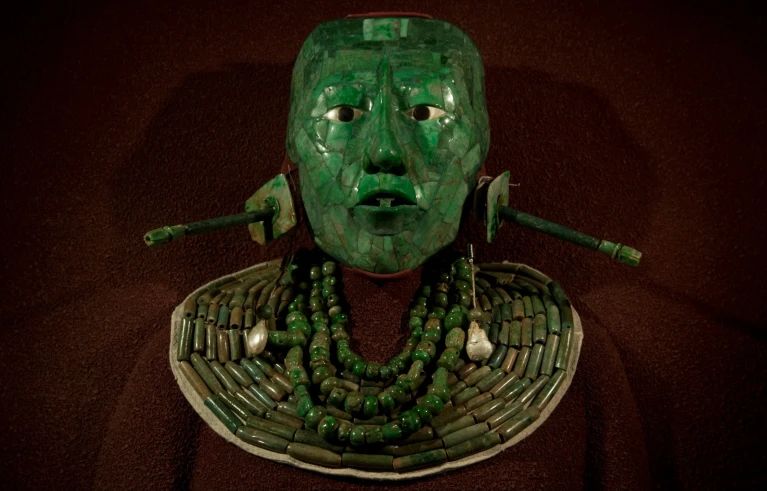
Several Maya artefacts, including this green jade death mask, were found in the tomb of Pakal the Great in Palenque, in what is now Mexico.Credit: Carver Mostardi/Alamy
He interprets the side view of the ruler’s reclining figure as lying on a bowl or dish designed for sacrificial instruments, with a skull at the base, representing a seed. From this dish, behind Pakal, rises a sacred tree of jade. On the coffin’s sides, Pakal’s ancestors — including his mother and father — are shown growing from the earth as trees bearing fruit, symbolizing rebirth and resurrection.
In essence, “the deceased king is shown as an infant who is sacrificed and ‘planted’ within the earth to emerge into the sky as the eastern sun”, Stuart notes. “In this way, in death, Pakal joins his ancestors on the sacred path of the sun, in its infinite cycles of movement.”
Janab Pakal III, the last known ruler of Palenque, came to the throne in ad 799. The site was eventually abandoned and became overgrown by the jungle. Palenque had few inhabitants when its buildings were first encountered by the Spanish conquistadors.
This disappearance was typical of the Classic Maya civilizations during the ninth century ad, although some sites continued to be densely populated by Maya until Spanish colonial times, for example in the Yucatán Peninsula, the Mexican state of Tabasco and the Guatemalan highlands. Yet Mayanists have struggled to explain what happened to the civilization. There is no evidence of a catastrophic war and no indisputable evidence of the effect of climate change, although the Maya lowlands clearly experienced extensive periods of drought between ad 800 and 1000 — as did the village in Yucatán that a young Stuart inhabited in 1975.
Instead, the author tends to regard “the top-heavy nature of elite Maya society” as a factor in its rapid decline. “Kings, queens, and other rulers were by their nature cosmic actors, whether the manifestations of divine warriors or the planters and harvesters of time. But there were too many of them.” This superfluity of the elite encouraged rivalries and conflicts, and inhibited responsible leadership, which might have eventually caused the breakdown of effective governance around ad 800–900.
The Four Heavens breathes life into these mysterious rulers and their societies in the millennium before the existential crisis that led to their disappearance. Stuart has realized his boyhood ambition of understanding more of their language and history. Thanks to the ever-growing decipherment of the Maya script since the 1950s, he concludes, the history of the ancient Maya is no longer dependent on “the quills of Spanish conquistadors or friars”.
Nature 651, 28-29 (2026)
doi: https://doi.org/10.1038/d41586-026-00663-0
Andrew Robinson is the author of more than thirty books and has written for The Guardian, New Scientist, New York Times, The Daily Telegraph, Nature, Physic World, Science, and The Lancet on Archaeology, Geology, Medicine, Physics, Art, History, Linguistics and Biography.
Every month, nine million people read news, analysis and commentary on nature.com. We are committed to developing the next generation of scientists through our backing for the Nature Awards for Mentoring in Science, the John Maddox Prize for Standing up for Science and the Nature Research Awards for Inspiring and Innovating Science.