
Why Three Scientists Said No to Epstein
Hundreds of scientists are mentioned in the recent trove of released emails related to disgraced financier Jeffrey Epstein, who was convicted of soliciting a minor in 2008 and who died by suicide in a New York City jail shortly after his arrest in 2019 on sex trafficking charges. Epstein relished connections with high-profile academics. Some took his money and used it for research; others were entertained lavishly at one of Epstein’s homes. Many of the scientists implicated in previous revelations admitted they had made a serious mistake. Several have been knocked off lofty professional pedestals since the latest releases by the U.S. Department of Justice (see sidebar, p. 969).
Many of the scientists Epstein courted were already well-established and well-funded. So why didn’t they all just say no? Science talked with three who did just that. Here’s how Epstein approached them, and why they refused to have anything to do with him.
The cancer researcher
David Agus, a professor of medicine and bioengineering, never met or spoke with Epstein. But he spent 7 years saying no to him.
Agus received his first email from Epstein in 2012. “I had given a TED talk, and I think he had an affinity for TED speakers,” Agus recalls. “He wrote me, ‘Can we meet next time you’re in New York?’”
After telling his assistant to raise the possibility of a meeting, Agus went online and learned more about Epstein, including his 2008 conviction. He also reached out to a few people he knew from among a list of names Epstein had mentioned in a subsequent email. “They all said the same thing: ‘Stay away from him. He’s a bad character.’”
Agus visited New York City regularly in his role as a medical correspondent for CBS News, and he says Epstein would often email him after a piece had aired, again asking to meet. Agus told his assistant to keep putting Epstein off, saying he was too busy. The exchanges continued until shortly before Epstein was arrested in 2019.
Why didn’t Agus just tell Epstein why he was unwilling to meet?
“I don’t want to upset a powerful person,” Agus says. “It wasn’t my job to judge him, and I’m not a confrontational individual. I’m also not a moralist, and I don’t pretend to know the whole story.”
“But at the same time, I’m not going to meet with a person with [the] history that I saw online,” Agus continues. “To me, it was very simple: Don’t associate with him.”
The computer scientist
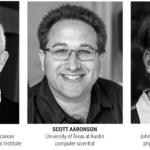
Scott Aaronson first crossed paths with Epstein as an assistant professor at the Massachusetts Institute of Technology (MIT) in 2010. One of Epstein’s emissaries took him to lunch at a Cambridge, Massachusetts, deli and then sent him an email describing how Epstein wanted to give him money to do research on cryptography using DNA and other molecules, a topic that interested both men.
Aaronson, who studies the capabilities and limits of quantum computers, did not know Epstein’s past and was initially intrigued. “I get contacted every day by random people I don’t know who claim they’ve solved the P versus NP problem [predicting how many problems are truly intractable],” he explains. “But a rich guy who potentially wanted to fund my research? That seemed unusual. I also knew that [Epstein] had some relationship with Seth Lloyd, who was my colleague at MIT.”
Instead of Googling Epstein, Aaronson, then 29, turned to what he considered an even more reliable source: his mother. She did some checking. “Be careful not to get sucked up in the slime-machine going on here,” she wrote back, adding, “Since you don’t care that much about money, they can’t buy you.”
Her wise counsel, Aaronson says, saved him from doing something he later would have greatly regretted. “If not for my mom, I might have gone and talked at a workshop to kick off the project,” he says. “I don’t think doing that would have made me complicit. But, you know, it would have been very embarrassing for me.”
Aaronson isn’t surprised that some colleagues, including Lloyd, fell into Epstein’s orbit. “Academics tend to have this way of interacting with people that works really well when there is mutual good faith,” Aaronson says. “But it breaks down when that doesn’t exist. And I think a lot of academics were just not prepared to deal with someone like him.”
Taking more time to vet potential donors is one way to avoid future scandals, Aaronson says, because there will always be financial incentives to say yes. “I’ve had federal funding in the past, but right now I don’t,” he says. “To be honest, I’d be happy to find a rich person, but one with better morals than Jeffrey Epstein.”
The physicist
Sean Carroll says he was also ignorant of Epstein’s criminal past in 2010, when someone associated with the California Institute of Technology, where Carroll was then a physics professor, invited him and his wife to dinner. His host interrupted the meal to call Epstein and then handed Carroll the phone.
“It was a 2-minute conversation, and frankly, it didn’t make much of an impression on me at the time,” Carroll says. “As best I can remember, we talked about the Big Bang and dark energy and things like that.”
But Carroll says when he told others about the call, including his wife, science writer Jennifer Ouellette, we “were rolling our eyes.” In a recent blog post, Carroll said Epstein came off as a “standard, fast-talking charlatan who trotted out lots of big words with no real understanding [of them].”
A few months later, Carroll received an email invitation to a scientific conference at Epstein’s home on his private Caribbean island. “It was billed as a workshop of scientists from different fields, something that I usually find appealing, and it sounded like fun,” he says. But he declined after learning a bit more about the arrangements.
“Jennifer was also invited,” Carroll recounts. “But when we asked if she would be a participant, they said ‘she could go shopping with the other wives.’ And we were repulsed by that sexist attitude.”
“I had no idea through any of this that he was a convicted sex offender,” Carroll adds. “That would have made it a much easier decision for me. But in 2010 he was not a famous person. If I had tried really hard, I could have found out about [his criminal record], but the thought that I would really have to try hard never entered my mind.”
Carroll says the lure of possible funding wasn’t an issue for him. “I’m not desperate for money,” he says. “And besides, at the end of your life, who you are is the accumulation of the things you did. It’s not just how much money you got.”
The spreading stain
Dozens of scientists have lost positions or seen their reputations tarnished because they socialized with and in some cases took funding from sex offender Jeffrey Epstein. In the past week, four prominent figures who had long friendships with Epstein faced professional repercussions after revelations in the latest release of material relating to the U.S. government’s investigation of the disgraced financier.
RICHARD AXEL, a Nobel Prize– winning biologist at Columbia University, is stepping down as co-director of the university’s Mortimer B. Zuckerman Mind Brain Behavior Institute “to focus on research and teaching in my lab,” he said in a 24 February statement. “My past association with Jeffrey Epstein was a serious error in judgment, which I deeply regret.” He is also resigning from his position as a Howard Hughes Medical Institute investigator.
LAWRENCE SUMMERS, an economist and former president of Harvard University, is leaving his faculty position there at the end of the academic year, the university announced on 25 February. Summers is also resigning as co-director of Harvard’s Mossavar-Rahmani Center for Business and Government in “connection with the ongoing review by the University of documents related to Jeffrey Epstein.”
MARTIN NOWAK, a mathematical biologist at Harvard, has been placed on paid administrative leave after “new information about [him] has come to light” in the latest release of Epstein documents, according to a recent statement from the dean of Harvard’s Faculty of Arts & Sciences. An investigation is underway, Dean Hopi Hoekstra said, “to determine whether Professor Nowak violated … university policies and standards of professional conduct.”
DAVID GELERNTER, a computer scientist at Yale University, is no longer teaching a computer science course this semester and “is facing a review” because of his relationship with Epstein, according to a university spokesperson. “I’ve been relieved” of teaching, Gelernter wrote to his students, the Yale Daily News reported last week. —J.M.
Jeff Mervis reports on science policy in the United States and around the world in an effort to explain to scientists how government works. He keeps a close eye on the changing fortunes of science across the federal government. He also follows efforts to improve science and math education, as well as the factors that shape the U.S. and global scientific workforce.
Mervis has reported from five continents, including Antarctica, and speaks regularly about the politics of U.S. science to both scientific and lay audiences. He's covered science policy for more than 30 years, including a stint at Nature, and joined Science in 1993.
Science has been at the center of important scientific discovery since its founding in 1880—with seed money from Thomas Edison. Today, Science continues to publish the very best in research across the sciences, with articles that consistently rank among the most cited in the world. In the last half century alone, Science published:
- The entire human genome for the first time
- Never-before seen images of the Martian surface
- The first studies tying AIDS to human immunodeficiency virus
A trailblazer in online publishing as well, the Science family of publications has grown to include online journals Science Translational Medicine, Science Signaling, Science Immunology, Science Robotics and the open access journal Science Advances.
Science Translational Medicine is an essential platform for peer-reviewed, multidisciplinary research driving the latest medical advances. Science Signaling offers original review articles, protocols and teaching resources for the growing field of cellular signal transduction. Science Immunology publishes basic, translational and clinical research specifically about immunology across all organisms and model systems, including humans. Science Robotics covers new developments in robotics and related fields, with a dual focus on the science of robotics as well as introducing researchers more broadly to how robots can be used to accelerate scientific study. Science Advances represents the next generation of online publishing, with rapid publication of significant, full-length research that is available free to readers.
The Science family of journals is published by the American Association for the Advancement of Science (AAAS), the world’s oldest and largest general science organization. The nonprofit AAAS serves 10 million people through primary memberships and affiliations with some 262 scientific societies and academies.
A voice for science and scientists everywhere, AAAS fulfills its mission to “advance science and serve society” by communicating the value of science to the public, helping governments formulate science policy, promoting advancements in science education and diversity, and helping scientists develop their careers.