
When the Pencil Was the Sword
In 2020, Democratic presidential nominee Senator Bernie Sanders was grilled by the media about his “repeated” history of praising Cuba’s education system. When the subject of Cuba came up at a Charleston, South Carolina, primary debate, Sanders was booed by some in the crowd. “Really? Really?” Sanders asked the audience. “Literacy programs are bad?”
Today socialism in Cuba hangs by a thread. In the last two years alone, the island nation has experienced a sharp drop in tourism, repeated blackouts and energy shortages, rampant inflation, and a devastating contraction in GDP. To make matters even worse, US secretary of state Marco Rubio, a Cuban American, has made no secret of his plans to follow up Washington’s successful operation to unseat Venezuelan president Nicolás Maduro with regime change in Cuba.
But for all the trials of the Cuban Revolution, its victories should not be forgotten. Despite seemingly perpetual economic crises, Cuba’s population remains one of the most highly educated in the world. And that’s entirely due to Cuba’s 1961 literacy campaign, one of the most undercelebrated accomplishments of the twentieth century.
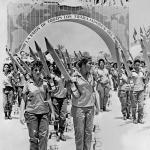
Over a period of eight months, one hundred thousand youths aged ten to nineteen volunteered to live and work in the countryside as part of a program that would teach, in total, seven hundred thousand people across the country to read and write at a first-grade level. The campaign, which also assigned a smaller number of young people to teach in urban areas, all but eliminated illiteracy on the island. Reflecting on the campaign more than forty years later, Gladys Bermello Lastra, who left her home in Havana to teach rural adults as a middle-class seventeen-year-old, called it a “triumph of humanity.” It was a demonstration of what multiracial, urban-rural, and gender solidarity looked like in the creation of a newly socialist society — one that had to simultaneously defend against violent attacks from US-backed forces.
Those forces would succeed in murdering several of the young volunteers, who were often known in rural areas as the Conrado Benítez Brigade. Their namesake, Benítez, had been working on the literacy campaign in the Escambray Mountains when he was murdered in 1961 at just eighteen years old. That counterrevolutionary danger, combined with the challenges of working in places that had no running water or electricity and scant food rations, had a fortifying effect on the youth. As adults, many participants looked back on the experience as one of complete trans-formation.
“The best thing that I have ever done in my life was the literacy campaign,” said Flérida Stuart, one of a hundred former participants interviewed for the documentary film Maestra, which highlights the stories of women who took part in the campaign. Another volunteer from that group said:
I was twelve years old, and at that time I didn’t have the foggiest idea that this would be something historic. I just felt that I was doing something good, and that I was giving something to others. I will never forget that some people risked their lives to defend us and support us, because it was dangerous. Sharing what you have with others makes you a better human being.
Esther Pérez, another interviewee, said:
Our country was changing before our eyes, and now young people were being called to participate in a transformation that we knew was transcendental: eliminating chronic illiteracy. It was a huge goal in itself, but also a symbol of the new direction we could give our country through our own efforts. It was a radical break with the past, and it was much more.
Another former participant said:
At that age, who doesn’t have a year to give? It was a brilliant idea and it took root in the spirit of young people, who were eager to take part in heroic, altruistic actions. The revolution gave each of us the opportunity to be a person, to become men and women. Young people need great tasks and noble actions that make them grow.
In the same year as the literacy campaign, Cuba nationalized its private schools and developed a fully funded, high-quality universal education system for which it is today recognized around the world. Longtime education writer and activist Jonathan Kozol praised Cuba’s school system in his 1978 book Children of the Revolution: A Yankee Teacher in the Cuban Schools, which was based on two visits he made to the island to interview teachers and students there in the 1970s. “There is a sense, within the Cuban schools, that one is working for a purpose,” he wrote, “and that that purpose is a great deal more profound and more important than the selfish pleasure of an individual reward.”
Announced in a 1960 United Nations speech by Fidel Castro, the literacy campaign was a natural outgrowth of the educational efforts of the revolutionary army led by Castro and Che Guevara, who both came from middle-class backgrounds and had been educated as a lawyer and a medical doctor, respectively. During the fight to oust Fulgencio Batista, they had set up schools to teach the peasant combatants to read and write. One former brigadista recalled almost fifty years later:
I was 16 years old, and Fidel said in a speech that a literacy campaign would be carried out as a continuation of what had been done in the Sierra Maestra mountains during the war. He said that volunteer teachers were needed to do that work, and that it would begin in Minas del Frío. I was at home, and right there and then I said, “As soon as we can sign up, I’m in.”
Sergio Ballester Pedroso, a brigadista at age twelve who later became a professor of pedagogy, recalled similar enthusiasm: “If I could not defend the revolution with arms, then I was going with pencils. I joined the campaign late. Although without the consent of my mother, my father signed my consent form.”
The pedagogy developed during the literacy campaign was later exported to more than a dozen other countries. But Cuba’s literacy outreach is just one part of its impressive internationalism. Since 1963, Cuba has regularly sent medical doctors all over the world to countries in need. Medical internationalism also includes emergency response medical brigades, the provision of health care to foreign patients on the island, and the training of medical personnel in Cuba and abroad. Notably, the Latin American School of Medicine in Havana, which provides scholarships to low-income students, has educated some of the 1,500 Palestinian students who have gone to study in Cuba since 1974. In 2024, Cuba’s president, Miguel Díaz-Canel, awarded two hundred new medical school scholarships to Palestinian students, a rare demonstration of solidarity with a society whose medical infrastructure has been decimated by genocide. Marta Placeres Hernández, who grew up in a rural area without a school and learned to read and write at age eleven during a pre-1961 trial phase of the campaign, said of the country’s ongoing internationalism, “I believe that the campaign here has never ended.”
Amassing this youthful army of educators, however, was no easy task. It would take hundreds of thousands of teachers to instruct hundreds of thousands of pupils. Professionals had to give the young student teachers a crash course in literacy pedagogy as well as instruction in health matters and how to approach reluctant adult learners. Most members of the teaching profession participated, even as the country experienced a large exodus of professionals of all kinds. Thirteen thousand workers would also sign up to be volunteer literacy teachers. But beyond teaching, the campaign needed people to build bridges, drive trucks to transport volunteers into the countryside, carry out a publicity effort via radio, television, newspaper, and billboards, and even conduct a census to identify as many illiterate people as possible. Richard R. Fagen estimated in his 1969 book about revolutionary Cuba that, apart from the two million people who were too young to participate, “one out of four [people] participated directly” in the campaign.
Women in particular recalled how they had to challenge both their parents’ and their culture’s gender expectations in order to participate. One explained, “It was a real battle for me with my family; they didn’t want me to go because I was a girl. But my mom had been a combatant with the Rebel Army. I was very young and I became part of that history.” Another said, “I was deeply convinced, and my mom didn’t object in any way. But my dad said, ‘Fine, let her go. She’ll be back in two weeks.’ At the age of 14, I had never even slept over at my grandmother’s house. I had never been away from home.”
Another participant recalled how the campaign helped women progress toward gender equality:
I’d say that this [campaign] had an enormous impact on women in Cuba, because they could then take on the same activities as men. Before, [women] only knew how to take care of the household, the family. Before, women were subordinate to men! Afterwards, [women] could participate more fully in society.
One woman related how dangerous things got in April of 1961, around the start of the campaign:
I was there during the Bay of Pigs invasion, and my husband also was there with my three kids. In the afternoon a militia member came to tell me that we were in a war zone and that I had to make a decision [whether to stay]. I stayed, and the militia members taught me how to handle a submachine gun in case the enemy forces showed up, but they didn’t.
René J. Mujica, who was a brigadista at age twelve and whose brother, at age sixteen, was active in the Escambray Mountains against the counterrevolutionary forces, said that the campaign had been the single most important experience of his life. It had “profoundly” impacted him by allowing him to see poverty, which he had not seen before, and to understand how important it was that poverty be addressed by society. Another brigadista spoke of another kind of important personal transformation, saying, “I was very shy. I was embarrassed even to greet people. The literacy campaign made me into a different person, because I felt useful, I felt needed. Without realizing it, you change because you know that you’ve done something important.”
Others had reflections on the challenges and rewards of teaching. “Some people learned how to read in a week, while for others, recognizing vowels was the hardest thing they had ever done in their lives,” one said. “It was incredible when they learned how to write their names for the first time. It was like they discovered themselves,” said another.
Another impressive feat of the campaign was that it provided eyeglasses for those who needed them. Eye doctors went out to assess the learners, and the campaign mobilized resources to manufacture 177,000 pairs of eyeglasses.
There was a little old man named Juan who wanted to read and write. Somebody told us that he was too old, but we said: “If he wants to learn, that’s what we’re here for, isn’t it?” It became evident that he couldn’t see very well. We took Juan to the ophthalmologist and they checked his eyes and gave him glasses. I will never forget the look on his face.
The story of how Cuba’s youth shaped the revolution is not only important for the history of socialism. It also sheds light on how our society might orient differently, in a more collaborative way, toward young people. The literacy campaign was a pivot, a movement of humanity in the direction of what might be considered solidarity with youth. Cuba’s young people were treated as valuable members of society in their own right. Revolutionary Cuba recognized and mobilized a great internal source of wealth, the talents of its young, and put it to good use for the benefit of the entire nation.
===
Lily Sánchez is a writer, editor, and medical doctor.