
Global Left Midweek — April 1, 2026
- Declaration: First International Conference Against Fascism
- Argentinians Continue to Defy Milei
- Largest Climate Alliance Denounces War on Iran
- Eastern Europe: Women in Digital Showdown
- Canada’s New Democratic Party Faces an Impasse
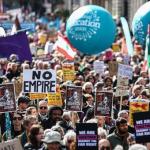
- March 28: ‘No Pasaran’ in London, 500k Strong
- South Africa: The Left and Xenophobia
- Gig Workers Mobilize in Indonesia
- Cuba: “Democracy is Not an Abstract”
- Lessons of the French Elections
[Moderator’s note: Last week Global Left Midweek listed a piece on Cuba that, before deadline, had only appeared in Spanish. An English translation is now available, and we urge you to read it in full: Cuba at the Crossroads of a Bogus Multilateralism.
__________
Declaration: First International Conference Against Fascism
Antifascist Conference for the Sovereignty of Peoples, Porto Alegre
Thousands of activists from more than forty countries across five continents celebrate our unity in diversity, seeking to advance organization for resistance and the struggle against the various forms of fascism, the far right, and imperialism in its most aggressive phase.
__________
Argentinians Continue to Defy Milei
Buenos Aires Times
A huge crowd descended on the Plaza de Mayo in Buenos Aires to mark 50 years since the March 24, 1976 coup d’état that brought Argentina’s military dictatorship to power. Journalists and photographers said it was likely one of the biggest rallies the capital has seen in years, with tens of thousands of people in attendance.
__________
Largest Climate Alliance Denounces War on Iran
Climate Action Network International (Bonn)
Climate Action Network (CAN) is a global network of more than 1,900 civil society organisations in over 130 countries driving collective and sustainable action to fight the climate crisis and to achieve social justice. CAN convenes and coordinates civil society at the UN climate talks and other international fora.
__________
Eastern Europe: Women in Digital Showdown
Megi Reci / Balkan Insight (Sarajevo)
On March 8, women across the Western Balkans and Turkey took to the streets to demand their rights, including in the digital sphere. They also raised their voices against war, abuse and oppression. In response, they faced waves of sexist attacks and gendered disinformation online, symptomatic of the rising anti-gender movement in the region.
__________
Canada’s New Democratic Party Faces an Impasse
Marcel Nelson and Nathan Rao / Midnight Sun (Winnipeg)
[Moderator’s Note: On March 29, Avi Lewis won the race to lead the New Democratic Party (NDP) with 56% of the vote.]
Avi Lewis’s campaign for the leadership of the NDP has attracted much attention, dedication, and debate. Lewis has won the support of many left organizers in part because he’s taken bold and promising policy positions on important questions.
__________
March 28: ‘No Pasaran’ in London, 500k Strong
__________
South Africa: The Left and Xenophobia
Imraan Buccus / Mail and Guardian (Johannesburg)
Xenophobia sits at the centre of right-wing politics globally. In South Africa, parties such as ActionSA and the Patriotic Alliance follow a similar script to figures like Donald Trump. The uMkhonto weSizwe party combines elements of authoritarian nationalism with xenophobic rhetoric. This is particularly concerning given its ethnic framing, militarised posture and association with violence.
__________
Gig Workers Mobilize in Indonesia
Arif Novianto and Raymond J. Kusnadi / Asian Labour Forum (Jakarta)
In Indonesia, ride-hailing drivers demanded the Religious Holiday Allowance, a legally mandated annual bonus equivalent to one full month’s wage for formal workers. The fight is not merely for an extra payment but a broader political confrontation over worker classification, state responsibility, and the meaning of enforceable social rights in the platform economy.
__________
Cuba: “Democracy is Not an Abstract”
Isaac Saney and James Counts Early / MR Online (New York)
Amid one of the most severe economic moments since the triumph of the Cuban Revolution, and under the weight of a suffocating, ever-expanding U.S. imperial siege, Cuba is consciously and systematically expanding and deepening citizen involvement in deciding the country’s economic and political future.
__________
France’s Municipal Elections: Left Disunity Prevails
Roger Martelli / Regards (Paris)
[Note: This article has been electronically translated. Read the original in French here.]
If we are to believe the party spokespeople, everyone has won. A closer look reveals, however, a fragmented political landscape, with some precarious trends, not all of which are encouraging.
In both the first and second rounds, voter turnout did not return to its 2014 level, which itself had been declining in previous municipal elections. There was a time when, in densely populated cities, municipal teams were elected by only 10 to 15% of the voting-age population. Since then, this pattern has spread across the entire country, and the phenomenon has intensified, with the rise in three-, four-, and even five-way races. This further erodes the legitimacy of those in power and exacerbates the crisis of representation.
Overall, the political landscape has not been overturned, but it has rather deteriorated on the left. If we take those cities with more than 50,000 inhabitants, we see that about thirty have changed their political affiliation: about fifteen in favor of the center-right, eleven in favor of the left and three in favor of the far right.
The increase in numbers is not a revolution. Rather, it is the internal balance of power within the major political families that is shifting. The Socialist Party (PS) certainly remains the strongest force on the left. It retains its crown jewels, sometimes brilliantly: Paris, Marseille, Nantes, Montpellier, Lille, and Rennes. It gains Saint-Étienne and Pau. But it loses Saint-Denis, Clermont-Ferrand, and Brest.
The Greens and the Communist Party (PCF) fared the worst. The Greens surprised everyone by retaining Lyon, but lost Bordeaux, Strasbourg, Annecy, Besançon, Colombes, and Poitiers. The PCF, for its part, regained most of its 630 municipalities. It recovered Aubagne and Nîmes, but ultimately failed to recapture Le Havre, Saint-Pierre-des-Corps, Champigny, Sète, or Arles. It lost about forty municipalities, including five to the National Rally (notably Vierzon and Lillers). Vénissieux, Champs-sur-Marne, Rive-de-Gier, Pont-du-Château, Somain, and Douchy-les-Mines are no longer communist-run.
There will be no mayors from La France Insoumise in Toulouse or Limoges, but the party is establishing itself in the suburbs. When it makes it to the second round, it more or less recovers its first-round scores in cities safe from right-wing influence. It even gains ground in some cases, as in Lille. With the exception of Roubaix, won from the center, it is the left that bears the brunt of its progress, both the Communist Party and the Socialist Party (Saint-Denis, Vaulx-en-Velin). LFI is beginning to overcome its municipal weakness, and it is doing so in traditionally left-wing areas, not in the strongholds of the right and the National Rally.
As for the National Rally (RN) and its allies, their failures in major cities, with the exception of Nice, are rightly emphasized. But this underestimates their continued entrenchment beyond these areas, as illustrated by their gains in Carcassonne, Castres, Carpentras, Liévin, Agde, Orange, La Flèche, and Montargis. The upper echelons of urban France continue to elude Jordan Bardella’s party, but not the medium-sized and small towns, where it is vying for ground with other components of the French right.
Who can stop the surge of the National Rally, which, as in 2024, is proving ultimately resilient? Coming out of the municipal elections, the Republicans and the so-called centrist movement (reinvigorated by Édouard Philippe’s success in Le Havre) appear best positioned to do so. But the elections have exposed the depth of their divisions, even in the second round. As for the left, it ultimately fared better than some predicted. In reality, it finds itself in a precarious situation.
Overall, its first-round results did not lift it out of its predicament. But in the second round, while maintaining its position at the top of the urban pyramid, it nevertheless lost some cities or failed to win back others, even though the first-round results gave it a numeric majority. In some cases, disunity can explain the disappointment: this is the case, for example, in Saint-Brieuc, Champs-sur-Marne, and Kremlin-Bicêtre.
However, when the alliance was formed between the two rounds, it had divergent effects. It worked in Nantes, Lyon, Grenoble, and Tours, but not in Limoges, Clermont-Ferrand, Brest, Poitiers, Besançon, Toulouse, or Tulle. Why? Probably because the alliance alone is not an explanatory factor. The party affiliation of the lead candidate certainly played a role, particularly when members of La France Insoumise held that position, as in Toulouse and Limoges. But we cannot ignore the need for renewal that the population expected from the left, a need that the incumbent left either failed to recognize or adequately address before the decisive round.
Beyond this, the question arises of the perceived sincerity of the alliance. When Socialists and members of La France Insoumise spend a large part of their campaign time distancing themselves from one another, often vehemently, their sudden reunion leaves a portion of their potential electorates perplexed. In their own way, Grégoire in Paris and Payan in Marseille felt that the foundations of the alliance were not credible enough to make it attractive and manageable beyond the election period. One can then hypothesize that it was easier and more credible for Greens and members of La France Insoumise, or Communists and members of La France Insoumise, to come together than for members of La France Insoumise and Socialists.
From this, we can outline two consequences. The first is that it is better to resolutely distance ourselves from the culture of the two irreconcilable lefts. This culture carries within it the seeds of certain defeat, sometimes at the local level, more certainly at the national level. On the issues of equality, citizenship, and solidarity, nothing irrevocably separates the lefts. The left must therefore find or rediscover a shared culture, one that does not obscure the differences between the various lefts, without ever forgetting the passion for unity.
And in order that the necessary rapprochements do not appear improvised, or even opportunistic, it is vital to make permanent substantive debate a continuous practice, on the aims, the values, the societal project and on a strategy making changes, partial or global, possible.