
This Week in People’s History, April 1–7, 2026
The Many Roots of ‘We Shall Overcome’
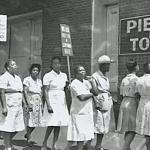
APRIL 1 IS THE 80TH ANNIVERSARY of the end of what is said to be the largest strike ever in Charleston, South Carolina. The strike, by 1,400 members of the Food, Tobacco, and Agricultural workers union, most of whom were Black women employees of the American Tobacco Company.
After five months on the picket line, in 1946 the workers won two important victories, an 8-cent-an-hour raise (worth $1.35 today) and the company’s agreement to end its Jim-Crow promotion practices, which was no mean feat in the city where the Civil War’s first shot was fired.
But perhaps even more important, during the strike the union members reworked and recombined musical and lyrical elements from an 18th-century Catholic hymn, a pre-Civil War work song, and a 1901 gospel hymn into a new song, “We Shall Overcome”, which became the sound-track of their picket line in Charleston, and soon the anthem of countless picket lines, in support of struggles for both labor and civil rights.
Pete Seeger and the Highlander Folk School in New Market, Tennessee, helped to introduce the world to “We Shall Overcome’ by publishing these easy-to-recall lyrics: 1. We shall overcome… 2. We’ll walk hand in hand… 3. We shall live in peace… 4. We shall all be free… 5. We are not afraid… 6. We shall be like “Him”… 7. We shall stand together… 8. We shall work together… 9. The Lord will see us through… 10. We shall end Jim Crow… 11. The truth will set us free… 12. The whole wide world around… 13. Black and White together… 14. Love will see us through… 15. We shall stand together… https://blackpast.org/african-american-history/the-charleston-cigar-factory-strike-1945-1946/
The Union Wins Big at Ford
APRIL 2 IS THE 85TH ANNIVERSARY of the beginning of a 10-day strike by the United Auto Workers against Ford that ended when the Ford Motor Company agreed to recognize the union, any union, for the first time ever. General Motors had recognized the union in 1937, as did Chrysler in 1939.
For four decades, Henry Ford, the founder of Ford Motor Company, had never met with any union official. Now he agreed to allow all the strikers to return to work, to come to an agreement with the union about a grievance procedure, and to abide by the result of what would be the largest collective bargaining election in the history of the National Labor Relations Board, when 85,000 Ford workers would chose whether to be represented by a union.
Less than three months later, on June 20, 1940, Ford Motor Co. and the United Auto Workers signed their first contract, covering 130,000 workers all over the country. The union won wages equal to the highest in the auto industry, a closed shop, and a dues check-off. https://jacobin.com/2023/10/united-autoworker-ford-black-detroit-race-labor
A Riot Teaches Important Lessons
APRIL 3 IS THE 90TH ANNIVERSARY of the completion of an intense and critical year-long study of social and economic conditions in Harlem, New York, which was produced at the request of Mayor Fiorello La Guardia after a major riot.
Enraged by what turned out to be a false rumor that a cop had killed a young shoplifting suspect, thousands of rioters, most of them African-American, targeted hundreds of stores, where they smashed display windows and stole merchandise, causing more than a million dollars in damage over a day and a half. It was New York City’s biggest civil disturbance in nearly 35 years.
The study, which was finished in 1936, emphasized that before the riot started, the residents of Harlem had been traumatized by more than five years of the Great Depression, which hit the Black population of the U.S. extraordinarily hard. The surprising thing about the outburst of violence was not that it happened, but that it had not happened months or years earlier.
Wave after wave of lay-offs had produced an unemployment rate for New York City Blacks at least twice that of the white population. The squeeze caused by unemployment, lack of affordable housing and racial discrimination in the availability of welfare support payments was causing malnutrition that was literally killing Harlem residents, who were experiencing a death rate 65 percent higher than the city as a whole. Harlem was like a powder keg, and the rumor was the spark that set it off.
Part of New York’s establishment blamed the violence on Harlem residents and on radicals among them, who had been organizing in Harlem for years. Even before the violence was over, the district attorney announced, “My purpose is to let the Communists know that they cannot come into this country and upset our laws. From my information Communists distributed literature and took an active part in the riot.”
But La Guardia, New York’s New Deal-inspired mayor, had a more enlightened view of the unrest’s cause. Immediately after the riot, La Guardia set up the Mayor’s Committee on Conditions in Harlem, headed by African-American sociologist E. Franklin Frazier, with members including Judge Hubert Thomas Delany, Countee Cullen, and labor leader A. Philip Randolph. The committee held extensive hearings during which it took testimony from a wide spectrum of New Yorkers and produced a 132-page report, “The Negro in Harlem: A Report on Social and Economic Conditions Responsible for the Outbreak of March 19, 1935”, which described the rioting as "spontaneous" with "no evidence of any program or leadership of the rioters".
The report concluded that “this sudden breach of the public order . . . among the colored people of Harlem [was] due in large part to the nervous strain of years of unemployment and insecurity [and] their deep sense of wrong through discrimination against their employment in stores which live chiefly upon their purchases, discrimination against them in the school system and by the police, and all the evils due to dreadful overcrowding, unfair rentals and inadequate institutional care. It is probable that their justifiable pent-up feeling that they were and are the victims of gross injustice and prejudice would sooner or later have brought about an explosion.”
"It is a grave state of affairs,” the report stated, “when the inhabitants of a large section of the city have come to look upon the men in police uniforms as lawless oppressors who stop at no brutality or at the taking of human life. . . . The existence of intense hostility on the part of the law-abiding element among the colored people is proof positive that there is something seriously wrong in the attitude of the officers toward the people whom they are there to serve and to aid and not to browbeat of abuse.” It also noted that the rioters had focused almost all their attacks on property and not on individuals, white or Black. The report even congratulated Communists as deserving "more credit than any other element in Harlem for preventing a physical conflict between whites and blacks".
With the committee report in hand, La Guardia and his administration, as well as the state government, shifted a significant quantity of resources toward reducing many of the shockingly discriminatory aspects of the city’s employment, housing, healthcare, recreational, and educational policies that the report identified. https://www.harlemindisorder.org/archive/documentation.html
‘Are You Now or Have You Ever Been . . .?’
APRIL 4 IS THE 60TH ANNIVERSARY of a U.S. Supreme Court ruling that has for six decades put a considerable dent in the right of a legislature or legislative committee to demand a witness respond to the question “Have you ever been a member of [any particular organization].”
For many years the House Un-American Activities Committee and the Senate Internal Security Committee had made a regular practice of asking disfavored individuals that kind of question and then charging the witness with contempt if they refused to respond.
In their 1966 decision in DeGregory v. Attorney General of New Hampshire, the Supreme Court ruled by a 6-3 decision that the First Amendment requires a state to justify the need to ask a person about his or her political activities before it can punish the witness for refusing to answer. https://www.wiley.law/newsletter-Apr_2019_PIF-The-First-Amendment-Right-to-Political-Privacy-Chapter-7-In-Need-of-Judicial-Clarity
When Anti-Apartheid Actions Made a Difference
APRIL 6 WAS THE 40TH ANNIVERSARY of the last day of Weeks of Anti-Apartheid Action that began on March 21, 1986.
During the 17-day period, anti-apartheid actions took place in 35 states and erected shantytowns replicating the housing conditions of South African blacks on 15 college campuses. The administrations of many colleges and universities were pressured to end all investments in South Africa and to stop doing business with companies linked to South Africa.
The University of California campus in Berkeley was the site of a series of bitter clashes between students and police over student demands that UC divest itself of $2.4 billion in South Africa-related investments. More than 150 students were arrested.
All the efforts to promote university divestment had substantial success. During the 12 months leading up to the Weeks of Protest, at least 29 schools had agreed to divest all South Africa-linked holdings, adding up to a total divestment of some $200 million in investments.
IBM was one of the major targets of the push for an end to support for South Africa. A dozen students in Portland, Oregon, were arrested for an IBM office sit-in. A hundred students and local residents picketed IBM’s East Coast headquarters in Poughkeepsie, New York. Shell Oil, which was designated by the Free South Africa Movement and the AFL-CIO as the target of a national boycott, was picketed daily in Houston, Texas and New York City.
In Atlanta on April 4, the anniversary of Martin Luther King, Jr’s assassination, demonstrators placed a wreath on his grave and then marched to Coca-Cola to protest the company’s large South African operation. https://americanarchive.org/primary_source_sets/anti-apartheid-movement
Bostonians Split Over Fugitive Slave Act
APRIL 7 IS THE 165TH ANNIVERSARY of a day when the bitter antagonism between Boston abolitionists and the city’s pro-slavery faction, led by bankers and merchants who were financially linked with the South’s slavery-based economy, came close to exploding.
The immediate cause for the clash was the arrest, under the 7-month-old Fugitive Slave Law, of Thomas Sims, who was accused of having emancipated himself from slavery in Georgia and stowing away on a Boston-bound merchant ship.
Sims was the fourth person accused of being a fugitive slave who had been arrested or threatened with arrest in Boston since the Fugitive Slave Law’s enactment the previous September, and the city’s well-organized abolitionists had used force or the threat of force to make it possible for the first three to flee the U.S. and become immune from arrest.
Boston’s pro-slavery faction was determined to prevent the escape of a fourth accused fugitive. “It had become a matter of pride” among some “that a fugitive should be seized in Boston and taken back to slavery.”
Under the Fugitive Slave Law, Sims was entitled to a brief hearing to decide whether he might be a fugitive slave, City officials, who were determined to enforce the law, surrounded the courthouse with more than 500 police and civilians who had been deputized for the occasion. Hundreds of abolitionists gathered to protest the proceedings, but they lacked the numbers needed to pose a challenge.
The court found that Sims was subject to rendition to Georgia. On April 12, more than two hours before dawn, he was surrounded by some 300 police and marched to a ship in the harbor. As he began his journey back to enslavement, the abolitionists present cried out, “Sims, preach liberty to the slaves!” https://www.journals.uchicago.edu/doi/10.2307/2715559
For more People's History, visit
https://www.facebook.com/jonathan.bennett.7771/