
This Week in People’s History, Apr 22–28, 2026
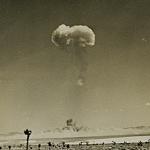
Nuclear War in the Living Room (1952)
APRIL 22 IS THE 74TH ANNIVERSARY of a major publicity coup, when the U.S. Department of Defense and the military-industrial complex spared no expense to bring live TV images of an atom bomb blast “into millions of homes.” The images of the 1952 explosion were a vivid reminder of the danger of nuclear war and the need for taxpayers to tolerate the federal government’s diversion of hundreds of millions of dollars into the pockets of the weapons industry.
National broadcasts carried by all three television networks were unusual enough to catch the public’s interest. An hour-long, live broadcast from the middle of the Nevada desert had never been attempted before. In order to make it possible, the networks and the Pentagon had to collaborate on the construction of three microwave relay transmitters to carry the images and sound 300 miles from Yucca Flat, Nevada, to Los Angeles.
To underline the message that the Nevada test had a major public-relations aspect, the National Association of Civil Defense directors had scheduled their annual meeting in San Francisco to take place at the same time. During the meeting, the Federal Civil Defense Administrator said, “I don’t believe anyone who saw the explosion will remain unimpressed with the possibility of an atomic attack.” https://thenevadaindependent.com/article/complicated-legacy-of-nuclear-testing-in-nevada-lives-on-in-bodies-politics
Virginia School Integration Came Hard (1951)
APRIL 23 IS THE 75TH ANNIVERSARY of a watershed moment in the struggle against segregated schools in the former Confederate states. It began with a mid-day walkout, led by 16-year-old Barbara Johns, by most of the 450 students at Farmville, Virginia’s, all-Black segregated high school.
The students marched to the county courthouse in the center of town, where they told the Superintendent of Schools that they were fed up with their school’s substandard conditions. In stark contrast to the spacious all-white high school across town, the Black students had to endure gross overcrowding, lack of teachers, lack of heat, and roofs so leaky that students and teachers needed umbrellas to stay dry in class when it rained.
The student strike continued for two weeks, long enough to come to the attention of the NAACP Legal Defense and Educational Fund office in Richmond, Virginia’s capital. After the striking students and their parents met with LDEF representatives, they filed a lawsuit demanding an end to Virginia’s bogus claim that it provided “separate-but-equal” educational services to students of all races.
The students' struggle to receive quality education continued without success for years. After a federal court dismissed their lawsuit, it reached the U.S. Supreme Court in late 1952, where it was consolidated with four other legal challenges to school segregation into the case known as Brown v. Board of Education. In May 1954, three years after the student walkout in Farmville, the Supreme Court issued its unanimous decision that “separate-but-equal” education was unconstitutional, because separate educational programs were never equal in fact.
When Virginia officials were ordered to integrate the public schools, they took the extreme step of closing all public schools in Prince Edward County. Then they opened “private,” schools for whites only and provided no education for Black students until 1964, when they were finally compelled by court orders to educate all students in integrated schools.
Thirteen years after Barbara Johns and her classmates first demanded access to quality education, they began to actually attain their goal. https://archive.org/details/theyclosedtheirs00smit/page/n5/mode/2up
U.S. Out of Vietnam! (1971)
APRIL 24 IS THE 55TH ANNIVERSARY of huge demonstrations against the Vietnam War in both Washington, D.C., where a half a million people protested, and in San Francisco, where 125,000 rallied. The protest in Washington was the largest-ever against a U.S. war. For much more detail and many images of both 1971 events, visit https://www.zinnedproject.org/news/tdih/anti-war-protests-dc-sf/
Springsteen Channels Seeger (2006)
APRIL 25 IS THE 20TH ANNIVERSARY of Bruce Springsteen’s album, “We Shall Overcome: The Seeger Sessions.”
The album, which won the 2007 Grammy Award for Best Traditional Folk Album includes Springsteen’s interpretations of 13 folk songs that had first been made popular by Pete Seeger: Old Dan Tucker, Jesse James, Mrs. McGrath, O Mary Don't You Weep, John Henry, Erie Canal, Jacob's Ladder, My Oklahoma Home, Eyes on the Prize, Shenandoah, Pay Me My Money Down, We Shall Overcome and Froggie Went A-Courtin'.
You can listen to all of the album’s songs here: https://youtu.be/OG1ctA7FXyU?si=O9vgwH5F1xc71B_M
Take Your Blacklist and Shove It! (1951)
APRIL 26 IS THE 75TH ANNIVERSARY of an unusually well-publicized rejection of the worst aspects of McCarthyism in the entertainment and broadcasting industries.
In September 1950 the American Legion had accused Gypsy Rose Lee of being pro-communist and demanded ABC cancel her weekly radio quiz show.
Then in 1951, when professional blacklisting was fast becoming the routine practice of the heads of broadcasting organizations, the annual Peabody awards for the broadcast media took the unusual step of honoring the American Broadcasting Company for taking a “courageous stand resisting organized pressure and its reaffirmation of basic American principles.”
The award said: “At a time when radio stations and networks were either firing or refusing to hire writers and actors on the basis of the unsupported innuendoes contained in a publication known as ‘Red Channels,’ Robert Kintner, president of A.B.C. and his associates, Robert Saudek and Joseph A. McDonald refused to be stampeded into either action. Mr. Kintner publicly stated his faith in Gypsy Rose Lee, one of the entertainers mentioned in ’Red Channels’ and kept her on the air despite an attempt by the American Legion to have her banned.” https://portside.org/2018-10-12/how-communist-blacklist-shaped-entertainment-industry-we-know-it
Building U.S. Prison Camps in 1951
APRIL 27 IS THE 75TH ANNIVERSARY of FBI Director J. Edgar Hoover telling a subcommittee of the House Appropriations Committee that the FBI knew the identities of 43,217 members of the U.S. Communist Party. He also said that the FBI had “thoroughly investigated” some 14,000 party members and considered them so “dangerous” that the FBI planned to arrest each of them in the event of a war between the U.S. and the Soviet Union.
The McCarran Act, which was passed by Congress over President Truman’s veto on September 23,1950, authorized the FBI to arrest "each person as to whom there is a reasonable ground to believe that such person probably will engage in, or probably will conspire with others to engage in, acts of espionage or sabotage" in the event of war.
In 1951, at the same time Hoover testified about Communist Party membership, he requested that Congress appropriate $775,000 (the equivalent of $10 million of today’s dollars) to pay the cost of converting abandoned military camps into prison camps for those the FBI planned to arrest. On November 1, 1951, Congress appropriated the sum that the FBI requested.
The McCarran Act’s detention-on-suspicion provision was repealed by the Non-Detention Act, which went into effect September 25, 1971. https://www.crmvet.org/docs/nor/eclc/6205_rights_eclc.pdf
No Job Is Worth Dying For (1971)
APRIL 28 IS THE 55TH ANNIVERSARY of the day the U.S. Occupational Safety and Health Act went into effect, when OSHA began to carry out its responsibility “to assure so far as possible . . . safe and healthful working conditions [for] every working man and woman in the Nation.”
In theory the OSH Act ensures that every U.S. worker has the right to a work environment that is free of hazards that are known to cause injury, illness, or death. Unfortunately it is almost impossible for a worker who is not covered by a union contract to enforce the right to a safe and healthful job. Hence, despite the OSH Act’s promise, April 28 was christened Workers’ Memorial Day in 1989 by the AFL-CIO.
It is a day to remember workers who have been killed, injured or diseased on the job and to highlight actions needed to prevent such tragedies. In addition to being the anniversary of the OSH Act, April 28 is the anniversary of the enactment of Canada’s federal workers’ Compensation law.
On Workers’ Memorial Day the AFL-CIO and Canadian Labour Congress try to bring the magnitude of workplace injuries and disease to the public’s attention and to gain support for the labor movement’s efforts to improve workers’ safety and health. In 2024, nearly 5500 U.S. workers were killed on the job, an average of one death every 96 minutes. For much more information, visit https://aflcio.org/dotj-2024
For more People's History, visit
https://www.facebook.com/jonathan.bennett.7771/