
How a Determined Scholar Captured the Breadth of Blackface

In 2013, Rhae Lynn Barnes was a 25-year-old history graduate student on a visit to the grand headquarters of the Elks Club in Chicago. She had put on her most professional suit and had her hair done.
“I wanted to look as serious as possible,” she recalled.
She knew the group, founded in New York City in 1868 as the Jolly Corks, had roots intertwined with blackface minstrelsy, which ruled the stages of northern cities in the decades before and after the Civil War. And in the club’s museum, there was plenty of memorabilia of minstrel shows, including blackface photographs.
But when Barnes asked if she could access the club’s private library and its historical membership rosters, she was denied.
“They were immediately like, ‘Who are you? What are you doing here?’” she said. “And then they called security and escorted me out.”
She started looking for information in other ways, including zooming in on the lapel pins in photographs of early Elks, which indicated lodge, rank and initiation year. Ultimately, she drew up a list of roughly 400 early members.
“I realized there was pretty much nobody who is a famous 19th-century minstrel performer who was not an Elk,” she said. “It just became synonymous.”
The visit to Chicago was neither the beginning nor the end of Barnes’s digging. In her new book, “Darkology: Blackface and the American Way of Entertainment,” she lays out the fruits of nearly two decades of scouring archives, eBay and estate sales, tracing a long, lurid tradition of amateur blackface performance that stretched deep into the 20th century, and seemingly into every corner of the country.
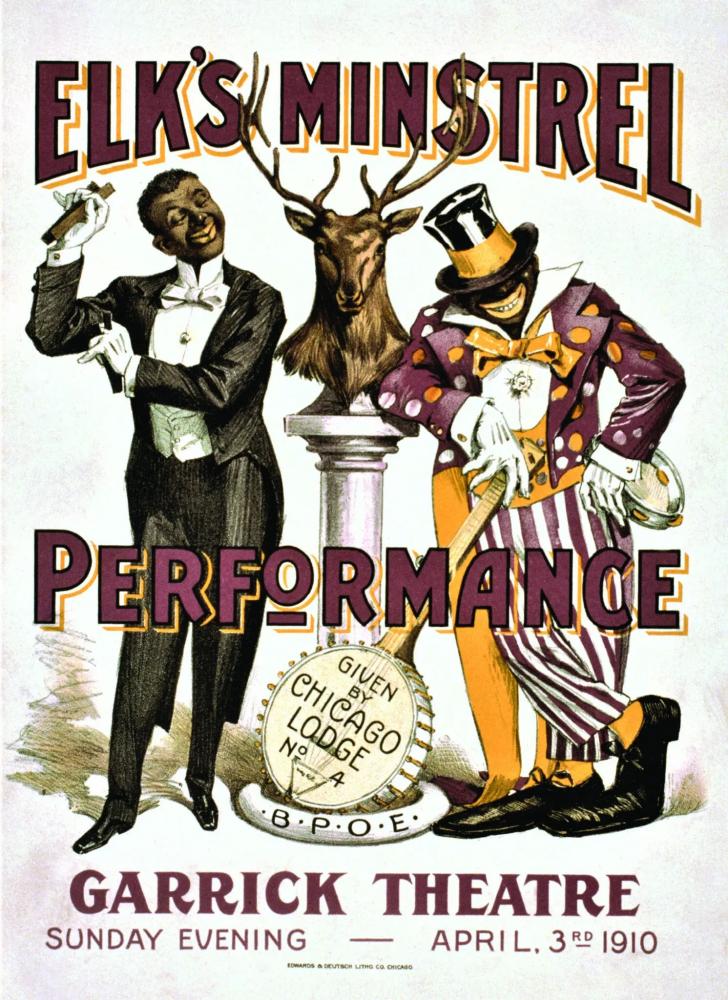
A poster for a 1910 blackface performance presented by an Elks lodge in Chicago. Rhae Lynn Barnes Family Blackface History Collection
She chronicles minstrel performances at fund-raisers for politicians, police forces and medical charities (including one cowritten by Franklin Delano Roosevelt). Government-sponsored minstrel shows at World War II-era military bases, and even in Japanese American internment camps. Annual blackface shows at elementary schools and community centers from small-town Maine to suburban California.
Scholars have estimated there were perhaps 20,000 professional blackface performances in 19th-century New York. But in the 20th century, Barnes writes, millions of ordinary Americans got into the act.
“All of a sudden, you are physically inhabiting and memorizing and singing these songs,” Barnes said. “And your wife or your mother or your Girl Scout leader is physically drawing onto your face what they think is a funny representation of Blackness.”
‘Consumed’ with counting
Blackface might seem like an awkward subject for a white scholar in an era when the right to tell particular stories, or particular histories, is sometimes questioned.
But Barnes, now a 38-year-old assistant professor of history at Princeton, said the question misconstrues the nature of blackface — which is white people’s creation, and white people’s problem.
“Dismantling white supremacy, as a white person, should be my responsibility,” she said.
Barnes grew up in Anaheim, Calif., in what she describes as an artistic, questioning family. Michael Jackson’s “Black or White” was all over the radio, but older, queasier representations of race were still hiding in the cracks of wholesome all-American entertainment.
At nearby Disneyland, the Splash Mountain flume ride took visitors past animatronic characters from the movie “Song of the South,” while the earliest iterations of Mickey Mouse, with his minstrel-tinged face paint, ran on a loop in the old-timey theater at Main Street U.S.A. In local thrift shops, there were more blatant blackface caricatures on knickknacks and old sheet music.
“There was never a time,” Barnes said, “when I wasn’t noticing it.”
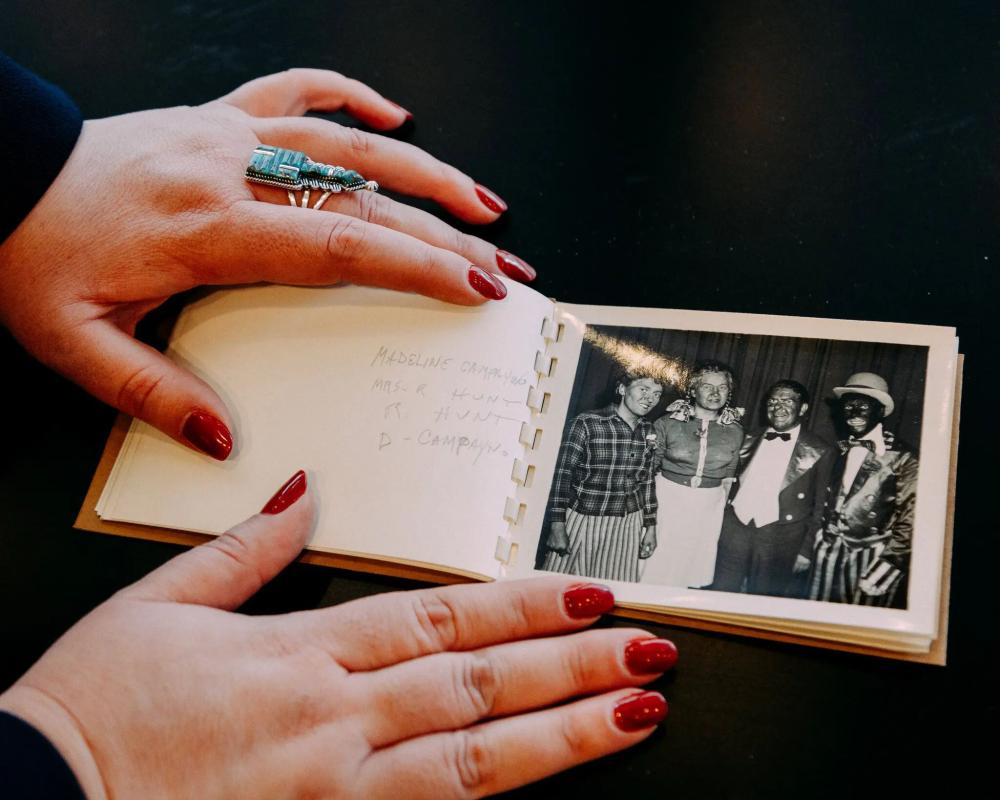
Barnes paging through a souvenir photo album from a 1946 minstrel show organized by a Lions Club. Daniel Terna for The New York Times
She traces her scholarly interest to a class about slavery in American life that she took in her freshman year at the University of California at Berkeley.
The standard account of theatrical blackface is that it had dwindled by the turn of the 20th century, and was subsumed into vaudeville, radio and Hollywood. But Barnes noticed that some books on the syllabus, while focused on the 19th century, had footnotes referencing minstrel plays reprinted in the 1930s. So she went to the university’s library to see what she could find.
She found mostly 19th-century sheet music and published plays. But online, she said, she saw notices from local libraries around the country trying to get rid of now embarrassing 20th-century minstrel joke books, scripts and how-to guides aimed at amateurs.
Barnes started compiling a database of these materials, which shot up to nearly 10,000 titles before she stopped. “I was consumed with trying to count how many shows there were, because I was trying to prove they in fact existed,” she said.
She also started building a personal collection, which now includes thousands of items. For an interview earlier this month, she brought a sampling of about 100 items to the office of her publisher, Liveright, in New York.
“I don’t do this very often,” she said of the array, whose colorful art mixed the seemingly cute with the shocking. “I don’t want this stuff to become normal to me.”
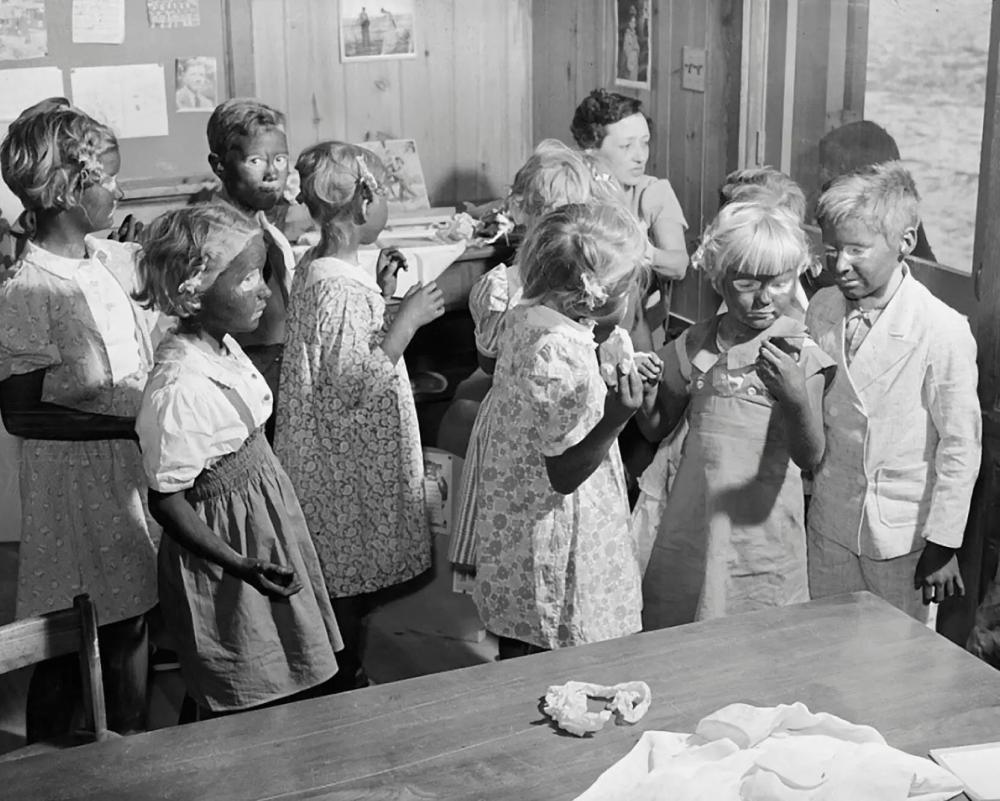
Third graders in Lee County, S.C., in 1939. Farm Security Administration, Office of War Information Photograph Collection, Library of Congress.
There was a pocket-size souvenir album featuring snapshots of blacked-up suburban couples; a program from a 1943 police minstrel show in Ohio; and a catalog called “Everything You Need for Your Minstrel Show,” from T.S. Denison & Company, one of 79 publishing houses she identified that specialized in minstrel materials (including wigs).She turned to the inside cover of a 1933 play called “The Chain Gang Minstrels.”
“Service with a smile…,” it read. “That’s what this sparkling new minstrel show provides.”
Many items came directly from people who heard about Barnes’s work, and offered to send embarrassing things discovered in a relative’s house, with the stipulation that their name and city of origin be kept private.
Barnes also discovered what she calls “a very seedy, creepy underground world” eager to monetize blackface. In a 2019 news media interview occasioned by the furor over blackface yearbook photos relating to Ralph Northam, then the governor of Virginia, she mentioned the title of a particular songbook.
“The next day, something that previously would have cost 50 cents was selling online for $700,” she said.
Roosevelt’s ‘Polio Minstrels’
Scholars in the field say Barnes has blown open an aspect of everyday American culture that is now as invisible as it once was pervasive.
Eric Lott, the author of the influential 1993 book “Love and Theft: Blackface Mistrelsy and the American Working Class,” credits Barnes with giving clear shape to a “shocking and edifying” history.
“It is a feat of recovery and discovery to locate this material and catalog it in the way she has,” he said. He added: “This material can really defeat you when you are in the archives. It’s everywhere.”
Henry Louis Gates Jr., one of Barnes’s advisers at Harvard, called it “a truly brilliant combination of archival research and critical analysis.”
“You can’t defeat racism by burying these caricatures,” he said.
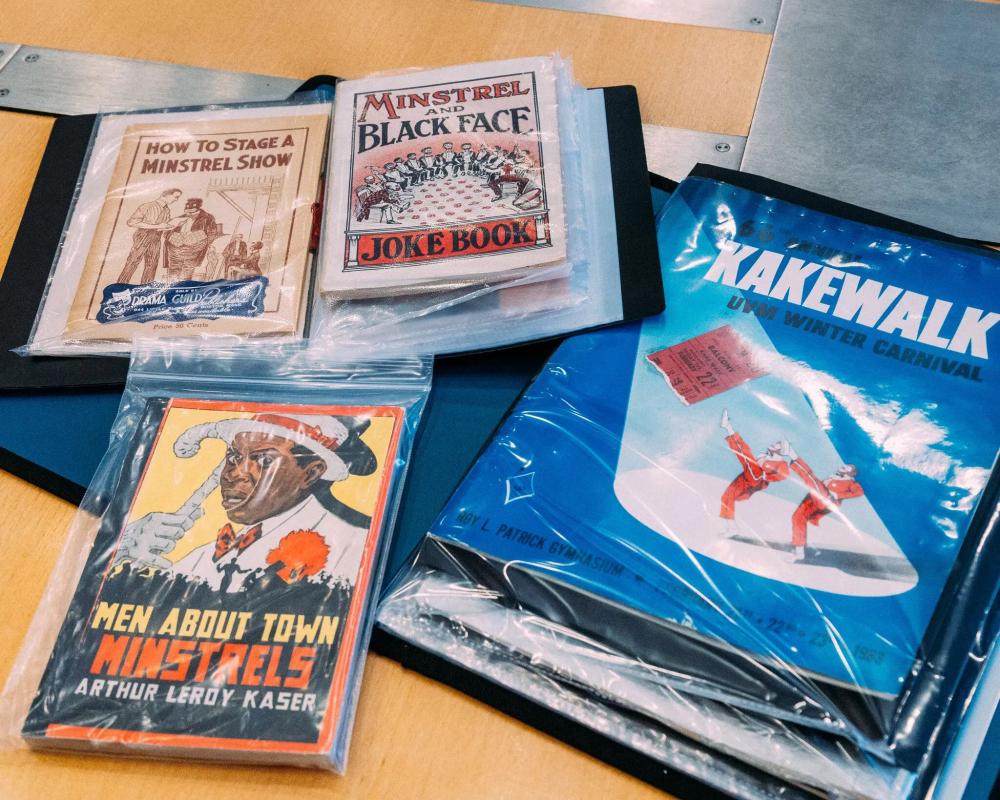
Items from Barnes’s collection, including “How To Stage a Minstrel Show,” from 1921.Daniel Terna for The New York Times
Barnes calls the history of blackface a “censored” history. When she started her research, she says, some academic librarians expressed reluctance to bring out materials, lest they fall into the wrong hands.
At one visit to the Library of Congress in 2013, she writes, every item she requested came back “missing/not on shelf.” Later, when she finally got a cart load of materials, she saw that most hadn’t been accessed in nearly three decades.
A few scholars had already written about the strange phenomenon of blackface shows in Japanese American internment camps during World War II. But talking with survivors and digging through camp newspapers, Barnes realized they were happening on “a weekly basis,” she said, using scripts and props created and provided by the U.S. government.
It was part of what she calls a broader “federalization” of blackface performance during the New Deal and World War II, when the government promoted minstrel shows at migrant work camps and army bases and even published anthologies of recommended skits.
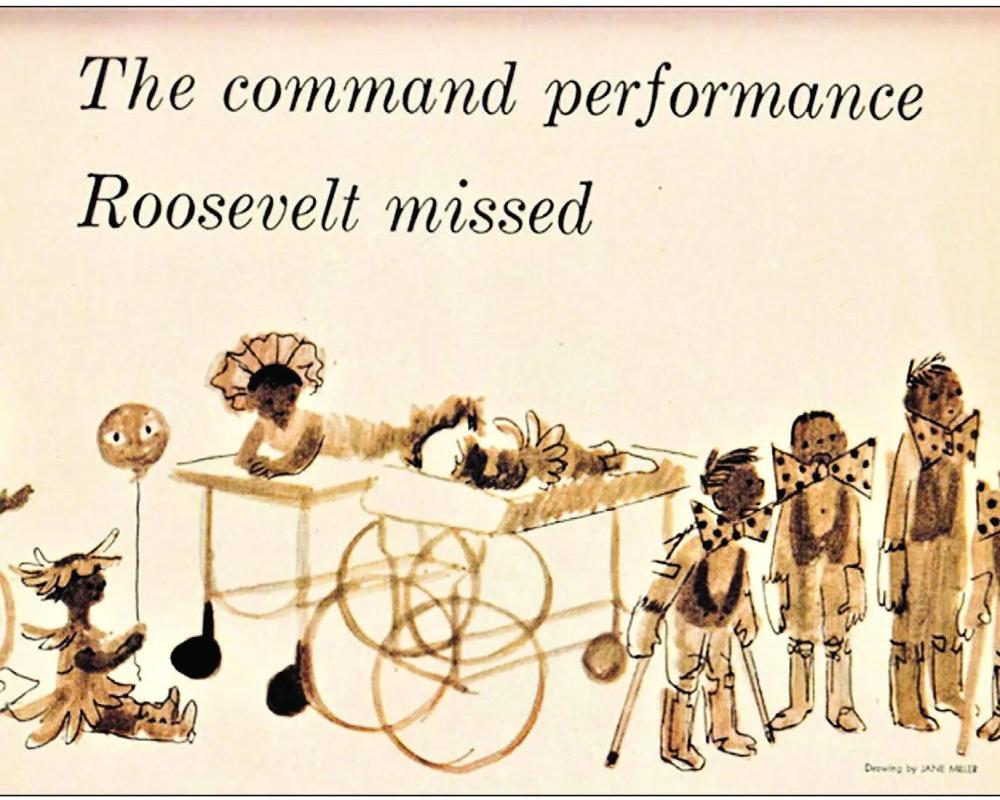
A Look magazine illustration depicting a minstrel show featuring children with polio that Franklin Delano Roosevelt helped organize in 1945. Rhae Lynn Barnes Family Blackface History Collection
And enthusiasm for blackface went right to the top. In one eye-opening section, Barnes reconstructs a forgotten aspect of the last days of Franklin Delano Roosevelt, who died suddenly in 1945 during a visit to the polio rehabilitation center he founded in Warm Springs, Ga.
The day he collapsed, Barnes reveals, Roosevelt was putting the finishing touches on a fund-raising show he had co-written, called “Polio Minstrels,” featuring child patients in blackface.
Paul M. Sparrow, a former director of the Roosevelt presidential library in Hyde Park, N.Y., who organized a 2022 exhibition about Roosevelt’s complex record on race and civil rights, said the show had been noted in press accounts at the time, usually without elaboration. “It was dog bites man,” he said.
Later, as blackface became taboo, that detail “started being brushed out of the historical story,” Sparrow said. “Nobody really wanted to dig into it.”
Sparrow credits Barnes’s book with restoring both that story and the broader context, including the federal government’s active role in promoting noxious racist stereotypes.
“I think it will be seminal in shifting our perspective on how pervasive blackface was and the incredible damage it did,” Sparrow said.
A ‘cultural hate crime’
Barnes said she was never able to access the program for the minstrel show, which had been removed from the small Roosevelt museum in Warm Springs. But at the Library of Congress, she located a reel-to-reel recording of an oral history by Graham Jackson, a Black Navy musician who was close with Roosevelt and there that day.
The recording, which discusses the show in detail, is classified — wrongly, Barnes argues — as “folklore.” And how blackface artifacts are cataloged matters.
Even “Darkology,” she said, is being classified by some libraries as “Black history,” despite involving almost no actual Black people. What it should be under, she said, is “American culture” and “white supremacy.”
Barnes calls the materials she has tracked down the “hidden evidence of a large-scale cultural hate crime.” And erasing it, she believes, does more than distort American history. It also erases the heroism of Black Americans who fought to make blackface so unacceptable that many people would prefer to forget it happened at all.
Before packing up her collection, Barnes gestured at the colorful, horrible material scattered across the table.
“This mess on the desk,” she said, “shows you what they were up against.”
Jennifer Schuessler is a reporter for the Culture section of The Times who covers intellectual life and the world of ideas.