
Book Review: Israel: What Went Wrong?
This urgently current volume will be widely discussed in the months ahead, with another important book on the same subject, appearing last Fall: Peter Beinart’s Being Jewish After the Destruction of Gaza. Well received across most of the global press (and cursed in the expectable places), Beinart’s work effectively stirred the pot. Bartov deepens the argument. The two authors, an American with parents from South Africa, and a native Israeli, will no doubt continue to be widely admired and denounced, amidst the heated controversies since the events of October, 2013. Omer Bartov’s particular angle of view, closer to the IDF’s onslaught against Gazan civilians among others, is horrendous and revealing, by turns.
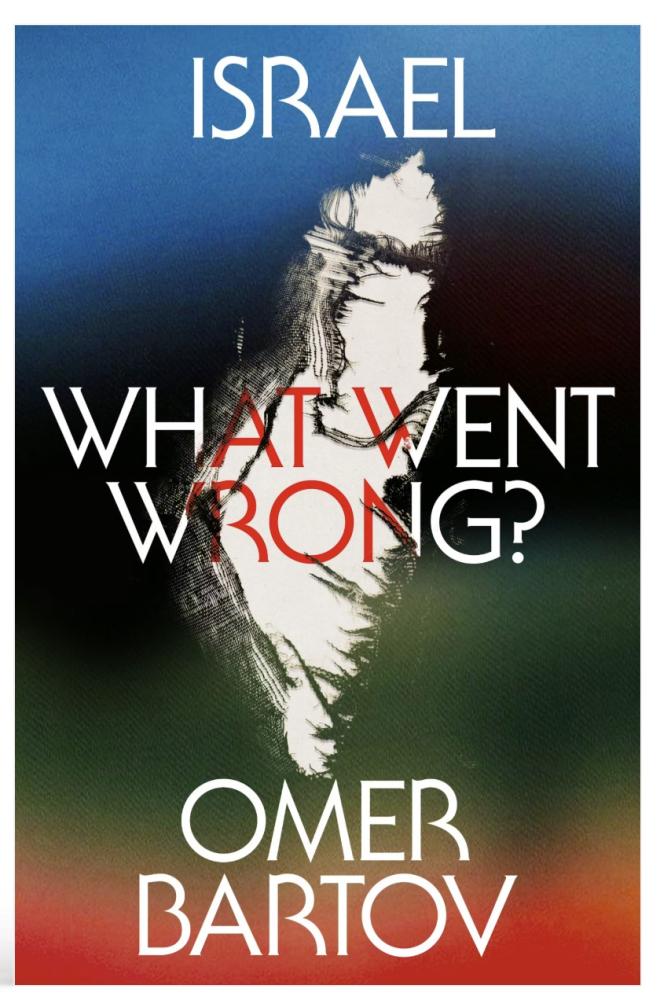
Israel: What Went Wrong?
By Omer Bartov
Farrar, Straus and Geroix / Macmillan; 256 pages
Hardcover: $28.00
April 21, 2026
ISBN: 9780374618186
The US and Israeli attack upon Iran has come too recently for either work. The joint assault nevertheless bears striking evidence for the authors’ arguments and why those arguments are crucial, not only for the Middle East but for the entire world today. Diplomats, businessmen and the rest of us reel as Israel has evidently taken the lead in promoting violent global disorientation. The abuse of Palestinians seems to have been only a beginning, with Iranian, Lebanese and other targets now evident.
Bartov’s account is analytical but also deeply personal. If Beinart learned among his South African relatives that the “Others” (that is, black African housekeepers) were considered unequal by nature, a view driven home by Israeli views of Palestinians, Bartov received his shock differently. Raised in a collective, avowedly socialistic setting, surrounded by descendants of Eastern European Jewish families with few other survivors, he imbibed their shared sense of trauma. It defined their sense of themselves, their existence. It also enured them to the sufferings of Palestinians.
Like almost every other young Israeli, Bartov readily took service in the IDF. Mobilized while in college in 1972, continuing service until 1976, he found himself more than uncomfortable at the outbreak of the Second Intifada. As he explains, he could not help himself: Prime Minister Itzhak Rabin’s order to “break their arms and legs” of the Palestinian youngsters, children included—anyone threw rocks at armed Israelis—shocked him deeply. Was this what the “New Jewishness” of Israel, freed from the old fears and weakness, had become?
This seemed to him so deeply wrong that he wrote two letters to Rabin, suggesting (both as a scholar and a soldier) that the order resembled the collective punishment practiced against the Jews earlier in the century. Rabin answered him twice, personally, with the same message: how dare he make that comparison! Everything in What Went Wrong hinges upon this experience. He suggests, with less hope, that Rabin’s turn toward peace, shortly before his assasination, still offers a path, with wide international participation.
An outstanding scholar, teaching at Tel Aviv University and grappling with the accumulating evidence about the Holocaust, Bartov also become more and more concerned about the changes in Israel going on around him. Seeking more freedom of expression abroad, he accepted a fellowship at the Society of Fellows at Harvard as a historian of Germany, took up study of the Holocaust there, spent eight years at Rurgers, and in 2000 came to Brown University.
Bartov stakes out his position in Israel: What We Wrong, by explaining what he learned about the history of genocides. Their modern version arguably began in the twentieth century with the Herero and Nama populations assaulted by German colonizers in 1904, and with the genocide of Armenians by the Turks. A later German govenment’s acceptance of the (Jewish) Holocaust seemed not to recall, let alone atone for the earlier genocide, until early in the current century. Even then, in making atonement cash payments, the Germans directed funds toward the existing Namibian government with a few actual members of the Herero and Nama nations benefitting. The wider European refusal to accept the genocide of African peoples is more than troubling to Bartov: it seems, by indirection, to justify the events in Gaza. Some mass murders, deadly hunger and other results of a mass destruction of infrastructure obviously count. Others evidently do not. The claim of historical uniqueness for the Jewish Holocaust thus places crucial events outside of history and beyond reckoning.
By the force of research and his own logic, Bartov turned his scholarly focus in the direction that we understand so crucial these days. Carefully analyzing the history of discussion and debate about the Jewish State, he came to explore why and how the Zionist worldview would be accepted as the only valid response to the threat of global Jewish “disappearance” by slaughter or by assimilation. This acceptance became internalized, most remarkably, for Jews around the world lacking any intention of actually emigrating to Israel. In the manifestly illogical phrase, only the existence of a Jewish Israel made the world safe for Jews anywhere.
Even in Israel of its early decades, as Bartov notes, the Holocaust was not the “ubiquitous reference point” (p.95) that it would become. Furiously promoted by the Likud party during the 1980s as a glue to hold together Ashkenazi and non-Ashkenazi Jews, also the old and the young, also the religious and non-religious, Holocaust memory “liberates Israel from the constraints imposed on other nations” (p.96) because….those nations stood by while Jews were endangered. For anyone to suggest that the extended families of Holocaust victims might themselves become the agent of another Holocaust seems absurd and grossly insulting to most Israelis. The all-out war against Gazans, then, is fought only to make the world’s most victimized people safe.
Further, as Bartov unpacks the processes of ideological formation, protests anywhere in the world against Israeli misbehavior bordering on genocide inevitably become expressions of anti-Semitism. They can be suppressed, protest organizations banned along with signs and slogans, even when written or spoken by the relatives of other Holocaust victims.
To this, Bartov applies a different logic. Accusing the Israeli government and the IDF of crimes against a particular section of humanity is no more “anti-semitism” than accusing the US of well documented, widely recognized war crimes in Vietnam. The call to boycott anything Israeli, political or cultural, cannot in itself be anti-Semitic. Neither is critical concern or protest anti-Semitic. For millions of people around the world, Israel offers a legitimate, riveting concern, as is the destructive power politics supporting Israeli bad behavior.
Bartov the university teacher and scholar sees the actions of Columbia University and other university administrations against pro-Palestinian demonstrators, against scholary opinion and debate, even against teaching employment for potential critics, as a “terrifying sign of things to come.” (p.87). The modest pushback by Harvard against Trump offers hope but not much more. A small minority of Jewish students, backed by a handful of multi-millionaires, had learned how to threaten any support of Palestinian rights and scholarship on Palestinian history. The Trump administration cheers on the repression and provides the tools to punish dissent.
This political repression ignores the obvious, twice over, as Bartov explains. Real anti-Semitism existed before the state of Israel and would exist if Israel ceased to exist. Today’s outbreak of antiSemitism, where it actually exists, cannot be separated from current events. “It is Israeli policies…that are giving license to real antiSemites.” (p.88).
A heavy hand of Bartov’s criticism also falls—readers may be pained but should not be surprised—upon President Biden. At the outset of the mass slaughter in late 2023, Bided might have summoned up the courage to refuse further delivery of US weapons to Israel. This would, Bartov insists, likely have spared many thousands of Gazan civilian lives and futures, not to mention lifting the weight off Israeli criminal actions before the worst grew worse, and still worse. True to his political background—enouraged early in his career by Senator Henry Jackson, both a staunch supporter of Israel and recipient of vast funding from the Israel lobby—Biden did the bidding of Tel Aviv.
Bartov’s analysis of what went wrong is certainly convincing. Likewise his own stories of how he returned to Israel to meet his grandchildren, and learned that the Netanyahu goverment had chosen not to negotiate the release of the hostages so as to move to an unshakeable position of absolute triumph.
Prime Minister Netayahu, facing massive corruption charges, could hope to escape only by winning the war against Palestinians and thereby winning legal as well as political vindication. The opportunity for Israel to smite its foes and emerge the chief regional power, even a global power, was seen to be….now or never.
How can Israelis climb down from this perch instead of marching into endless wars and the increasing slaughter of non-Jews already evident in the attack upon Lebanon? Bartov says that the Palestinians are too weak to take part in the peace effort more than symbolically. It is for other powers in the world to intervene somehow, convincing ordinary Israelis that their current road is their own disaster.
To judge from comments on Facebook, Bartov is holding out too much hope for the salvation of Israel as a Jewish state or a shared Jewish-Palestinian state under new rules more fair to all sides. This may be. But it is hard to think of another way out of the mess.##
[Paul Buhle, retired Lecturer at Brown U, co-authored a biography of comics giant Harvey Kurtzman and with Harvey Pekar, edited YIDDISHKEIT the comic. He wrote several volumes on the (very Jewish) Hollywood Blacklistees.]