
This Week in People’s History, May 27-Jun 2, 2026
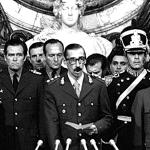
Hard Time for Right-Wing Terrorists (2016)
MAY 27 IS THE 10TH ANNIVERSARY of an Argentine court’s conviction of the former dictator of Argentina and 14 other high Argentine and Uruguayan officials for an international conspiracy, known as Operation Condor, to kidnap and murder South American leftists during the 1970s and 1980s.
Operation Condor had been initiated in 1975 by the right-wing Chilean government to coordinate the systematic repression of the left by Argentina, Chile, Uruguay, Paraguay, Brazil and Bolivia. There is no known evidence the U.S. was directly involved in the program’s inception, but it soon received very substantial U.S. support, including the use of a U.S.-owned communications network.
The 2016 verdict was not the first conviction for crimes committed as part of Operation Condor, but it was the first to identify the multinational operation itself as a criminal conspiracy, making possible the prosecution of anyone who played a role in it, even if their responsibility for harming a particular individual could not be proved. https://nsarchive.gwu.edu/briefing-book/southern-cone/2025-11-26/operation-condor-network-transnational-repression-50-years
General Strike Stops Rochester Cold (1946)
MAY 28 IS THE 80TH ANNIVERSARY of the beginning of what is called the Battle of Rochester, when New York State’s third largest city was paralyzed by massive general strike.
The 1946 action, which was not a general strike at first, started when the city government suddenly fired 489 municipal workers who had just joined a labor union and were preparing to ask for a contract.
Over the next two weeks, virtually all city unions, with some 60,000 members, demanded the municipal workers' rehiring. Thousands picketed essential government facilities, including water works, bus depots and sanitation garages, shutting them down. More than 250 pickets were arrested.
When the city refused to reverse firings, many unionized workers, including teamsters, printers, electrical workers, theater projectionists, the staffs of Rochester's two daily newspapers, and 13,000 Amalgamated Clothing Workers members struck simultaneously and brought the city to a standstill.
At that point, city officials gave in, rehired those who had been fired and agreed to recognize their union. https://peoplesworld.org/article/today-in-labor-history-rochester-general-strike-2/
‘Ain’t I a Woman?’ (1851)
MAY 29 IS THE 175TH ANNIVERSARY of Sojourner Truth's delivery of her justifiably renowned Ain't I a Woman? speech, during the Women's Convention in Akron, Ohio. Here's Alice Walker's recital of it, with a short intro by Howard Zinn https://vimeo.com/1251809
A Real Super-Hero (1431)
MAY 30 IS THE 595TH ANNIVERSARY of the execution of Joan of Arc, who was being punished then, in 1431, for heresy and is now considered to be the patron saint of France.
One need not have faith in the reality of divine intervention or be religious to be confident, based on the evidence, that Joan had an exceptional ability to have a tonic effect on the morale of individuals and on large groups of people who had, as a practical matter, very little reason to hope.
Despite having had no experience as a leader, military or otherwise, she was skilled at winning peoples’ confidence and convincing people they had every reason to hope for success despite all indications to the contrary.
Joan garnered a reputation for her exceptional abilities during the Hundred Years’ War that was being fought between the English and the French in what is now central France.
The historical record concerning Joan’s actions is far from complete, but there is substantial evidence that Joan, who was a peasant teenager, persuaded a captain of the French forces that she had a divine vision that she was destined to help defeat the English.
After having persuaded the French captain of her sincerity, she was sent, with a military escort, on a 320-mile journey to meet with Charles, who was a contender to become King of France. After several meetings, Joan convinced Charles of her “powers” (or at least her possible usefulness). After Charles provided Joan with a horse, armor, and an escort, he sent her on a 100-mile journey to Orleans, where French forces had been barely withstanding an English siege for six months.
Exactly how and whether Joan’s arrival in Orleans changed the military situation is unknown, but it seems clear that it made a tremendous difference in the morale of the French, who went on the offensive and forced the English to retreat nine days after Joan arrived.
In subsequent weeks the French forces, swollen with fresh volunteers thanks to a great extent to Joan’s presence, won battle after battle, pushing the English 125 miles to the north and making it possible for Charles to be crowned King of France.
But the English were not decisively defeated and the war continued, with Joan continuing to play a critically important role in the maintenance of French morale. Nine months after Charles was crowned, Joan was taken prisoner in battle. Seven months after she was captured, she was put on trial for heresy, convicted and executed by burning at the stake. https://theconversation.com/friday-essay-joan-of-arc-our-one-true-superhero-81097
A ‘Coordinated, Military-Style Attack’ (1921}
MAY 31 IS THE 105TH ANNIVERSARY of an attack on the Black citizens of Tulsa, Oklahoma, which began when White mobs invaded and systematically destroyed almost all the homes and businesses in Tulsa’s Greenwood district, which was one of the the most prosperous African-American communities in the U.S. At least one hundred, and perhaps as many as three hundred Greenwood residents were killed, about 6000 were jailed and more than 1000 homes were destroyed. https://eji.org/news/justice-department-finds-tulsa-massacre-was-a-coordinated-military-style-attack/
‘Death-Flow from a Pipe’ (1972)
JUNE 2 IS THE 54TH ANNIVERSARY of Life magazine’s publication of the shocking photo-spread, "Death-Flow from a Pipe" by W. Eugene Smith and Aileen Smith, about the deadly mercury poisoning taking place in Minamata, Japan.
The article and photographs were the first introduction for many people to a major and deadly-to-humans environmental catastrophe that had been going on for two decades. Most people had never heard of Minamata before then because of the power of large corporations to make a secret of what is going on in plain sight.
In the case of Minamata disease, the corporation's first cover-up tool was power over its victims. Minamata is a company town, dominated by a huge chemical company, Chisso, which is the town's biggest employer and owner of the local hospital.
Some Minamata residents had been concerned for years about an unidentified syndrome that was killing cats and crows and was suspected of causing central nervous system problems in humans. Their concerns were poo-pooed by local health authorities, who were all either on the Chisso payroll or the public payroll, which was heavily funded by taxes paid by the corporation.
Finally when multiple cases of unexplained paralysis among children could not be ignored, the hospital director, a Chisso employee, reported for the first time the existence of an "epidemic of an unknown disease of the central nervous system."
The Chisso Corporation took charge investigating the cause of the epidemic, which had a fatality rate of 35 percent. It took them more than three years to conclude that the victims had been poisoned by mercury, more than 20 tons of which had been intentionally dumped by Chisso into Minamata Bay. The bay's fish and shellfish were a major food source for Minamata residents.
Faced with the certain knowledge that many Minamatans were suffering from mercury poisoning, Chisso denied that its dumping was responsible, and continued to use the process that produced tons of mercury-contaminated waste. Then children began to be born in Minamata with horrible physical deformities and deafness and blindness, caused by the mercury poisoning of their parents.
For nearly a decade after mercury was identified as the culprit, Chisso continued to dispose of mercury waste in the bay. When Minamatans and their supporters protested, Chisso unleashed their second weapon against public health, namely thugs or goons, which in Japan are known as yakuza. Any Minamatan bold enough to protest what Chisso was doing was very likely to be heavily beaten.
And even though the mercury-caused disease had been officially identified, Chisso was powerful enough to keep the lid on the story. When W. Eugene and Aileen Smith decided in 1971 to live in Minamata in order to document the disaster, yakuza beat Eugene badly enough to cause permanent brain damage and considerably shorten his life. But they were unable to prevent him and Aileen Smith from taking the photographs and writing the text that appeared in Life and later formed the nucleus of the Smiths’ award-winning book, Minamata, published in 1975. Smith, who had never recovered from the attack by Chisso's goons, died less than three years later. http://aileenarchive.or.jp/en/minamata-then-and-now/
For more People's History, visit
https://www.facebook.com/jonathan.bennett.7771/