
The DNC Autopsy Is a Confession
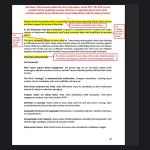
On the executive summary page of the Democratic National Committee’s long-promised, long-delayed, finally-released 2024 autopsy, there is one line: “This section was not provided by author.”
Not vague. Not hedged. Not corporate-careful. Missing.
That is the report Ken Martin released, after months of trying to bury it, after Kamala Harris herself signaled she would not stand in the way of its release, after RootsAction flooded DNC inboxes with thousands of emails, after CNN had already obtained a copy and was preparing to publish. 192 pages, authored by a Democratic consultant named Paul Rivera, who reportedly never interviewed Joe Biden, never interviewed Kamala Harris, never interviewed Tim Walz, never interviewed any of the campaign principals whose decisions are the actual subject of the post-mortem. Pages marked up in red ink by the DNC itself, flagging factual errors, missing source material, and unverified claims. A document whose own author the chair has publicly disowned: “I am not proud of this product; it does not meet my standards.”
I want to be clear about what we are looking at. This isn’t a failed analysis. This is a confession.
It is a confession because of what it doesn’t include.
The words “Israel” and “Gaza” do not appear once in 192 pages, despite Rivera privately telling the IMEU Policy Project in July 2025 that the war hurt Democrats in 2024. The decision to keep Joe Biden on the ticket until July is glossed over. The decision to truncate Kamala Harris’s campaign to 107 days is not interrogated. The Uncommitted movement, which warned the party for a year that the party’s position on Palestine was demobilizing the base, is not mentioned. The structural reality of voter suppression, which has accelerated since Shelby County in 2013 and was reinforced when the Supreme Court gutted Section 2 of the Voting Rights Act in Louisiana v. Callais, is not engaged with as a strategic variable. The tech broligarchy that delivered young men to Trump through Joe Rogan, Theo Von, Tim Pool, and the rest of the podcast pipeline is not named. None of the actual reasons the Democrats lost are in this autopsy.
What is in it is the same diagnosis the party has been writing about itself since Bill Clinton: too much attention to people of color, too much attention to women, too much attention to queer people, too much “identity politics,” and not enough attention to a particular imagined “Middle America” and “the South.”
Let me say this plainly. I live in the South. I work in the South. My South is the Black Belt that runs from East Texas through the Mississippi Delta to Alabama and Georgia and the Carolinas. My South is Appalachia, where I live, where working-class people are already organizing across race and class in ways the autopsy cannot see because it assumes the region is a monolith. My South is Chattanooga, where the state legislature blocked the city’s Electric Power Board from extending municipal broadband to its neighbors, because preemption is how Tennessee keeps its own people from building power locally. My South is Memphis, where the City Council passed a living wage ordinance, only for the state to strike it down. My South is Montgomery, where, days ago, I stood at the Alabama State Capitol as part of the All Roads Lead to the South National Day of Action, alongside organizers from across the region and nation, who are still doing the work this autopsy refuses to acknowledge.
The South in this autopsy is not my South. The South in this autopsy is a euphemism. When Rivera writes that Democrats must focus on “voters of Middle America and the South, who have come to believe they are not included in the Democratic vision,” he is not talking about Black voters in Atlanta, or Latine voters in Houston, or working-class white voters in East Tennessee who have already organized themselves into solidarity with the people the autopsy treats as a problem. He is talking about a fantasy demographic that votes Republican when the Democrats run people of color and women, and that votes Democratic when the Democrats run white moderate men. That demographic does not exist at scale. The autopsy is built on a ghost.
The actual demographic that exists, at scale, are the ones I wrote about in The 89 Million.
The Locked Out: voters who tried to vote and could not, because of voter ID laws, polling place closures, signature matching, mail-in rejections, the deliberate degradation of Black and Brown precincts, and the disenfranchisement of millions of formerly incarcerated people across the South.
The Politically Homeless: voters who used to vote Democratic and stopped, not because they discovered the Republican Party, but because they discovered that the Democratic Party would not fight for them with the same urgency it asks them to fight for it.
The Ideologically Out: voters, particularly young voters, particularly Arab and Muslim and progressive voters, who could not in good conscience cast a ballot for a party that would not condition aid on the lives of children in Gaza.
That’s just a taste of the 89 Million. That is the actual swing constituency in American politics. They did not stay home because Democrats paid too much attention to them. They stayed home because Democrats paid too little, and what attention they did pay was extractive: show up for us in November, disappear on us the other forty-seven months.
The autopsy does not mention this constituency once. It cannot. To name them would be to truly confess. To admit there is a problem and be in the position to have to fix it.
Here’s the contradiction at the heart of the document. On one page, it frames “identity politics” as something the party needs to abandon. On another, it tells Democrats who want to win male voters to “deploy male messengers” and not to “assume identity politics will hold male voters of color.” This is not analysis. This is a posture. Identity politics, in this autopsy, means attention to Black people, women, queer people, immigrants. Attention to white men is not called identity politics. Attention to white men is called strategy.
I am not interested in arguing with the autopsy on its own terms. I am interested in naming what its terms are. They are the terms of a party that has not done the work of reckoning with patriarchy and anti-Black racism as the twin systems they are. You cannot beat the Republican coalition by mimicking its gender politics. You cannot out-misogyny the misogynists. The recommendation to deploy “male messengers” is itself a capitulation to the broligarchy: the tech-billionaire-podcast-bro infrastructure that delivered young men to Trump by selling them a vision of masculinity premised on the diminishment of women and the erasure of Black political power. The Democratic Party’s official 2024 post-mortem proposes to compete for those men by adopting the gendered logic that organizes against the rest of us.
That is not a winning strategy. That is surrender dressed as analysis.
And there’s a deeper reason the autopsy reaches for cultural posture instead of structural critique. Many of the same billionaires who funded the broligarchy also write checks to Democrats. Many of the same corporate PACs that fund the state legislators dismantling democracy at the state level also fund the federal candidates the autopsy is built to protect. Structural critique would cut both ways. So the post-mortem reaches for what is safe: telling the base it cared too much about us, instead of asking who paid for the campaign that lost.
The hardest part of reading this document is that the party already has the receipts for what works, and the autopsy ignores them. Down-ballot Democrats outperformed the top of the ticket in 2024. In states like North Carolina, Democratic candidates running statewide ran ahead of Kamala Harris. The autopsy itself notes this. What it refuses to draw the conclusion from is that base voters, Black women in particular, did the work the party did not pay us to do, and saved the seats the party could not save itself. Black women voted Democratic at over 90 percent in 2024, as we have in every election since 2008. We were not the problem. We were the proof.
This is not a new story. In 2017, after Hillary Clinton’s loss, Tamika Mallory, Marcia Fudge, Star Jones, and more than two dozen other Black women activists, civic leaders, and elected officials wrote an open letter to then-DNC Chair Tom Perez. The letter said plainly that Black women had carried the party, and the party had not carried us back. The letter asked for investment, for representation in leadership, and for resources commensurate with the turnout we deliver. The party’s answer, nine years later, is a 192-page document that argues we should be paid less attention.
I want to be careful here about who I am addressing. I am not writing to convince Ken Martin or Paul Rivera. I am not writing to convince the consultant class that authored this autopsy or the class of donors who will fund the next one.
I am writing to the people who are organizing in the South and in the Midwest and in the West, who are building a multiracial democracy that the Democratic Party has not figured out how to build yet, and who keep being told by post-mortems like this one that their work is the problem rather than the solution. I am writing to the Black women who delivered over 90 percent, and to the young people who organized for Uncommitted, and to the Locked Out voters in Texas and Georgia and North Carolina who tried to vote and could not, and to the Politically Homeless across the South who have not given up on democracy but have given up on a party that cannot find its way to fight for it.
I am writing to say: the autopsy is not about us. It is about the party.
So here is what we do with the confession. We name what the autopsy will not. And we build what the party cannot.
The autopsy was finalized in December 2025. On April 29, 2026, the Supreme Court gutted Section 2 of the Voting Rights Act in Louisiana v. Callais. Three weeks later, the Democratic Party’s official explanation for losing in 2024 lands without engaging the structural reality of voter suppression at all, and without naming the corporate actors whose PAC dollars fund the legislators who write the suppression laws.
So we name them.
On May 16, organizers from across the South converged on the Alabama State Capitol in Montgomery for the All Roads Lead to the South National Day of Action. That morning, I launched Fix It, FedEx. FedEx Corporation, headquartered in Memphis, has contributed approximately $1.9 million through its corporate PAC to Tennessee lawmakers since 2009, including the architects of the post-Callais legislative agenda that the autopsy will not say out loud. The demand is simple: publicly oppose the Tennessee laws your money paid for. Sign on at fixitfedex.com.
FedEx is one name. There are others, in every state, where corporate dollars are quietly underwriting the dismantling of democracy. The work is to name them, locally and specifically. The autopsy will not. We will.
And we build what the autopsy cannot.
The Democratic Party cannot be the political home of the 89 Million because the Democratic Party is funded by the people the 89 Million are trying to defend themselves from. We need a different political home. We already have the beginnings of one.
I am a proud member of the Working Families Party, and I have had the honor of hosting WFP Mass Calls for a couple of years now. I have met grassroots WFP leaders from all over this country, and Working Families champions who have committed to fighting for us in elected positions. Summer Lee and Kendra Brooks in Pennsylvania. Greg Casar in Texas. Delia Ramirez in Illinois. Chris Rabb, who won his congressional primary in Pennsylvania. There are many others, and there will be many more. They are funded by their members and the movement, not by the corporate PACs that pay the legislators who write the suppression laws. They organize year-round, in the off-years the consultant class treats as dead time, in the places the Democrats treat as flyover. They do the work the autopsy refuses to learn from. And together they are doing something the autopsy cannot account for: they are successfully challenging the map of where Democrats think they can win, the definition of who Democrats think can win there, and the idea that the only way to win is without being who we are or believing what we believe.
Take New York. Zohran Mamdani ran for mayor on both the Democratic and Working Families Party ballot lines in 2025. He won. The WFP line alone delivered roughly as many votes to Mamdani as the entire Republican ticket received. That is not a third party. That is a second party. In New York, the meaningful electoral competition to the Democratic Party is the Working Families Party, on the same ballot, with the same voters, fighting for a different politics.
If you’ve read this far, you already know. It’s call to action time. Here is the door.
Show up to the next Working Families Party mass call.
The call is where the work starts. Find the WFP champion in your state. If your state does not have one yet, that is the work. Become a member. Show up to the year-round organizing. Every mass call has calls to action from leaders you can trust. That is how we build the political home the autopsy will not name, and that the 89 Million have been waiting for.
What winning looks like isn’t what the Democratic Party thinks it looks like. The Democratic Party thinks winning looks like reclaiming a “Middle America” that votes for it because it has abandoned the people the autopsy thinks prioritize “identity politics.” That is not winning. That is the slowest possible way to lose.
What winning looks like is the South the autopsy cannot see. What winning looks like is the 89 Million the autopsy cannot name. What winning looks like is the multiracial coalition that already exists, that already does the work, that already turns out at over 90 percent for a party that returns again to write 192 pages explaining why we are too much. What winning looks like is a political home that is built by us, funded by us, and accountable to us.
The autopsy is a confession. What we do with the confession is the strategy.
Join us on the next mass call.
Ash-Lee Woodard Henderson is a movement strategist and founder of Utopian Visions LLC. Her recent piece, “The 89 Million,” is available at medium.com/@ashleewoodardhenderson.