
& 3000 Miles to the East
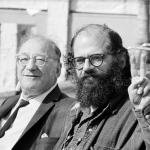
Louis Ginsberg, an old man on shaky legs,
reads his poem “At My Father’s Grave,”
while his son Allen sits cross-legged on the stage
staring up at his father.
Louis reads.
His voice cracks.
He is crying.
& 3000 miles to the East,
waiting in a Greenwich Village liquor store
for a nighttime mugger or the boss who tosses him a copy of the New York
Daily News,
my father, an old man on shaky legs,
sells dreams and forget-me-nots in brown paper bags.
Downtown on the lower East Side the Jewish temple is burning.
Louis says that America was once a melting pot
and is now a pressure cooker.
The steam churning into dirty cement,
tying knots into the bodies of newly arrived immigrants,
who worked fourteen hours a day in garment factories,
watched their young women selling themselves for survival,
and went blind bending over buttons and buttonholes.
Perhaps they were farmers in Hungary.
“At My Father’s Grave” is a recurrent thread in our lives.
Hours and minutes, events and situations roll by before the eye notices.
Before the heart allows entrance.
And then, we mourn the dead.
& 3000 miles to the East
the liquor business is booming.
Bottle after bottle slide from shelf to customer,
replaced by more bottles for more customers.
There’s more anesthesia handed out here
then in St. Luke’s Hospital just up the street.
At his Waverly Lounge he controlled his reality;
When the Trolley Song was played on the piano,
he was there to provide the clang, clang, clang in real time.
& from behind the bar
a rendition of “keep your head down fritzie boy”provided relief from
the pressure cooker.
& later, much later, he revealed
“it was good to make some people happy,
even if only for a short time.”
Louis Ginsberg finishes reading.
Allen steps up to the podium.
Bill Berkowitz is a longtime observer of the conservative movement. His Conservative Watch columns document the strategies, players, institutions, victories and defeats of the American Right.