
Global Left Midweek — July 15, 2026
- Workers’ Rights in Crisis
- Thousands in the Streets Defy AfD
- Iran Analyses
- In Defense of Indigenous Women in Argentina
- Reports from Africa
- An Anarchist in Rojava
- Reports from Mexico
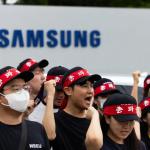
- A Crucial Win at Samsung
- The Left’s Opposition to Antisemitism Must be Unconditional
- The Limits of Social Democracy
Pete Dolack / Systemic Disorder (New York)
Fully half of the world’s national governments launched attacks on the rights to free speech and assembly, and half also arrested or detained workers, the highest total yet. In a record high, workers in 75 percent of the world’s countries had their right to union organizing impeded, 80 percent have restricted collective bargaining, and 87 percent of countries violated the right to strike.
__________
Thousands in the Streets Defy AfD
Matthew Moore and Paul Jäger / Deutsche Welle (Berlin)
__________
Iran Analyses
Iran’s Round Imran Khalid / Foreign Policy in Focus (Washington DC)
Between Oppression and Aggression Alain Alameddine / Red Pepper (London)
Left Behind Mina Khanlarzadeh / Mina’s Substack (Big Pine CA)
Khamenei and a Bindspot on the Left Amana Begam / The Print (New Delhi)
__________
In Defense of Indigenous Women in Argentina
Florencia Galarza / openDemocracy (London)
On 16 April 2026, a small group of Indigenous women succeeded in getting the state legislature of Salta, a province in northern Argentina, to recognise, for the first time, the existence of ‘chineo’: the systematic sexual abuse and assault of Indigenous girls and women by ‘criollo’ (non-Indigenous) men, who typically wield greater economic, social or political power.
__________
Reports from Africa
Left Unity in South Africa: No Shortcuts Gunnett Kaaf and Mazibuko Kanyiso Jara / Africa is a Country (New York)
Kenya: Protest and Repression Malcolm Webb / Al Jazeera (Doha)
Rubber Workers in Liberia Win a Union Andrew Tillett-Saks / MSN (Redmond WA)
New Coalition Defies Zimbabwe President’s Power Grab Senzeni Ncube / CITE Zimbabwe (Bulawayo)
__________
Red Threads
Rojava contributed to a rebirth of internationalism, not just in theory but in practice. It became a source of hope, not just for the heroic resistance of many women and men against terrible enemies. It is also an example of decentralization and local autonomy, with models based on grassroots democracy and municipalism.
__________
Reports from Mexico
Sheinbaum Demands Answers on ICE Hit Eman Rehman / Brandsynario (Karachi)
The Teachers’ Strike, the World Cup, and Sovereignty Isabel María Villalón / NACLA (New York)
Inside Morena Javier Bravo / Mexico Solidarity Project
__________
Myungkyo Hong and Gina Ledor / Jacobin (Brooklyn)
Semiconductor workers at multinational South Korean corporation Samsung won significant contract gains after a credible strike threat this spring. Their struggle is a crucial one for the global labor movement as AI reshapes the world economy.
__________
The Left’s Opposition to Antisemitism Must be Unconditional
Jordy Cummings / The Breach (Montreal)
Solidarity is not solidarity if it is conditional or contingent. If we leave a vacuum, it will be filled by the antisemitic and white nationalist right, confusing those new to anti-war and pro-Palestine politics. And it will mean we lose a crucial chance to help push forward the already-emerging unravelling of the Zionist consensus in the Jewish community.
__________
The Limits of Social Democracy
Juan Manuel Cincunegui / Rebelión (Madrid)
[Moderators note: This is excerpted from a longer piece, electronically translated from Spanish. Lee aquí el texto completo.]
The crisis of legitimacy of neoliberal democracy is not simply that citizens distrust institutions or that political parties have stopped keeping their promises. It consists of a deeper contradiction: contemporary democracies continue to formally affirm political equality, universal dignity, and common citizenship, while materially organizing inequality, vulnerability, and differential exposure to harm.
Rights remain, but the conditions for their effective exercise are radically unequal. Housing is proclaimed as a right, but it increasingly functions as a financial asset. Employment is presented as a path to social integration, but large sectors of the labor market produce precariousness, dependency, and constant availability. Care work is recognized as a collective need, but it continues to disproportionately fall on women, families, and migrant workers. The ecological transition is framed as a common imperative, but its costs frequently fall on those with fewer resources, less mobility, and limited decision-making power.
Democracy promises equality; the economic order distributes time, security, mobility, access to resources, and even the very possibility of planning a life unequally. Inequality, therefore, is not simply about the amount of goods each person possesses. It affects the unequal capacity to inhabit the world without being constantly exposed to eviction, debt, illness, job insecurity, border violence, or ecological degradation.
Therefore, the problem is not solely one of distribution. It is not simply that some accumulate too much while others receive too little. It is that some actors have the power to decide on the material conditions of existence of others. They decide on land and housing, credit, energy, food, employment, data, infrastructure, and territories that can become sacrifice zones in the name of growth, competitiveness, or profitability.
Inequality is, therefore, a power relationship. And this power relationship is precisely what a critique limited to a lack of political will or democratic culture fails to consider.
…
The problem isn’t simply that institutions fail, governments lack the will, or democratic culture has weakened. We must recognize that the capitalist system, in its various historical configurations, produces victims not only as an accidental consequence of its shortcomings, but also as a requirement of its processes of accumulation, expansion, and reproduction.
Precariousness, indebtedness, residential displacement, the subordination of care work, ecological destruction, the racialization of labor, and the conversion of entire territories into sacrifice zones are not mere anomalies external to an otherwise functioning order. They are concrete ways in which that order distributes costs, extracts value, ensures profitability, and sustains the material conditions for its continuity.
Therefore, the question cannot be limited to what we should do to repair the damage, expand rights, or restore trust in democracy. It must also address the relationships of property, power, labor, energy, technology, and geopolitical dependence that systematically perpetuate this damage.
…
The problem isn’t abandoning the democratic promise. It’s deciding whether we’re willing to detach it from the relations of exploitation, dispossession, and sacrifice that have historically limited its reach. A democracy that continues to produce residual lives while proclaiming itself universal will not have overcome its crisis of legitimacy. It will merely have learned to manage its crisis with more refined language.
As long as politics is limited to morally managing the damage of the existing order, it will continue to call a crisis of values what is also a crisis of legitimacy, a material crisis of democracy and, perhaps more profoundly, a crisis of civilization.