
This Week in People’s History, Aug 5–11, 2026
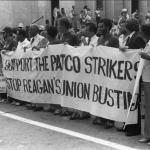
Reagan Shows the Union Who’s Boss (1981)
FORTY-FIVE YEARS AGO, ON AUGUST 5, 1981, President Ronald Reagan fired more than 11 thousand striking air-traffic controllers who refused his order to return to work. Two months later, their union – the Professional Air Traffic Controllers Organization – was decertified. The breaking of the strike and dissolution of PATCO is often characterized as a watershed moment in the history of organized labor in the U.S.
While it is true that the size and clout of U.S. unions have sharply declined since 1981, there is plenty of reason to believe that the PATCO debacle was a symptom and not a cause of the growth of labor’s troubles over the last 45 years. For short and informative examination of that question, visit https://labornotes.org/blogs/2011/12/patco-syndrome
On Vacation and Asleep at the Switch in Texas (2001)
TWENTY-FIVE YEARS AGO, ON AUGUST 6, 2001, 36 days before the 9/11 attacks on the World Trade Center and the Pentagon, President George W. Bush, who was vacationing in Texas, was handed a top-secret 2-page memo from the Central Intelligence Agency.
The memo’s 10 paragraphs were devoted to a single subject, explained by the memo’s headline: “Bin Laden Determined To Strike in US.”
It was one of several CIA reports for the President warning of imminent attacks by Bin Laden and al-Qaeda that were written by the CIA during 2001.
None of those reports resulted in a request for more information by the President or other senior officials who knew about them, including Vice President Dick Cheney, “Defense” Secretary Donald Rumsfeld, Secretary of State Condoleezza Rice and Gen. Richard Myers, the chair of the Joint Chiefs of Staff. On the contrary, Cheney and Rumsfeld asked whether those reports might not be deception on the part of al-Qaeda, purposely designed to expend resources in response needlessly. https://web.archive.org/web/20070806112749/http://www.gwu.edu/~nsarchiv/NSAEBB/NSAEBB116/index.htm
The Sniper Known as ‘Lady Death’ (1941)
EIGHTY-FIVE YEARS AGO, ON AUGUST 8, 1941, a 25-year-old Ukrainian sharpshooter named Lyudmila Pavilchenko began an exceptional military exploit that resulted in her becoming one of the most famous soldiers in the Red Army.
On this day, during the siege of Odessa, Pavilchenko began her career as a sniper when she shot two German officers dead from a distance of 450 yards. In less than a year, by June 1942, she had earned the nickname Lady Death, having killed no less than 309 German soldiers, making her one of the most effective snipers in history and the deadliest female sniper known.
In June 1942 Pavilchenko was hit in the face by shrapnel and hospitalized. When she recovered from her wounds, she was sent on a good-will tour of Canada and the U.S., as part of the Soviet Union’s effort to convince North Americans to support the allies’ opening a second front against Germany. For many more details about Pavilchenko’s fascinating career, visit https://en.wikipedia.org/wiki/Lyudmila_Pavlichenko
Police Brutality Gets an Official Work-Over (1931}
NINETY-FIVE YEARS AGO, ON AUGUST 10, 1931, the President’s National Commission on Law Observance and Enforcement surprised many “respectable” members of the public when it released a 352-page report about police brutality in the U.S. entitled Lawlessness in Law Enforcement.
The Commission, which was usually referred to as the Wickersham Commission, gave a detailed account of the “third degree,” the brutal method used by police to extract confessions, tactics that were used behind closed doors and seldom reported in the media.
The Commission’s report devoted 69 pages to a description of the use of the interrogation by “third degree” methods in 15 cities – New York, Buffalo, Boston, Newark, Philadelphia, Cincinnati, Cleveland, Detroit, Chicago, Dallas, El Paso, Denver, Los Angeles, San Francisco and Seattle. It stressed that New York City was “one of the worst” places for the abuse of prisoners and called for federal legislation to prevent such “unprintable barbarity.”
The report’s blistering account of widespread police brutality caused a national sensation. https://www.ojp.gov/ncjrs/virtual-library/abstracts/us-national-commission-law-observance-and-enforcement-report-no-11
Taking a Baby Step Down the Slippery Slope (1961)
SIXTY-FIVE YEARS AGO, ON AUGUST 11, 1961, President Kennedy signed the top-secret National Security Action Memorandum 65, which committed the U.S. government to pay the cost of creating and maintaining 200,000 troops in the South Vietnamese Armed Forces.
Any U.S. citizen or taxpayer who did not have a top-secret security clearance would have been surprised to learn that the United States was paying the entire cost of the escalating War in Vietnam, but the secrecy was essential, not as a military necessity, but because there was no popular support for U.S. military intervention in Southeast Asia.
As Kennedy and his war-mongering “Defense” Secretary Robert McNamara saw it in 1961, the easiest way to begin a large-scale military intervention in Vietnam was to keep the U.S. public in the dark. https://www.jfklibrary.org/asset-viewer/archives/jfknsf-330-015#?image_identifier=JFKNSF-330-015-p0001
For more People's History, visit
https://www.facebook.com/jonathan.bennett.7771/