
El-Sayed’s Challenge: Overcoming ‘Otherness’
Most Americans—most people—vote like their social peers.
That’s the undisputable finding of the most valuable study of American politics in recent years, Lainey Newman and Theda Skocpol’s Rust Belt Union Blues. The book documents the disappearance of 90 percent of the Steelworker union locals, and their union halls and social centers, from Western and Central Pennsylvania over the past half-century, eliminating union perspectives and union buddies from the lives of much of the state’s working class. The only remaining social centers in many of these former mill towns were gun clubs.
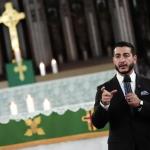
Since Newman and Skocpol wrote, America’s new left—socialist, social democratic, college-educated, young, and predominantly white—has surged. But it hasn’t surged in rural America or in those quadrants of suburban and urban America where its demographic makeup remains exogeneous and culturally alien. In Tuesday’s election in Michigan, Abdul El-Sayed got just enough votes in the state’s rural areas and inner-city Detroit to squeak past Haley Stevens, but Stevens’s surprising strength, particularly in rural Michigan, makes clear the vote-like-your-peers problem that El-Sayed has to surmount to hold the state’s Senate seat in the Democratic column come November.
In other words, the challenge before the new left’s capacity to win outside its home turf of demographically diverse cities and college towns may not be so much one of message, and more one of messenger. Most of the social democratic proposals on tap today—higher taxes on the rich to fund universal health, child, and senior care; enhanced worker power and constraints on oligarchic power; greater public provision of necessities (e.g., governmental subsidies to first-time homebuyers) that are otherwise unaffordable—are largely popular across the economic and political spectrums. But such proposals meet resistance when they come from candidates and campaigns that the right can vilify as culturally alien and threatening (which the right tries to do, of course, to any candidate not on the right), and when the candidate is, in fact, culturally alien to a sector of the electorate. “Socialism” is only one marker of this outsider status; so are race, gender, national origin (if not of the candidates, then of their parents), religion, religiosity—hey, this is America, you know the story. So, for that matter, is “billionaire.” Depends on who you ask.
There is, of course, precisely nobody in these United States who isn’t alien, in this sense, to tens of millions of Americans. The challenge now before El-Sayed and the new left is to win enough support in those parts of Michigan’s body politic where he and that left are, in fact, exogeneous.
One such sector is Black Detroit—most particularly, its older denizens. Most Black churches are not the natural habitat of DSA and the new left, but they’re certainly more open to the racial egalitarianism and populist economics of El-Sayed than they are to any Trump acolyte. El-Sayed surely understands that he needs to be church-hopping in Black Detroit on every Sunday from now to November.
Once upon a time, Black Detroit regularly sent to Congress its most far-left members: George Crockett (who’d actually served some jail time for having defended leaders of the Communist Party in court at the height of McCarthyism) and John Conyers. From the 1930s through the 1960s, it was communists and socialists, many of them leaders and staffers of the United Auto Workers, who cultivated Black activists and were part of their campaigns for housing integration and against the city’s viciously racist police. Not only were Black communists and socialists thoroughly enmeshed in the daily lives of Black Detroit, they often emerged as leaders of such mainstream groups as the city’s huge chapter of the NAACP. Coleman Young, who served five terms as Detroit’s Democratic mayor from 1974 through 1994, got his start as a stalwart of the Young Communist League in the 1930s and ’40s.
That, of course, was then, and by the time Young became mayor, he’d become a mainstream social democrat. That strain of politics surely persisted in Black Detroit, but the new left that began to emerge with Bernie Sanders’s first presidential campaign didn’t penetrate very far into the city’s venerable Black churches. Its political substance wasn’t the problem, but the vast majority of its enthusiasts simply weren’t Black Detroit’s churchgoers or appeared to be anything like them.
On Tuesday, however, a young Black DSA member, state Rep. Donavan McKinney, ousted the two-term incumbent, Indian immigrant Shri Thanedar, in the Democratic primary for Conyers’s old House seat. Economically and culturally, there was nothing alien or exogeneous about McKinney. The same can’t be said of El-Sayed, but he’s a lot less alien and exogeneous to Black Detroit than his Republican rival, much less the vile president with whom that rival is joined at the hip.
El-Sayed’s challenge is more acute in rural Michigan, and in the white working-class neighborhoods of towns and cities like Flint—the parts of the state where Stevens ran better than expected. The Republican campaigns there will focus entirely on El-Sayed’s “otherness,” and that of his supporters, in the hope that it will eclipse any comparison voters may make between his social democratic proposals and the economic policies that Trump has inflicted on them. Should typical El-Sayed volunteers knock on their doors, they may well seem visitors from an alien culture. If a critical mass (not a majority, but enough to swing the election) of rural Michiganders’ peers nonetheless either vote for El-Sayed or just don’t vote at all, that will mainly be because Trump has made their lives economically fraught and unsustainable, and doesn’t even seem to care that he has.
While El-Sayed will do his damnedest to convince voters he’s a regular guy, his overriding message has to be that his election will help end Trump’s disastrous control of the economy. In 2026, that’s really the only way that Democrats can overcome what many Americans see as their “otherness.”
[Harold Meyerson is editor at large of The American Prospect. More by Harold Meyerson ]
Read the original article at Prospect.org.
Used with the permission. © The American Prospect, Prospect.org, 2026. All rights reserved.
Support the American Prospect.
Click here to support the Prospect's brand of independent impact journalism.
=====
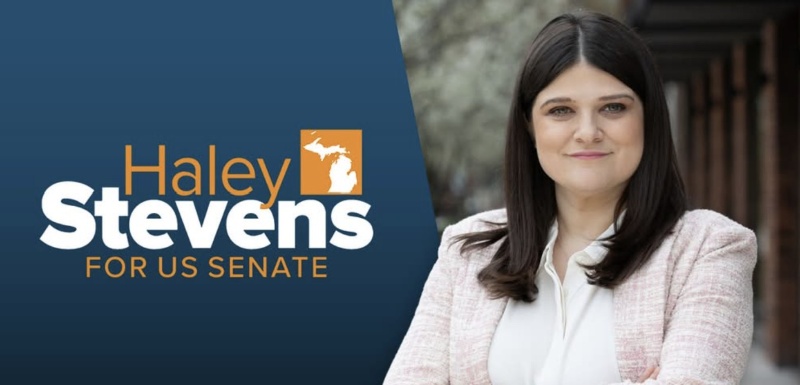
Official Election Concession Announcement from Rep. Haley Stevens, congratulating Dr. Abdul El-Sayed on his Democratic Primary victory
August 5, 2026
Haley Stevens Statement on Election Results
Haley Stevens for Senate
“I want to congratulate Abdul El-Sayed on winning the Democratic nomination for U.S. Senate. He is a doctor, a community health official, a Rhodes Scholar, and a dedicated Michigander. I am proud to offer my support as he takes on Mike Rogers in the general election.
“This was a thorough and rigorous campaign that brought out the full span of views within the Democratic Party - and that is why we have primaries. I am proud to have put up my hand to serve, and prouder to continue to work together to make sure this Senate seat remains blue, that we flip the United States Senate and continue the work for Michigan.
“Donald Trump and Mike Rogers want us to come out of this primary tired and divided, so their billionaire backers can come in and let multimillionaire Mike Rogers walk away with this Senate seat. They want to keep the Senate red, so Mike Rogers can keep rubber-stamping Donald Trump’s harmful agenda of higher prices, manufacturing jobs lost nationwide, corruption and abuses of power, and so he can ban abortion, gut health care, and roll back workers’ rights and voting rights.
“I’m not going to let that happen.
“We must elect Democrats up and down the ballot. We need to flip some important House seats. We need to re-elect my friends Hillary Scholten and Kristen McDonald Rivet. We need to win this Senate seat, because Elissa Slotkin deserves a partner like Abdul in the U.S. Senate.
“I am proud of the coalition our campaign put together: Black Michiganders, working class Michiganders, union members, farmers, hard-working families. The Michiganders who backed this campaign truly represent the grit, diversity, and spirit of our state, and I am honored to have earned each of their votes
Read full statement here
=====
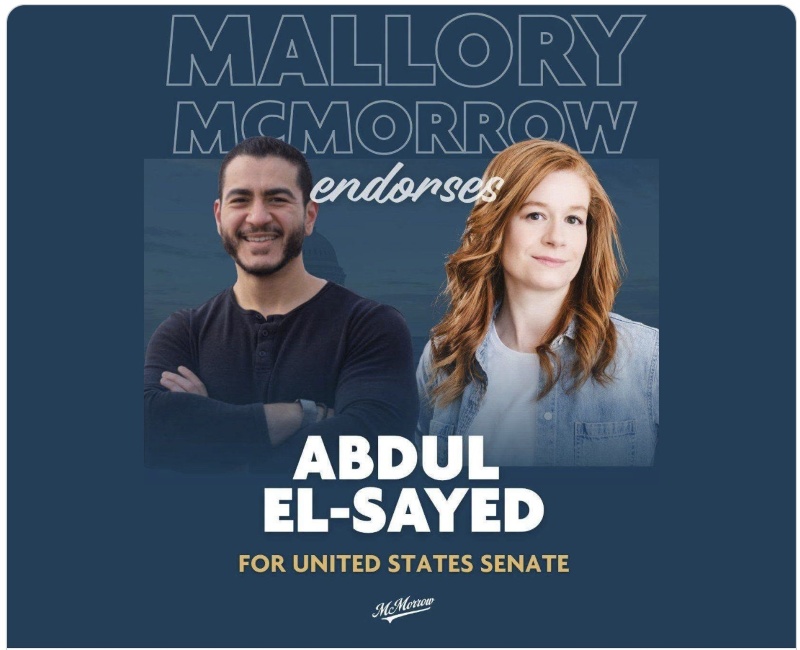
Mallory McMorrow Endorses Abdul El-Sayed
August 5, 2026
Mallory McMorrow Facebook page
Huge congratulations to Abdul El-Sayed for winning the Democratic primary to become our nominee to be Michigan’s next US Senator. I’m proud to give Abdul my full endorsement and support as we head to November together as a unified party.
Take it from me — this was a brutal primary. But whatever differences there were between the candidates in this race, those differences are nothing compared to the contrast in November. Donald Trump and Mike Rogers are banking on all of us being too bruised, too proud, and too hurt to come back together to beat them. Let's prove them wrong.
Because if we want everyone to have healthcare, if we want to protect our voting rights, if we want to end the grift and corruption of the Trump administration, if we want to end the abuses of ICE, if we want to lower costs and end illegal wars and rebuild this country to serve the people — not Donald Trump — the only way we get there is together.
The entire country will be watching Michigan. Let's show them who we really are. Let's come together, fight with all we’ve got, and on November 3rd, beat Mike Rogers. Again (embarrassing for him). Let's prove that Michigan can and will lead the fight to take our country back