
Looking Back To Look Forward
Most histories of the Communist Party end in 1956–1957 with the Khrushchev revelations about the Stalin period in the Soviet Union, the Soviet Union’s intervention in Hungary, and the resulting division in the ranks of the CPUSA. The press and “public opinion” proclaimed that the CPUSA was dead.
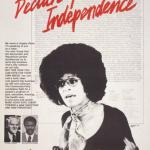
Books have been written about the movements of the 1960s, 1970s, and even through the 1990s and up to Obama’s election. Participants in these movements wrote some. Yet other than Angela Davis’s writings, nothing has been published about the roles and contributions of the Communist Party members or the various youth organizations that were allied and affiliated with the Party: the Labor Youth League, the W.E.B. Du Bois Clubs, the Young Workers Liberation League, or the Young Communist League during these decades.
Red Lives: Our Years in the U.S. Communist Party fills that gap in the historical record with first-person accounts of 16 former CPUSA members. My contribution, “Born Red: Pages from a Socialist’s Life,” recounts experiences from my 23 years in the Party, which I joined in 1968.
The Sixties were a time of hope. The aspirations and struggles of people shaped the consciousness of U.S. society and of the world. The Sixties were a time of social unrest that made this country what it is today and what the MAGAites are trying desperately to undo.
It was when the African American people of the United States regained the right to vote and won a century-long fight against segregation and Jim Crow inequality, while the anti-draft and anti-war movements were in their ascendancy.
Growing up at this time, one would wonder what was happening in that part of the world where the economic, political, and social systems were entirely different from those in the United States. It was not a matter of agreeing with those countries, but rather of acknowledging that they were different from ours and offering an alternative. No matter what the Cold War threw at the Soviet Union, it remained. The USSR was the first country to put a human being in orbit. And then, as the 1960s began, there was a new and different country — socialist Cuba — just 90 miles from U.S. shores.
Our generation was in motion. Like so many others, I protested and sought an alternative to the system that had brought about the crisis that we faced. We explored many socialist publications and organizations, the largest of which was the Communist Party. It was also the most multi-racial, the most multi-generational, and the most working-class.
As a high school student, I wanted to join a large, national, militant student movement and a multi-racial national socialist organization. So I joined Students for a Democratic Society (SDS) and the Du Bois Clubs. I joined the Communist Party in 1968. I was elected to the CPUSA national committee in 1975 and reelected at every convention until 1991, when I left the Party.
Like so many others in the Party from working-class families, I went to work, following in our parents’ footsteps. In Chicago, I worked in a small machine shop. On the job, we Communists were able to join with other workers– young, middle-aged, and older–to build a rank-and-file movement and to recruit workers into the Party.
In Chicago, I was a leader of the Young Workers Liberation League and also a Communist Party district leader. I represented the League in coalitions and was a leader of the citywide anti-war movement through the Chicago Peace Council. In 1974, I was a Communist Party candidate for statewide office and a co-convener of the first Young Voters state conference. I share this because, for me, building and participating in the socialist and communist movement was not a contradiction to involvement in and building of the broader democratic people’s movement.
I then became part of the national leadership of the Young Workers Liberation League. From 1975 to 1983, the YWL had a membership of upwards of 15,000 nationwide over this period, but no more than 3,000 in any one year. I estimate that there were many thousands more who joined the Party between 1960 and 1990, especially during movements like the campaign to Free Angela Davis and all political prisoners; the anti-Vietnam war movement; the numerous labor rank-and-file upsurge campaigns and movements; the movement to end apartheid in South Africa and free Nelson Mandela and others imprisoned; the movement in solidarity with the people and government of socialist Cuba; the campaign against the fascist junta in Chile; and the numerous Party election campaigns.
This is the story that several of us felt needed to be told. Why did thousands seek out this socialist organization; why did they join it; what did they do; what did they accomplish; what movements did they build; how did they work; what mistakes did they make; what might today’s generation of activists and socialists learn from them?
A group began meeting to discuss how we could proceed. We assembled a list of about five hundred of our friends and former comrades and began contacting them. Fifty agreed to write, and we are producing three volumes. The first is Red Lives: Our Years in the U.S. Communist Party (1950–2000); Vol. 1: Coming of Age in the Communist and Labor Movements.
The Romance of American Communism, by Vivian Gornick, was published in 1977. Gornick interviewed 40 former Communists about their membership and activities. They felt that their time in either the Communist Party or the Young Communist League was the best years of their lives. They left, no matter when, at the right time. They were not bitter about those years; they were bitter about the period after they left — the McCarthy era.
The 16 writers in Red Lives are also not bitter. They are writing about young people whose lives are full of activity and excitement, lives in struggle for a better life for themselves, their generation, their class, and the generations that would follow. As during the McCarthy era (1947–1954), there is today a danger of fascism and the erosion of our basic democratic rights and liberties, but resistance to that is developing and growing daily.
In my opinion, a socialist movement must include several pillars:
• A commitment to democracy and to the struggle for the fullest expansion of democratic rights, both in the United States and worldwide.
• A fight for equality, against racism, sexism, misogyny, homophobia, and for transgender rights.
• Socialism is a political and economic process, not a finished product that can be declared achieved. Further, there needs to be a recognition that both socialist democracy and a socialist economy require pluralism and a multitiered economy.
• The preservation of the earth must be a primary focus for everyone: dealing with climate change, getting rid of nuclear energy and nuclear weapons, and protecting the food we eat.
• The working class is diverse and not static. The working class is multinational and multiracial.
• Peace and the prevention of nuclear war are not tactical but fundamental issues that should underlie everything we do.
• Democracy must be extended to a socialist organization itself with full discussion and debate.
Beginning in the mid-Eighties, the Party leadership developed a political position that counterposed the building of the mass movement with the building of the Communist Party. This position intensified after the death of National Chairman Henry Winston in 1986. The Party promoted the ideological concept of the “Communist-plus” to define the unique role of Communists within broader democratic people’s movements.
This approach prioritized the Party’s public role over building and participating in popular movements. It included growing the circulation of the Party press (the Daily World and later the Daily People’s World), pushing its own speakers and candidates within coalitional movements, and Party members being public about being Communists. Running Party candidates for public office required collecting thousands of signatures to get them on the ballot, and all members were required to participate in these signature drives, including members who were not publicly known as Communists.
Communists who were leaders of mass organizations but not known publicly as Communists and who had not recruited new members were criticized and characterized as “not-real-Communists.” The Party’s attitude toward the McGovern campaign in 1972, that “the only vote that counted was a vote for Gus Hall and Jarvis Tyner,” was a preview of “Communist-plus.” Then came Gus Hall’s report to the Central Committee after the 1972 election, “A Lame Duck in Turbulent Waters: The Next 4 Years of Nixon,” which prioritized running Communist candidates over an electoral approach that included participation in Democratic Party campaigns.
I believe the primary catalyst for change is the broad people’s democratic movement, whatever form it takes, with the socialist movement as a component, agitating for more advanced positions within the larger people’s movement.
The height of the Party’s mass influence and membership was not in the Thirties, as some might think, but in the period right after World War II, after the Party was reconstituted following its dissolution under Earl Browder in 1944. The start of the Cold War at home in 1947 and the traveling HUAC hearings and roadshow were no accident. Much of the history written about the Cold War and the McCarthyite purge of the U.S. Left was tied to postwar developments in Europe, the “loss” of China, and the Korean War. But the goal of McCarthyism was to roll back New Deal policies and the influence of the Left, especially after the massive strike wave and unionization after World War II and the rise of the Civil Rights movement.
From the CPUSA to DSA
Today, I am proud to be a member of the largest socialist organization that the United States has ever seen, an organization that is growing, that is part of today’s movements for social change, and that is electing democratic socialists to city councils, county governments, state legislatures, and to the halls of Congress. That organization is Democratic Socialists of America, and it boasts more than a thousand members holding elective office from one end of the country to the other.
In fact, I have now been a member of DSA for more years (33) than I was a member of the Communist Party (23). In fact, I joined DSA about two years after I left the CPUSA.
There is a huge difference between joining DSA and joining the Communist Party or joining any of the other communist-type parties that existed from the Sixties to the Nineties.
One just joins DSA, either at a meeting or event, or individually online. During the period when I was a Communist Party member, one had to be recruited, sponsored by two members, vetted, and then voted on by a Party collective (club or district organization) that the prospective member would join. DSA members are usually assigned to a chapter closest to their geographic area. Party members belonged to either a neighborhood, a shop, or an industry club.
Larger DSA chapters today are simply not physically able to hold chapter meetings, given their membership size. They send out activity notices and have working groups and committees, and members participate in many activities and campaigns, especially elections. They are welcomed into membership and told about educational activities. However, it is up to the individual member to determine their level of involvement and participation. In larger chapters, there may not even be a follow-up phone call to find out why a member is not participating.
I pay dues to the national organization, pay a national sustainer fee, and receive regular monthly email receipts. I also pay local dues and a sustainer to my local chapter. I have signed up for a couple of working groups. I have participated in some electoral campaigns. I get emails and texts. But I have never once received a phone call to find out why I did not participate in an activity, why I pay as a sustainer, or what I think.
My experience during my years in the Communist Party was completely different. An individual was part of a collective, a club, which met regularly, usually every two weeks. The collective discussed the overall political situation and the Party’s immediate tasks, the specific tasks in our community, industry/union (or shop), and how each of us could fit into that work. Club members were generally familiar with the political work of other members and would often discuss specific problems individual members were encountering. Contrary to the public perception, the club could not discuss in advance how members should vote at a particular meeting because it did not know in advance what others in a given mass organization or union might, in fact, say and do.
The experience of the Communist Party organizational form cannot be repeated or replicated. It fell apart because the politics — “the science of Marxism-Leninism,” democratic centralism, the infallibility of existing socialism — did. I came to reject democratic centralism, one of the bedrock principles of the world Communist movement, as it was practiced. It has no place in today’s world in the struggle to expand and develop full democratic rights.
Democratic centralism was supposed to mean the fullest discussion in the ranks of the membership with the elected leadership at all levels, then making decisions based on such discussion, including full debate of positions and alternatives, which would then be binding on all members.
In reality, the membership lacked access to information, knowledge of events elsewhere, or awareness of which resources might be available to implement policies and decisions, and therefore could not fully participate in discussions of policy and programs. Instead of resolutions that could be debated in leadership bodies, omnibus reports were presented, and a “general line” was voted on. As a result, the membership, including members of those leading bodies, never really knew what the actual issues or various policies were.
The reality today is that individuals respond to events much faster than at any other time. Our task is to organize that response. How do we make it not individual but collective? How do we affect change and policy? This project requires both ever-larger democratic movements for reform and, within them and alongside them, ever-larger democratic socialist organizations whose politics go beyond patching and band-aiding capitalism.
And then, as an organization, how do we find ways to be better and more regularly in touch with our members, not just our active and involved members, but our full membership, including those members who just pay their annual membership dues? How do we raise the level of socialist understanding among our membership, both in general and on all issues where we take a position or issue a statement? These are tasks that our growing and developing democratic socialist organization needs to take on and grapple with.
This article is based on opening remarks at a Book Talk Conversation at Busboys and Poets Books, Washington, DC, May 21, 2026, with Red Lives co-editor and contributing author Jay Schaffner and Chris Townsend, contributing author. The event was co-sponsored by the Labor Heritage Foundation and Metro DC Democratic Socialists of America (DSA).
[Jay Schaffner, was born in 1952 and grew up in Skokie, a Chicago suburb. He was in Students for a Democratic Society, the socialist, multiracial W.E.B. Du Bois Clubs and was a founding member of Young Workers Liberation League. In 1975, was elected to the CPUSA national committee, and then at every convention until 1991, when he left the Communist Party. In 1990 he became a clerical worker for Local 802 of the American Federation of Musicians; and then later the head of the local's Recording Department. He was later elected to the Executive Board. A founding moderator of Portside, he continues collaborating with the progressive news website. In retirement, he co-chairs a tenant committee in his housing cooperative. He is an elected member of the New York State Committee of the Working Families Party and is a member of DSA.]
Democratic Left is the official magazine of the Democratic Socialists of America (DSA), run by the Democratic Left subcommittee of the National Editorial Board. The National Political Committee appoints the Editorial Board every two years in accordance with a 2023 National Convention Resolution.