
Tidbits-Aug. 13: Reader Comments: Credible Threat?; Todd Blanche?; Contempt of Congress – No Question; New Health Care Crisis; Howard Zinn; Dr. Anthony Fauci; Prairieland; Abortion Rights; How Domestic Workers Built POWER; Announcements – New York;
-
Credible Threat -- Cartoon by Lalo Alcaraz
-
Trump Gets His Blanche -- Cartoon by Pedro X. Molina
-
Contempt of Congress -- Cartoon by Adam Zyglis
-
Re: Did Howard Zinn Tell Too Simple a Story About American History? (Bob Bussel; Frank Stricker)
-
Government of White People, By White People, For White People.... -- Cartoon by Garry Trudeau
-
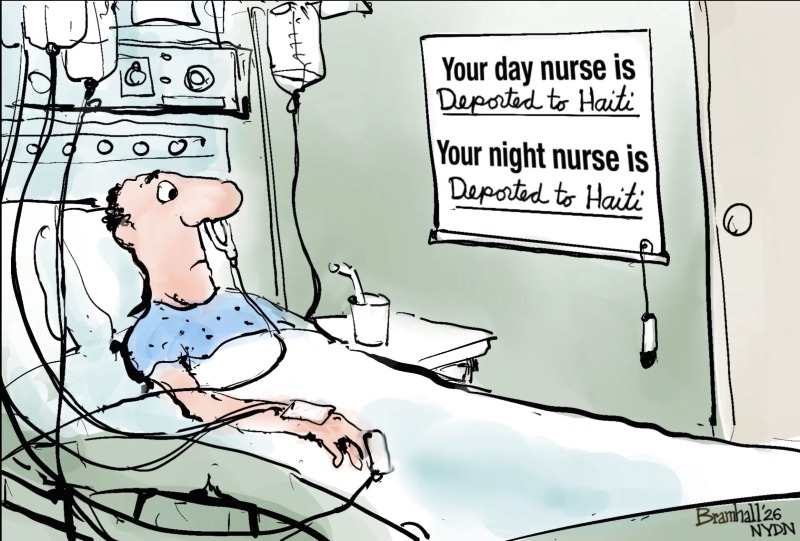
New Health Care Crisis -- Cartoon by Bill Bramhall
-
Re: ‘What Was Criminalized Here Is Dissent, Not Terrorism’: CounterSpin Interview With Dorothee Benz on Prairieland (Marjorie Kramer)
-
Re: The Fight for Abortion Rights Was Won in the Streets (Carol Hanisch)
-
Re: How Domestic Workers Built POWER in Philadelphia (Georgia Wever)
-
There Goes the Neighborhood -- Cartoon and Commentary by Steve Sack
-
In Support of Dr. Fauci (Gene Grabiner)
Announcements:
-
The Debra E. Bernhardt Labor Journalism Prize - Entry Deadline August 31, 2026
-
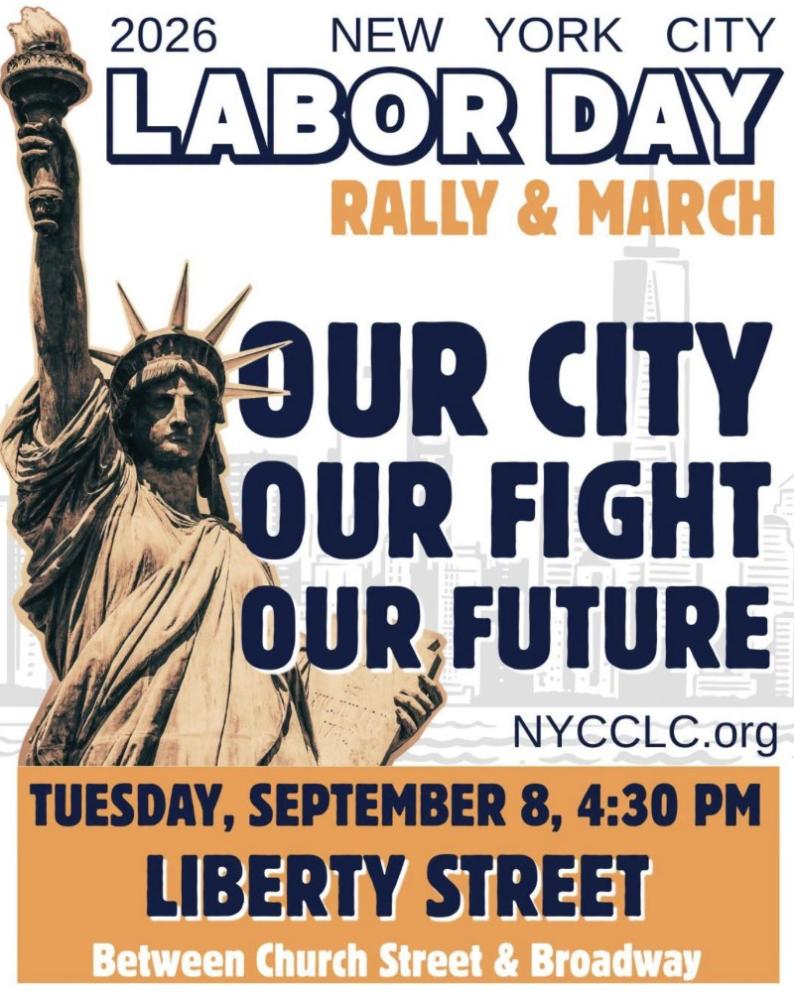
2026 New York City Labor Day Rally and March -- Tuesday, September 8
-
NYC Democratic Socialists of America's Academy for Socialist Education has two courses coming up - Fascism through the lens of the Frankfurt School, and the history of Red New York -- Starting September 9
.
.
Credible Threat -- Cartoon by Lalo Alcaraz

My latest syndicated editorial cartoon for Andrews McMeel! 25 years strong! Also, can you believe this chicken taco motherfarker???
Lalo Alcaraz
August 11, 2026
Lalo Alcaraz Facebook page
Trump Gets His Blanche -- Cartoon by Pedro X. Molina
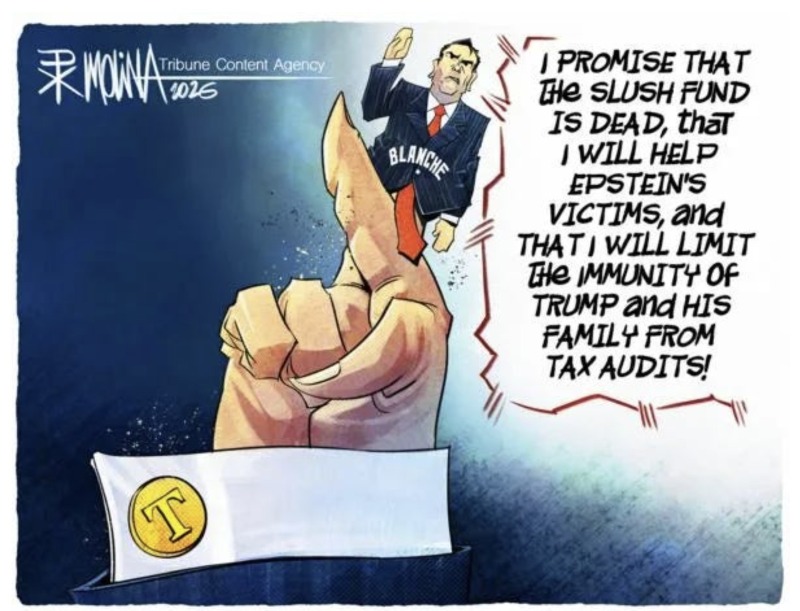
Pedro X. Molina
August 3, 2026
Tribune Content Agency
Contempt of Congress -- Cartoon by Adam Zyglis
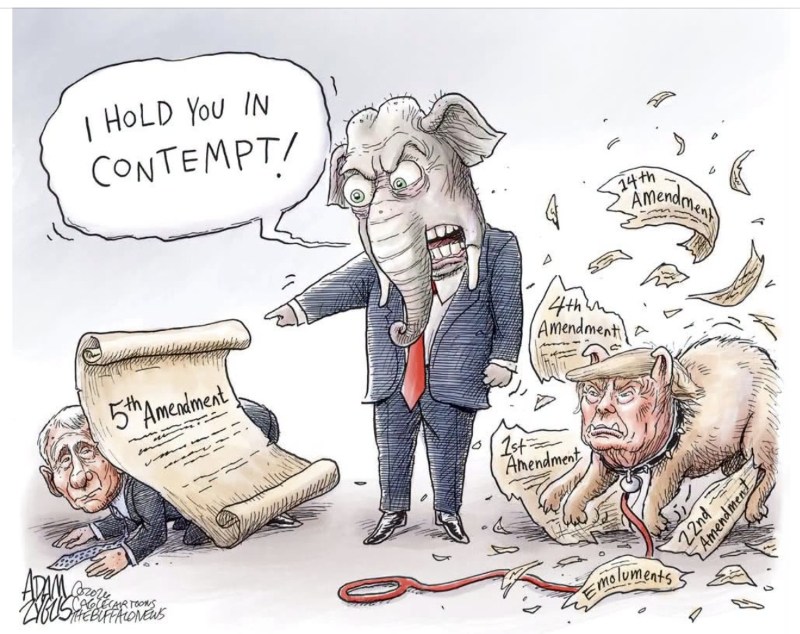
Adam Zyglis
August 6, 2026
The Buffalo News
Re: Did Howard Zinn Tell Too Simple a Story About American History?
I thought Mike Kazan's critique of Zinn cited here was spot on, as is this piece. I give Zirin his due but nuance is not his stock on trade.
Bob Bussel
=====
have not read the article but the answer seems obvious. yes, of course, he simplified And we needed that. his was one of the few easy to read, compact alternative histories that was still somewhat serious. Name another? Gary Nash et al created a big kinda alternative and it was good. But not as exciting. many of my students were thrilled or astonished to read Zinn, and in a college course.
Frank Stricker
Government of White People, By White People, For White People.... -- Cartoon by Garry Trudeau
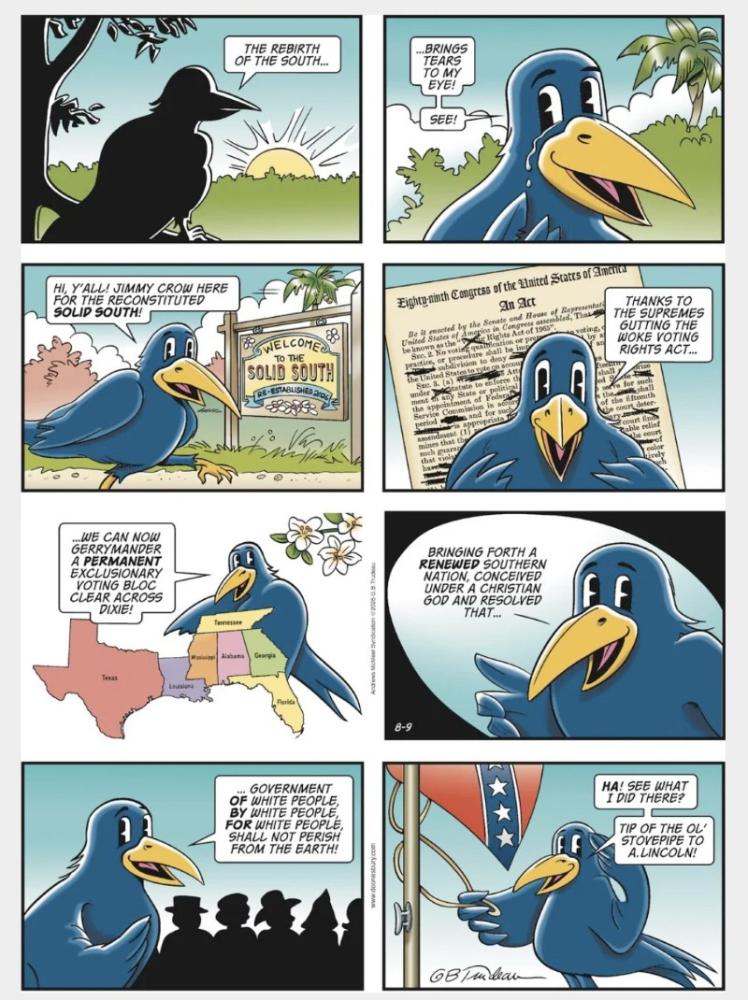
Garry Trudeau
August 9, 2026
Boston Globe
New Health Care Crisis -- Cartoon by Bill Bramhall
Bill Bramhall
New York Daily News
June 28, 2026
Dissent can be a sign of and part of good government.
Marjorie Kramer
Posted on Portside's Facebook page
Re: The Fight for Abortion Rights Was Won in the Streets
Although the large demonstrations "in the streets" organized by WONACC and others in the early 1970s certainly contributed to the Roe vs. Wade Supreme Court decision, they are only part of the history. The claim is misleading on two counts: what we got with Roe v. Wade was far from winning the repeal of all abortion laws that we fought for and it took a lot more than being in the streets—though we were there too.
The first necessity in the 1960s, was to break through the wall of silence that surrounded the reality of abortion. Most abortions were a crime. Even the word was rarely mentioned in public and often not even in private among friends. It also was considered shameful and in most cases women bore the full brunt of it all.
By the second half of the '60s, this was beginning to change. Some states moved toward reform, though with many restrictions, and in 1967 Colorado became the first state to do so. In November of that year, the National Organization for Women (NOW) included abortion repeal in its Bill of Rights for Women. A national web of Women's Liberation Groups also began to form in 1967, and abortion became a topic of consciousness raising and discussion and sometimes action. Cindy Cisler, then a member of NOW and a founder of New Yorkers for Abortion Law Repeal, soon joined New York Radical Women, bringing the demand for repeal of all abortion laws with her.
In January of 1969, a group of those radical women, soon to become Redstockings, disrupted a New York State legislative hearing composed of 14 men and a nun. They proclaimed that "women are the experts on abortion" and demanded to be heard. The hearing adjourned to another room, but some of the protesting women bravely stuck around spoke to the media about their own illegal abortions, and three months later held the historic Redstockings public speak out on abortion, a great leap in breaking the silence.
From consciousness-raising to protests to organizing to lobbying to writing and speaking out, feminists worked hard and took all kinds of risks in the fight for reproductive control. Some groups, like the underground abortion service known as "Jane" in Chicago and the Self-Help Clinic of the Feminist Women's Health Center in California, even took matters into their own hands—literally—and learned to perform and teach safe abortions. All this activity alarmed the power structure. In New York, Gov. Rockefeller and some legislators admitted they supported a REFORM bill passed in 1970 to prevent a REPEAL bill that would result in "no law at all". It pays to fight for what we really want.
It's also important to remember that the struggle for abortion rights was part of a militant and independent grassroots movement for Women's Liberation. It went much wider and deeper than any single issue.
Carol Hanisch
Re: How Domestic Workers Built POWER in Philadelphia
(posting on Portside Labor)
This article is well worth reading and grasping its tactics. Thanks,
Georgia Wever
There Goes the Neighborhood -- Cartoon and Commentary by Steve Sack
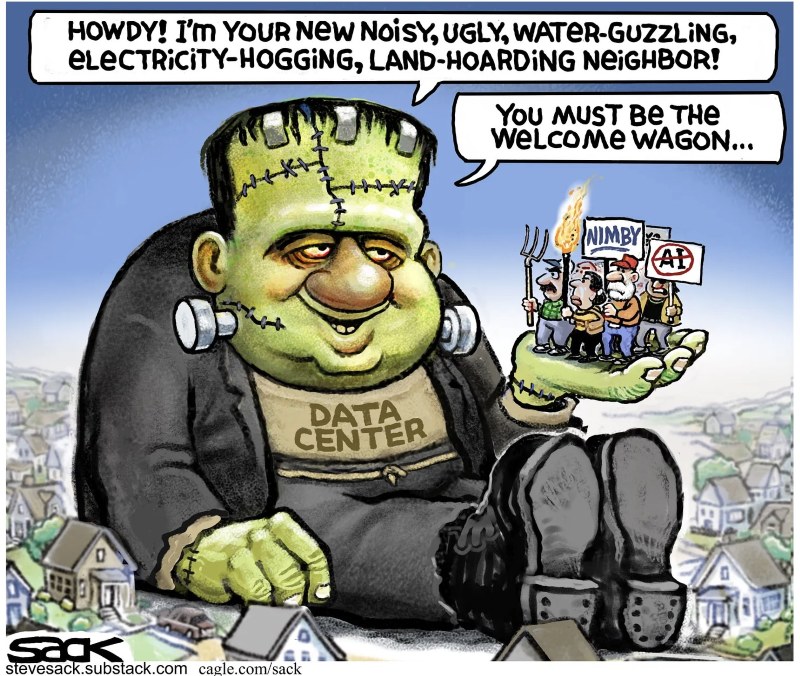
Data centers are today’s version of the smokestack factory—minus the smoke. They consume staggering amounts of electricity and water, generate relatively few jobs, and leave nearby residents wondering why they traded open fields for a giant beige box full of somebody else’s selfies and AI generated homework.
Steve Sack
August 6, 2026
The Art of Sack
I write in support of Dr. Fauci.
Having been found guilty of a crime, a person loses some of their social being or citizenship rights or, perhaps ultimately, their life. However, the Fifth Amendment provides for protection against self-incrimination. No matter how many times one pleads the Fifth, it is their right to do so. And doing so is not a crime. Nor does it constitute criminal contempt of Congress. Additionally, First Amendment freedom of speech is also the freedom not to speak. And so, there is an interrelationship between the First and Fifth Amendments.
There are additional rights within the Fifth Amendment. As the Amendment states: “No person shall be held to answer for a capital, or otherwise infamous, crime unless on a presentment or indictment of a Grand Jury…” Infamy (Latin: Infamia) is social disgrace, or loss or reduction of social being or social status or citizenship rights. So, for example, the class of the infames in Rome were reprobate by virtue, unavoidably, of their occupations or their very social being. The Roman infames included; gladiators, prostitutes, small business traders, thespians, and, of course slaves, who had no social being. But their infaming status was not necessarily violation of the law (infamy of act). Indeed, they were infamed simply because of who they were or because of their occupations (infamy of fact).
As I have said, infamy because of social status or occupation or social being is infamy of fact. That is not the case among us, where the Bill of Right expels the subjective arbitrariness of infamy of fact. (Sadly, infamy of fact persists culturally in the consciousness of arbitrary shame, humiliation, and shunning of, for example, one who is born out of wedlock or one who is homeless etc.) Among us, however, a crime must be proven at law, (infamy of act) and the accused benefits from a two-jury protection. If guilt is established for a given infaming crime or crimes, (usually, a felony) there is a sentence passed which carries with it the shame of social disgrace. The “capital crime” of the amendment is one for which guilt brings incarceration (capitis deminutio media) or, in extremis, execution (capitis deminutio maxima--literal loss of the head, or capit).
The Grand Jury protection of the Fifth Amendment is a guard against a regime of arbitrariness, which had been typical of the English Kings’ jury-less and secret Star Chamber, which was founded by Henry VIII, and used by Charles 1 against his political and religious opponents. This was also the case with colonial Massachusetts’ witchcraft trials. Star Chamber was abolished by the Long Parliament in 1641.
While Rand Paul’s machinations against Dr. Fauci are not secret, they are still arbitrary, subjective, unconstitutional, and, per the Fifth Amendment, criminal in themselves. The Fifth Amendment bans both the Congress and the President from arbitrarily infaming anyone in the American social space outside of the rule of law (consider the immigrants–both incarcerated and deported, consider all the those threatened Haitians now made to wear ankle bracelets[1], consider military women and African Americans purged from the Service or denied promotion: all because of their very social being). Yet, we are supposed to have no extrajudicial infamy, no infamy of fact. The only constitutional infamy we have is infamy of act–-linked to guilt established via the rule of law after a Grand Jury Indictment and a Trial Jury (Petit Jury) conviction. To reiterate, violation of these protections is unconstitutional and criminal in itself.
Sincerely,
Gene Grabiner
SUNY Distinguished Service Professor Emeritus
The Debra E. Bernhardt Labor Journalism Prize - Entry Deadline August 31, 2026
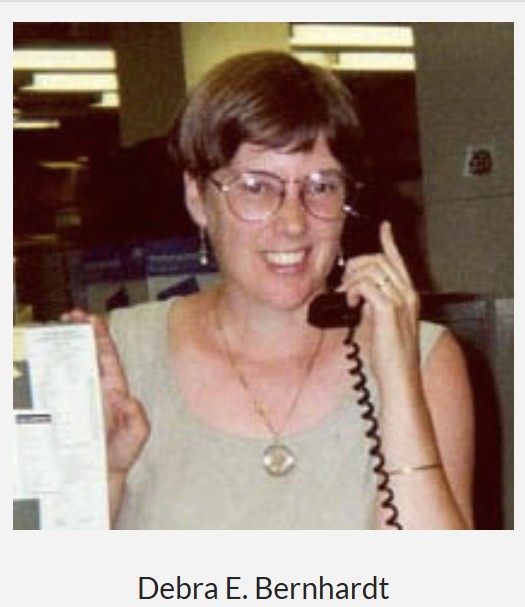
The New York Labor History Association’s Bernhardt Prize awards $1,000 to an article that exemplifies great writing for a general audience and furthers the understanding of the history of working people. The prize and the forum honor the vision of the late Debra E. Bernhardt, who worked in so many different realms to share the hidden histories of working people.
Catching up after a year without an award, the current contest will accept entries published September 1, 2024 – August 31, 2026.
DEADLINE FOR ENTRY: August 31, 2026
GUIDELINES – We welcome articles that put current issues like work, housing, organizing, health, or education in a historical context AND also articles about historical events. The work must be published in print or online between September 1, 2024 and August 31, 2026. The prize is given to insightful work that contributes to the understanding of labor history; shows creativity; demonstrates excellence in writing; can reach a broad audience; and adheres to the highest journalistic standards of accuracy. Previous winners are listed below.
DETAILS – Only one article per entry; only one entry per person; publications and subject matter should target the United States and Canada; neither books nor plays are eligible.
TO ENTER: Send an email to info@laborarts.org with the following information:
Your name
Title of article
URL for article
Name of Publication
Date of publication
SUBJECT LINE: Bernhardt Contest entry
====
The New York Labor History Association and NYU’s Tamiment Library/Robert F. Wagner Labor Archives sponsor this award in order to inspire more great writing for a general audience about the history of work, workers, and their organizations.
We are guided by the vision of the late Debra E. Bernhardt, who worked in so many different realms to share the hidden histories of working people. As head of the Wagner Labor Archives she reached out to an astonishing number of people and organizations, to document undocumented stories and unrecognized contributions, and to make links between past and present. The LaborArts project is dedicated to Bernhardt, and the online exhibit “Making History Personal” explores her work.
See the new paperback edition of the book that features many of the materials she brought to the Robert F. Wagner Labor Archives – Ordinary People, Extraordinary Lives – A Pictorial History of Working People in New York City.
Previous Prizes
Kim Kelly received the 2024 prize for her article “Lawsuit: Alabama is Denying Prisoners Parole to Lease Their Labor to Meatpackers, McDonalds” (In These Times, April 19, 2024). The October 17th Forum focused on the Labor and the 2024 election, with Alethia Jones (movement educator and labor studies faculty), Lucia Gomez (NYC CLC Political Director) and Eric Blanc (organizer and labor studies professor). Natalia Shevin spoke about Bernhardt. Watch video of the event here.
Alex Press received the 2023 prize for her article, “Hollywood Is on Strike Against High-Tech Exploitation” (Jacobin, July 21, 2023). The November 8 forum focused on labor and artificial intelligence with Jane Chung (Justice Speaks), Christopher Kyle (Writers Guild) and Susan DeCarava (News Guild). Sonia Bernhardt Bloom spoke about Bernhardt. Watch video of the event here.
Molly Crabapple received the 2022 prize for for the article “How the Taxi Workers Won,” The Nation and the Economic Hardship Reporting Project, 12/13/21. The October 2022 forum focused on new forms of organizing and featured Tom Robbins (moderator), Joselyn Chuquillanqui (Starbucks worker organizer), Claire Chang (REI worker organizer), Mat Cusick (former Amazon Union organizer); Alexander Bloom spoke about Bernhardt. Recording available here.
Martha Pskowski received the 2021 prize for “Saving Lives and Going Hungry: NYC Ambulance Workers Demand Higher Pay,” The Nation, April 6, 2021. The October 2021 virtual forum focused on newsroom organizing and the larger labor movement and featured Nastaran Mohit (NewsGuild) and Edward Ongweso Jr. (VICE); Alexander Bloom spoke about Bernhardt. Recording available here.
The 2019-2020 prize went to two articles: Josh Eidelson, “How the American Worker Got Fleeced,” with data analysis and graphics by Christopher Cannon, Bloomberg Businessweek July 2, 2020 and David Unger, “Which Side Are We On: Can Labor Support #BlackLivesMatter and Police Unions?” New Labor Forum, July 6, 2020. The October 2020 Forum featured labor journalist and author Steven Greenhouse and Culture Workers Education Center founder Natasha Bunten; Jon Bloom, Joe Doyle and Janet Greene spoke about Bernhardt. Video of the event available here.
Jaeah Lee received the 2018-19 Award for “The Real Cost of Working in the House of Mouse,” Topic Magazine (online), September 2018. She was a featured speaker at the 2019 Bernhardt Labor Journalism Forum on October 16, 2019, Labor Journalism – The Next Generation, with Kim Kelly (Teen Vogue) and Alex Pres (Jacobin); Sonia Bloom spoke about Bernhardt.
Toni Gilpin received the 2017-18 Award for “A Louisville Union Built Its Strength as Blacks, Whites Took on International Harvester,” in Louisville Weekly, August 30, 2017. She received the prize at the Bernhardt Labor Journalism Forum on October 16, 2018 – “2018 – The Year of the Teachers Strikes” with investigative journalists Micah Uetricht (Jacobin, In These Times) and Tom Robbins (CUNY); Keri Amanda Myers spoke about Bernhardt.
Garret Keizer was the 2016-17 Award winner for his article “Labor’s Schoolhouse” – Lessons from the Paterson SIlk Strike of 1913,” in Harper’s Magazine, July 2017. The prize was awarded at the Third Annual Bernhardt Labor Journalism Forum on Thursday October 12, 2017 at Tamiment Library, with investigative journalists and labor activists Ginger Adams Otis (NY Daily News); Michelle Chen (The Nation); and Ed Ott (CUNY) participating; Jon Bloom spoke about Bernhardt.
The 2015-2016 winner was Chloe Kent, for her article “The Women of New York’s Bravest” in Enchantress magazine, May 2016. The award was announced at a forum at NYU’s Tamiment Library on October 13, 2016. Columnist and broadcast journalist Juan Gonzalez joined historian Kimberly Phillips-Fein for a discussion about using history to improve reporting on current labor issues, with Tom Robbins returning as moderator; Jon Bloom spoke about Bernhardt.
The 2014-2015 prize was awarded on October 15, 2015 to David Kameras and Emily Harris for their May, 2014 article in the United Mine Workers Journal: “From Tragedy to Triumph – 100 Years Later, Workers Benefit from Ludlow’s Legacy.” The presentation was held at NYU’s Tamiment Library, following a program moderated by Tom Robbins, Investigative Journalist in Residence, Graduate School of Journalism, CUNY; with panelists Esther Kaplan, Editor, The Investigative Fund at The Nation Institute; and Richard Steier, Editor, The Chief-Leader; Alex Bloom spoke about Bernhardt.
2026 New York City Labor Day Rally and March -- Tuesday, September 8
Our City, Our Future, Our Fight
We invite you to join us on Tuesday, September 8, at 4:30 PM for Our City, Our Fight, Our Future, a rally and march beginning on Liberty Street in Lower Manhattan.
New York City's strength comes from the people who build, maintain, teach, heal, transport, protect, and keep our city running every day. This mobilization is an opportunity for the entire New York City Labor Movement to come together and demonstrate the strength, solidarity, and power of working people, while standing up for the rights, freedoms, and future of all New Yorkers.
Just as our Labor Day Parade has long served as a public display of labor's unity and collective power, this event will bring together union members from every sector to send a clear message: when working people stand together, we can meet any challenge and shape a better future for our city.
We encourage everyone to join us for this important evening of solidarity and action. Together, we'll demonstrate the collective strength of New York City's Labor Movement.
-
Fascism and the Frankfurt School will explore the appeal of the far right—the promises it makes, the desires it appeals to.
Four alternating Wednesdays starting Sept 9 in lower Manhattan. - Red New York will examine the history of the left in our largest city—what it is about the city that has given rise to so many radical movements.
Five alternating Tuesdays starting Sept 15 in lower Manhattan. See less
Deadline for Applications: August 23, 2026, 11:59pm / Note: Course is in-person only.
The Frankfurt School on the Far Right: Critical Theory and Fascism
Instructor: Jeremy Cohan
Dates: Wednesdays, 7–9pm • September 9, 16, 23, 30, 2026
Location: DSA Office 14 Jefferson Street, NY, NY 10002
Course cost: $35 DSA members / $45 nonmembers
Course Description
Mark Twain said that history does not repeat itself, but sometimes it rhymes. And surely our time rhymes with the early 20th century’s political terrain: the collapse of the free-market capitalist center, the rise of democratic socialist politics and a resurgent left, and the rise and accession to power of the far right—the rise of fascism. With the rise of fascism, a new force entered onto the stage of history: mass movements of the far right, dedicated to dictatorship, exploitation, violence, and mass murder. Understanding and combatting a mass movement for authoritarianism was then, and is now, core to the tasks of a democratic left.
The Frankfurt School—Theodor Adorno, Max Horkheimer, Leo Lowenthal, Erich Fromm, Herbert Marcuse, Walter Benjamin, Franz Neumann, Otto Kircheimer, and others—were a group of heterodox, mostly Jewish, Marxist scholars, centered around the Institute of Social Research in Frankfurt, Germany. They both saw firsthand the effects of fascism as they fled to the United States to escape persecution, and they were uniquely positioned intellectually to analyze how potentials for freedom and equality created by the modern world turned to hatred and destruction. The question of how fascism works and what the movement provides its mass base became core to the school’s intellectual agenda, and they brought their unique set of interdisciplinary tools from Marxist theory, psychoanalysis, academic sociology, media analysis, aesthetics, and more to the task of solving the puzzle of what makes a fascist tick.
This course will review some of the core writings of the school on the far right, mostly but not exclusively focusing on the writings of Theodor Adorno. It will begin with some of the foundational writings and history of the school, then turn to excerpts from Prophets of Deceit, The Authoritarian Personality, Escape From Freedom, “Freudian Theory and the Pattern of Fascist Propaganda,” and “Aspects of the New Right-Wing Extremism.” We will explore the analysis in these works of how fascist agitation works, as well as the social psychology of those tempted to follow far right agitators. In what ways does modern capitalism create the basis for the rise of the far right? What does a fascist movement promise its followers? What desires does fascism appeal to? What are fascists looking to find and willing to do? What are some of the core characteristics of the far right that the left needs to understand to fight against it?
Jeremy Cohan is a sociologist who studies teachers unions, political economy, philosophy, and Marxist theory. He is a former co-chair of NYC DSA. He has held leadership role's in the chapter's work on Palestine solidarity, electoral campaigns, socialists in office, political education, and student organizing.
Apply for Frankfurt School & Fascism - Click here
Deadline for Applications: August 30, 2026, 11:59pm - Note: Course is in-person only.
Red New York: A History of the Left in America's Most Radical City
Instructors: Steve Fraser and Josh Freeman
Dates: Tuesdays, 7–9pm • September 15, 22, October 6, 20, November 3, 2026
Location: DSA Office 14 Jefferson Street, NY, NY 10002
Course cost: $35 DSA members / $45 nonmembers
Course Description
New York City has long been known as a hot-bed of radicalism, as America’s “Red City.” Zohran Mamdani’s election is the latest confirmation of that perception. This course will examine the city’s left-wing history, exploring the political and cultural manifestations of its insurgent character and what that might suggest about our current moment.
The course will tackle some large questions: Why has New York been a pre-eminent center of radicalism? What has been the relationship between the city’s immigrant demography and its radical past? How has New York’s history of cultural dissent and inventiveness been linked to its revolutionary political movements? Has the city’s radicalism shifted with respect to the evolution of capitalism? What has been the relationship between socialist revolution and reform in the shaping of Red New York.
Times have changed in many ways between when 19th century radicals electrified the life of New York City and Zohran's recent victory. But there are lessons to be learned and questions that confronted the left of yesteryear that continue to face us today. Red New York will try to engage the city's past, in part, in order to bring that wisdom to the prospects and dilemmas we must deal with today.
Red New York will consist of five sessions: The first session will meet for one hour. The subsequent sessions will meet for two hours.
Session 1 will provide some measure of why New York has earned its reputation as the country’s Red City. It will introduce for class discussion the largest questions about the city’s radicalism that the rest of the sessions will explore in greater detail. Although the chronology of the course begins in the Gilded Age during the late 19th century, in this first session we will examine how the democratic heritage bequeathed by the American Revolution continued to inform New York’s radicalism far into the future.
Session 2 will examine the movements of the Gilded Age: the Henry George mayoralty campaign of 1886, District Assembly 49 of the Knights of Labor (the largest in the country), the anarchist movement, the Irish Land League, the Social Gospel, among others. Was anti-capitalist resistance in this period socialist in its perspective? Why was the question of land so important to left-wing movements in the era?
Session 3 will concentrate on the heyday of socialism in the city: The Socialist Party, the IWW, Black radicalism in Harlem, Greenwich Village cultural radicalism, the uprisings of garment workers, and circles of Progressive reform. The “labor question” dominates the era and we will try to understand its connection to the cultural rebellion against conventional middle-class values.
Session 4 will examine the Popular Front of the 1930s and 40s. The city’s Communist Party was the largest in the nation. New York’s CIO unions were among the most radical. Popular Front groups, like the National Negro Congress and the American Student Union, were rooted in the city. Left institutions ranged from summer camps to fraternal organizations to educational groups like the Jefferson School. The cultural imprint of the Popular Front was seen throughout New York. What was the relationship between the left-wing Popular Front and the transformation of the city under Mayor LaGuardia? What happened to socialism?
Session 5 will explore the shift from labor-centered left-wing politics to radicalism more focused on war, race, and gender. Postwar repression decimated the Communist Party, but the Popular Front vision continued to influence the city’s economy and political life through the 1960s. Then the limits of liberalism led to new radical movements, including the anti-war movement, student uprisings at Columbia and CUNY, the Black Panthers, the Young Lords, Stonewall, and the feminist movement. What was the role of anti-capitalism in this era’s radicalism? Why did it subside? What is the relationship of DSA to this history?
Instructor Biographies:
Steve Fraser is an historian of American capitalism and labor and author of The Age of Acquiescence: The Life and Death of American Resistance to Organized Wealth and Power.
Apply for Red New York -- Click here
About the NYC DSA Academy for Socialist Education
Education, broadly defined, is and always has been a vital function of revolutionary socialist movements. The NYC DSA Academy aims to enhance the ongoing political education efforts of the New York chapter of DSA. Designed to connect the history and theory of socialist struggles with the work of today’s activists, the Academy aims to offer a rigorous but accessible curriculum for working adults to develop their understanding and strategy.