
This Week in People’s History, Sep 16–22, 2026
No More Dangerous Than a Smoggy Day, Said the Experts (2001)
TWENTY-FIVE YEARS AGO, ON SEPTEMBER 17, 2001, six days after the deadly attack on the World Trade Center, many questions were going through the heads of the hundreds of thousands of people who lived within sight of the smoke plume that continued to rise high into the air above the rubble where the twin towers once stood.
Many wondered, is the smoke a health hazard? What about the dust that covers Lower Manhattan, plus wide swaths of Brooklyn and New Jersey, which is an ultra-fine powder that billows high into the air from the force of just a foot-fall or a gentle breeze? And if it is a hazard, what should I do to protect myself and my family?
On Sept. 11, after towers collapsed, the Environmental Protection Agency had the same question, so federal workers took samples of the dust-filled air in nearby Brooklyn. An EPA spokesman said the samples “did not show any elevated level of concern, especially for asbestos”.
On Sept. 13, EPA put out a press statement which was widely reported by the media: "Monitoring and sampling conducted on Tuesday [9/11] and Wednesday have been very reassuring about potential exposure of rescue crews and the public to environmental contaminants."
Then on Sept. 16 the EPA told the media that the head of the Occupational Safety and Health Administration had said this: “Our tests show that it is safe for New Yorkers to go back to work in New York’s financial district.” The OSHA statement also received wide publicity.
The message was very clear. As the New York Times put it, the air “poses a very small, and steadily diminishing, risk to the public”. The Sept. 14 Times article continued, “There could be a slight health threat, [the experts] said, to city residents with weakened immune systems, heart disease or asthma, and to rescue workers who did not wear protective gear or who smoke. Smoking greatly amplifies the effects of some kinds of pollution, scientists said. But over all, the danger was no greater than that on a smoggy day, some officials said.”
Despite the widely publicized assurances, some New Yorkers were skeptical. They would probably have been more skeptical if they had known about this secret Sept. 12 directive from EPA headquarters, which was not declassified until 2015: "All statements to the media should be cleared through the NSC [National Security Council] before they are released." No doubt the NSC was worried that a careless statement might give the terrorists information about the great Satan’s ability to test the air.
Some New Yorkers who had expert knowledge of environmental health hazards and who did not report to the National Security Council were working diligently to independently determine whether the dust was hazardous. They had no preconceived answer, but they had many reasons to wonder how dust that was likely to contain materials that had been used to build the Trade Center – such as asbestos, drywall, cement, polyvinyl chloride and lead-based paint – could be harmless.
One of the organizations making an independent investigation of the situation was the non-governmental, non-profit New York Committee for Occupational Safety and Health. NYCOSH was, and still is, devoted to understanding the causes of occupational illnesses and injuries and to offering safety and health training to workers and others in New York State. On 9/11, its small staff included two industrial hygienists.
NYCOSH did not investigate the potential health hazard in Lower Manhattan alone; it consulted at great length with the staff and leaders at both the Mount Sinai-Irving J. Selikoff Center for Occupational and Environmental Medicine and the NYU/Bellevue Occupational & Environmental Medicine Clinic, as well as the New York City Central Labor Council.
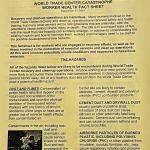
Based on those consultations and their hands-on investigation, NYCOSH published the World Trade Center Catastrophe Worker Health Factsheet on Sept. 17. It warned that the recovery and clean-up operations in Lower Manhattan have “the potential to cause serious illness, injury, or death.” The factsheet was the first concerted challenge published by experts to the “reassuring” messages approved by the National Security Council.
The NYCOSH factsheet described multiple hazards that cleanup and recovery workers were likely to encounter, urged the workers to be aware of them and listed specific ways that workers should protect themselves, such as wearing appropriate respiratory protection and protective clothing.
NYCOSH printed thousands of copies of the 4-page factsheet. Staff members stood at the gates that limited public access to Lower Manhattan and handed the factsheet to any worker who wanted one. Others carried the factsheets into Lower Manhattan and handed them to the hundreds of day-laborers who were hired to clean dust-filled Lower Manhattan office buildings.
The struggle over an accurate characterization of the health risk created by the attack continued for years. The official position was always to deny any risk or to minimize it when denial was impossible.
The proponents of the official position, with the resources of government at every level and the major media solidly behind them, refused to be decisively defeated, but neither could they ever win the argument, because, with the passage of time, more and more people got sick (and some died), as a result of their exposure to contamination that had been alleged to pose only a “slight health threat . . . to city residents with weakened immune systems, heart disease or asthma”. And they continue to get sick and die to this day.
In the words of occupational medicine doctor Jacqueline Moline, who has been treating people with 9/11-related illnesses since shortly after the towers collapsed and is now director of the Northwell Health Queens World Trade Center Health Program, “For over 25 years, we have cared for people who were exposed to the aftermath of September 11th. Hundreds of thousands of people were at risk then and remain at risk for disease now. While we initially saw respiratory disease, we now are faced with increasing numbers of our patients developing cancer. Over 57,000 cases of cancer have been documented.”
Nearly ten thousand people have died as a direct result of their exposure to 9/11-related contamination.
(Full disclosure: The author of this item was the public affairs director at the New York Committee for Occupational Safety and Health on 9/11 and contributed to the composition of the NYCOSH factsheet.)
The text of the NYCOSH factsheet can be viewed at http://www.immuneweb.org/911/articles/nycosh.html
‘There Is Power In a Union’! (1986)
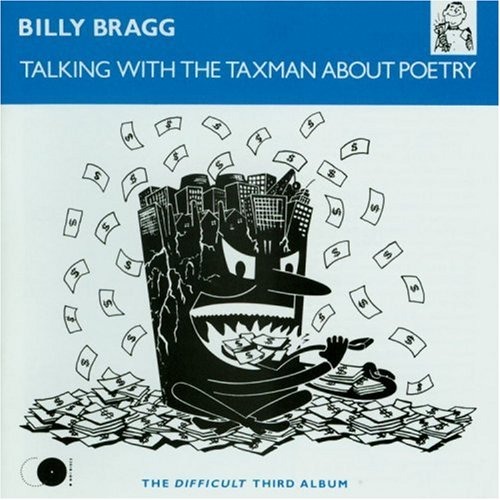
FORTY YEARS AGO, ON SEPTEMBER 22, 1986, Elektra Records released Billy Bragg’s album Talking with the Taxman About Poetry.
The album includes There Is Power In a Union, with Bragg’s lyrics set to music composed in 1862 by George Frederick Root for Root’s patriotic Civil War song, The Battle Cry of Freedom.
Bragg’s version of There Is Power In a Union, which has the same title as an unrelated song by Joe Hill, has become an international anthem for the labor union movement. You can listen to it here: https://youtu.be/DwbzxemJZIc?si=yZh5untA7iAQJfyk
For more People's History, visit
https://www.facebook.com/jonathan.bennett.7771/