
America’s Future: Fossil Fuel Island in a Greentech World?
As we have seen throughout this series, the Greentech revolution is transforming energy production and use worldwide. Along with its other advantages, fossil free energy has become radically cheaper than fossil fuel energy. More than 90% of utility-scale renewable projects commissioned in 2025 delivered power below the cost of the cheapest new fossil-fuel plant built in their market. Natural gas energy is currently 3–4 times more expensive than solar and wind. Meanwhile, fossil fuels are increasingly vulnerable to disruptions like the Ukraine and Iran wars, which destabilize whole economies with shortages and higher prices for energy, food, and other necessities of life.
Donald Trump and the US government are doing everything possible to shut down fossil free energy and to expand our dependence on fossil fuels. That is already having a devastating effect on American workers and communities, and it is likely to get far worse in the future. We are being marooned on what two energy experts call a fossil fuel “energy island” as the rest of the world turns to an “electric world order.”
If Trump and his fossil fuelers succeed in defeating the Greentech revolution in the US, the result is likely to be a growing affordability crisis; devastation for the most fossil-fuel dependent industries like autos, coal, iron, and gas; a general decline of the fossil-fuel intensive US economy; disinvestment; a loss of international competitiveness; and macroeconomic effects like inflation and recession or both.
These trends can sometimes be seen in the day-to-day operation of markets, like the decline of the US and European auto industries or the worldwide shift to renewables after the closing of the Strait of Hormuz. But paradoxically, they can also be concealed by short-term fluctuations. For example, the sharp rise in the cost of oil after the closing of the Strait of Hormuz produced a boom in oil company profits. Similarly, the rising demand for electricity for data centers created a boom for natural gas generators. Such developments might appear to refute the argument that the fossil fuel-based US economy is increasingly uncompetitive and in danger of becoming a stranded asset. However, amid all the price gyrations, nothing seems to refute the fundamental underlying fact: Fossil fuel energy is and will remain more expensive and less secure than fossil free energy. I have seen nothing that indicates otherwise.
The long-term decline of the fossil fuel-based economy is manifested in many ways. In this commentary I will examine two impacts on Americans of our country’s failure to join the Greentech revolution:
- It makes prices higher for Americans
- It makes US-produced goods and services more costly and therefore less competitive at home and abroad
Crashing autos

Electric Car at Charging Station | Photo credit: sofiiashunkina, Envato
The headline example of eschewing the Greentech revolution is the US auto industry. For decades, the industry – supported by US government policies — failed to invest in EVs and concentrated instead on its highly profitable gas-guzzling cars and trucks. Briefly under the Biden administration the federal government invested in EV charging infrastructure and a $7,500 consumer tax credit. Electric vehicle sales grew 60%.
Then Trump abandoned pro-EV policies and subsidized fossil fueled vehicles with a panoply of strategies. EV sales plummeted. The industry began shutting down its EVs factories. In 2025 Stellantis wrote down $26 billion in EV-related losses; Ford reported a $19 billion loss. The auto journalist Martin Padgett told the New York Times, “We pulled a U-turn while the rest of the world was pushing forward.”
Fossil fuel dependence is costly for American car owners. Here’s what gas dependence means in dollars and cents for auto drivers: In January 2026, before the disruptions caused by the Iran war, the cost to drive 100 miles in an electric car was $5.77; in a gas car it was $11.23. By summer — after the closing of the Straight of Hormuz — to drive 100 miles in the electric car cost almost the same as before, $5.89, but in the gas car it cost $16.69 –three times as much as the EV.
Its failure to develop EVs and its addiction to gas guzzlers has made the US auto industry non-competitive domestically. In 1965, US companies produced more than 90% of new cars purchased in the US; today, barely a third are built by the Big Three.
The failure of the US auto industry to adopt Greentech is at least equally significant internationally. A quarter of all vehicles sold globally in 2025 were battery powered. (That figure is projected to reach 29% in 2026 due to high gas prices caused by the Iran war.) Bloomberg analysts predict that by next decade fewer than half of cars sold globally will be gas-powered. China, which provides 30% of the global car market, has seen sales of internal combustion vehicles plummet by nearly two-thirds since 2017. China now makes 75 percent of all EVs sold worldwide; the United States makes around 5 percent. Susan Helper, a professor at Case Western Reserve University who was chief economist at the Commerce Department under President Barack Obama, told the New York Times that in the worst-case scenario the US auto industry will become a “shrinking island of ICE (internal combustion engines),” churning out outlandishly large trucks and not much else. At which point, the Times noted, the obsolescence of the mighty U.S. automobile industry” would be “all but guaranteed.”
About three million Americans work for automobile and parts manufacturers and dealers. About 24 million jobs depend on spending by car manufacturers, their employees, or car owners.
Vehicle and parts makers shed about 21,000 U.S. jobs in the last year, despite Trump administration tariffs designed to force them to manufacture domestically.
The fossil fuel island
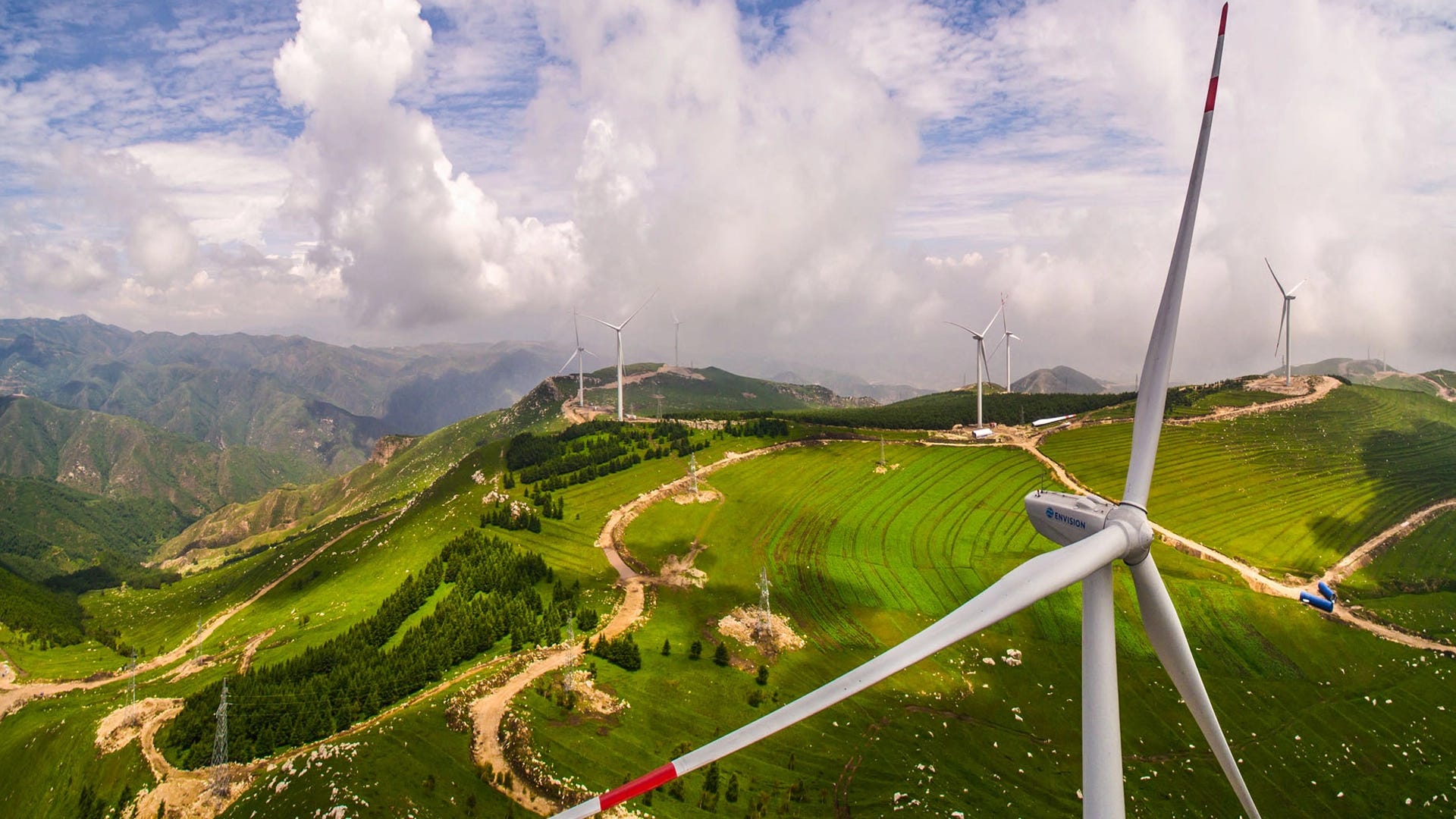
Wind farm Shanxi, China, November 4, 2015. Photo credit: Hahaheditor12667, Wikipedia Commons, CC BY-SA 4.0

The global shift from gas guzzlers to EVs is part of a more general long-term shift from fossil fuels to fossil free energy which is rendering the US a fossil fuel island. Two energy experts summarized the current phase of this process:
“Global clean energy investment reached a record $2.2 trillion in 2025, twice the flow into fossil fuels. In 2024, 91 percent of newly commissioned utility-scale renewable projects produced electricity more cheaply than the cheapest new fossil fuel alternative, and battery storage costs have fallen 93 percent since 2010, allowing utilities to use batteries to store solar and wind power even when the weather is uncooperative. In 2025, fossil fuel electricity generation fell in both China and India.
“Before the Iran war, this green transition was also spreading beyond wealthy markets. In 2024, Chinese solar exports to developing economies surpassed shipments to advanced economies. Pakistan imported approximately 17 gigawatts of Chinese solar modules that year, equivalent to almost half of its grid-connected capacity. In Indonesia, Thailand, and Mexico, the cheapest Chinese-made EVs have reached price parity with the cheapest internal combustion options.”
In July, China announced binding targets to increase wind and solar power generation by more than 50% over the next five years.
How the Greentech transition will develop in the future is of course a matter for speculation, but BloombergNEF’s (BNEF) New Energy Outlook2026 provides one plausible projection:
- Solar will become the world’s single largest source of electricity in the next six years, due to a major supply glut, technology advances, and falling prices.
- If countries continue on their current path of rapidly deploying economically competitive clean technologies, they stand to cut their reliance on imported fossil fuels and ultimately strengthen their energy security.
- Many countries that depend on fossil fuels are now able to reduce their economic exposure to energy commodity imports by adopting low-carbon technologies.
Energy investor Rob Carlson recently drew the implications for the US economy: Continuing to burn fossil fuels is a “self-imposed financial penalty” which will “ultimately degrade the country’s long-term global competitiveness.” The same applies to any nation or polity that “chooses to continue burning fossil fuels in any application in which electricity could instead be provided more competitively with renewables.”
The replacement of fossil fuel energy by Greentech has been greatly accelerated by the war in the Persian Gulf region. According to a June 30 report by NPR, “The Iran war and high oil and gas prices have supercharged the adoption of renewables and EVs worldwide. Global investors say these technologies make financial sense and increase energy security.” As fossil fuel prices soared, countries are “turning to these technologies that are basically impervious to whatever happens in the Strait of Hormuz. Solar batteries and EVs have gotten a lot cheaper.” Chinese battery exports rose 69% in March compared to 2025; their solar exports in March are up 84% compared to 2025.
The NPR report concluded,
“It doesn’t look good for oil long term. With all these new EVs, that means a lot less people filling up their cars with gas around the world. Before the war in Iran, the International Energy Agency was expecting global oil demand to rise this year. But the disruptions caused by the Strait of Hormuz led them to downgrade expectations to a decline in oil demand this year. In some ways, the U.S. is becoming an outlier in the global energy transition.”
In the face of the Iran war energy shortages some countries have been turning to coal. But analysis by the thinktank Ember found that even a worst-case return to coal would raise global coal-fired generation by no more than 1.8 percent in 2026 relative to a no-crisis baseline; indeed, global coal generation could still fall this year.
Currently there is little reason to expect the Straight of Hormuz to be reopened any time soon, or for fossil fuel prices to return to their levels before the Iran war. And there are plenty of reasons to expect further disruptions with further fossil fuel gyrations in the future.
The US trend towards ever greater fossil fuel dependence and the consequent rise of its energy prices is being further aggravated by the expansion of gas, oil, and even coal to provide energy for hyperscale data centers. That is likely to further increase the isolation of the US as a high-cost fossil fuel island.
If the US becomes ever more a fossil fuel island in a Greentech world, the consequences are likely to be dire. Bill Hare, chief executive of the thinktank Climate Analytics, said, “Any investment in new fossil fuels now is a fool’s gamble, while joining the race to renewables can only bring benefits – not just jobs and cheaper energy at stable prices, but energy independence and access where it’s needed most.”
Is the US doomed to be a fossil fuel island? Our next series of commentaries will lay out an alternative: The Green New Deal 2.0.
===
Jeremy Brecher