
This Week in People’s History, October 21–27, 2026
Forewarned Is Forearmed, but Being Forearmed Isn’t Foolproof
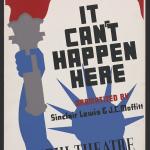
NINETY YEARS AGO, ON OCTOBER 27, 1936, an unprecedented and highly political theatrical event took place simultaneously in 21 different U.S. cities from coast to coast, thanks to the Federal Theater Project, a unit of the New Deal’s Works Progress Administration.
On a single night, professional theater companies from Miami to Seattle and from Los Angeles to Boston, presented a never-before-seen dramatized version of It Can’t Happen Here, the best-selling anti-fascist dystopian novel by Sinclair Lewis.
Most of the performances were in English, but two (in Manhattan and Los Angeles) were in Yiddish, and one, in Tampa, in Spanish. Every seat in every theater was filled, and wherever it was legal, hundreds of standees filled the remaining space.
October 27 was also special because it was exactly a week before the U.S. Presidential election in which Franklin Roosevelt would make his first attempt to be re-elected President.
On that day, concern about fascism was very widespread. Fascist regimes in Italy and Germany were seizing territory in Africa, where Italy had invaded and taken over Ethiopia, and western Europe, where in the spring of 1936 Germany had flouted the treaty that ended World War 1 and marched twenty thousand troops into the the Rhineland, a vast territory that had, for almost two decades, been a demilitarized zone between Germany from France
Also in the spring of 1936, the Emperor of Japan had bent to the will of the army and navy and given the military complete authority to shut down any civilian government. Even more recently, in July 1936, pro-fascist Spanish troops had started the Spanish Civil War by making a coup in Morocco, beginning the eventually successful overthrow of the left-leaning, democratically elected Spanish government.
Even within the U.S., pro-fascists were acting with unprecedented boldness in 1936. In the spring, members of what had been the Friends of New Germany adopted a new name, the German-American Bund, and chose a German-born U.S. citizen to be their leader, or Bundesführer.
In the summer a right-wing priest, Father James Coughlan, whose weekly radio broadcasts attracted an audience of millions from coast to coast, helped to establish the Union Party to carry out his reactionary social program. The Union Party’s presidential candidate in 1936 attracted only two percent of the votes cast, but Coughlan and other Union Party supporters spoke enthusiastically about the possibility of making a revolution in the U.S. if the Republican candidate, Alf Landon, defeated Roosevelt’s attempt to win a second term.
At the same time, a mysterious and sinister white supremacist organization called the Black Legion had become active in southeastern Michigan, where it was terrorizing Blacks and leftists. The Detroit police let it be known that the Black Legion, which was thought to have thousands of members, was suspected of responsibility for scores of unsolved murders.
Opening night for It Can’t Happen Here was a week before Election Day, when U.S. voters would decide whether FDR would have a second term as president. As such, it was a quite a night for a U.S. government agency to stage the a coast-to-coast premiere of a play that’s set in the very near future, that begins with FDR losing the election to a man who leads a fascist take-over soon after taking office.
But of course, It Can’t Happen Here the play had the same title and author as the best-selling novel that had sold more than three hundred thousand copies during the previous year, so many ticket purchasers had a good idea of what would unfold on the stage that night, and they wanted to see it anyway. The most expensive ticket to the Manhattan production was 55 cents, about one-quarter the price of admission to any of the nearby for-profit Broadway houses.
The play, in its more than a score of iterations, was a great success. It ran for months almost everywhere it opened, and was seen by hundreds of thousands of people, many of whom had never previously seen live, professional, theater.
The November 3 election was also a great success. Roosevelt took 60.8 percent of the popular vote and was the winner in 46 of the 48 states. He won the Electoral College poll 523 to 8. Democrats controlled both the Senate (76 to 16) and the House (331-89).
Similarly, the Federal Theater Project as a whole was a triumph. In four years it staged some 1200 different plays to a total audience of some 30 million people, two-thirds of whom had never seen live theater before. And it provided about 13,000 theatrical professionals, from actors to makeup artists to set-builders to theater managers, all jobless as a result of the Great Depression, gainful employment practicing their crafts. https://progressive.org/latest/it-could-happen-here-bader-20240702/
For more People's History, visit
https://www.facebook.com/jonathan.bennett.7771/