
The Said Phenomenon

The Last Amateur: Jonathan Swift, Edward Said, and the Profession of Literature
Helen Deutsch
University of Chicago Press
ISBN: 9780226849560
The Humanist Critic: Lionel Trilling and Edward Said
Daniel Rosenberg Nutters
Anthem Press
ISBN-13: ?9781839991592
TWENTY-THREE YEARS after his early death, Edward Said remains a writer and thinker to whom many turn, and whose influence seems only to grow. We can measure this interest in various ways. For example, the volume of posthumous material published—most recently Said on Opera (2024), edited by Wouter Capitain, which collects Said’s 1997 Empson Lectures at Cambridge University—has been extensive. And the studies and monographs on Said keep coming: Timothy Brennan’s authorized biography Places of Mind: A Life of Edward Said in 2021, and Nubar Hovsepian’s Edward Said: The Politics of an Oppositional Intellectual last year. Two new books treat Said at length, albeit in radically different ways and in comparison with profoundly different precursors and interlocutors.
Introducing his Edward Said: A Critical Reader (1992), the late Michael Sprinker wrote of a senior academic colleague who told him he was “tired of the Said phenomenon.” This person clearly felt that Said’s fame, even then, owed more to notoriety and political controversy than to literary-critical originality or scholarly prowess. We can see now that this view was really just a matter of envy, since the academic responses to Said’s work have come in equal measure to the political reactions. To separate Said’s literary from his political interests is, and always has been, a classically weak liberal position, geared to permit an admiration of his output that is not sullied by his allegedly controversial politics. But the most interesting way to look at Said is to see the political and the literary as having always been conjoined. The two books under review here appear in the immediate wake of the attacks of October 7, 2023, and all that has followed from them. Both books are primarily concerned with literature and criticism, but both also register Said’s political work significantly.
Daniel Rosenberg Nutters’s The Humanist Critic: Lionel Trilling and Edward Said and Helen Deutsch’s The Last Amateur: Jonathan Swift, Edward Said, and the Profession of Literature (both 2026) are remarkable, interesting, and valuable works. Their projects are quite different, yet both discuss Said in unusual ways and, for this reason alone, are books of note.
Deutsch’s book deals with Said’s interest in Jonathan Swift, and Nutters’s compares Said with his Columbia colleague and friend, Lionel Trilling. In his warm and humane obituary for Said in the London Review of Books, Michael Wood (also a Columbia colleague) discussed Said’s relationship with Trilling and with F. W. Dupee, “Columbia’s master of style and irony, and a sort of foil to Lionel Trilling, whom we also liked but felt a little more distant from.” Brennan vividly recounts Said’s early years in Columbia’s Department of English and Comparative Literature, where he learned from both Trilling and Dupee. Brennan suggests that Said sought to position himself between what James Wolcott called Trilling’s “ambiguity, dialectical subtleties and flickering equivocations” and Dupee’s “note of defiance” as (in Mary McCarthy’s words) “an idle saunterer, in an age of academic criticism, of ‘field’ specialists on the one hand and fanatic ‘close readers’ on the other.” From both, Said learned to place his early essays in para-academic journals and to think of addressing audiences beyond the seminar room, becoming what Brennan calls “an upstart member of the New York intellectuals.”
Even allowing for Dupee’s sympathy toward American communism, his overt Trotskyism, his vocal opposition to the Vietnam War, and his foundational work with Partisan Review, the Trilling-Dupee opposition ultimately came down to alternative models of intellectual suavity. The contrast with Jonathan Swift could not be greater. Yet around 1967, Said planned a study of the greatest and angriest polemicist in English literature, and the project, though it never reached the level of a complete book, stayed with him for many years. Brennan rightly argues that the Swift monograph eventually emerged as a kind of shadow text for The World, the Text, and the Critic (1983). This volume, Said’s most powerful and “political” academic book, contains two great essays on the Irish writer, “Swift as Intellectual” and “Swift’s Tory Anarchy.” In his introduction to the volume, Said notes “the special role played by Swift” for his own work—as a model of “the critical consciousness in a raw form.” Interestingly, in an extended 1984 review of The World, the Text, and the Critic, Daniel O’Hara concluded by proclaiming Said’s book “the finest work of American criticism since Lionel Trilling’s The Liberal Imagination.”
So here we have Said triangulated between the writer he called “the tiger of English literature” and the most famously urbane of modern New York intellectuals. It’s an extraordinary testament to the richness and complexity of his work.
Deutsch’s book is a highly personal and unorthodox work of criticism. Drawing on Said’s published work but also on unpublished notes, letters, and teaching materials from his archive at Columbia, she describes how she first became interested in Said’s Swift—through an invocation in a 2003 essay on the Bush administration’s invasion of Iraq—and gradually realized how useful, enabling, and liberating his engagement with the earlier writer was. Reading Swift through Said and vice versa, Deutsch came to a new appreciation of the politics of her own field of 18th century studies, with its sometimes rigid orthodoxies and highly gendered power relations. Reading Swift and Said together allows Deutsch to find a critical and political voice she had not previously achieved.
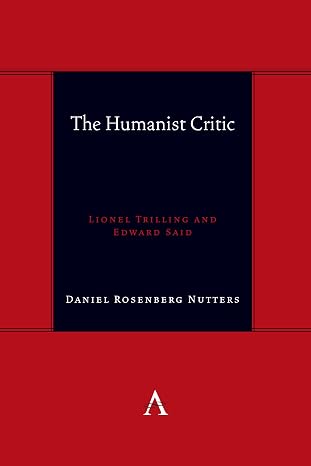
Nutters’s book is more conventional but no less interesting and original. In consecutive pairs of chapters, he reads Trilling in light of his interests in Matthew Arnold and Thomas Mann, and Said in relation to his interests in Joseph Conrad and Gerard Manley Hopkins. No less than Deutsch, Nutters wrenches Said away from a critical obsession with his 1978 masterpiece Orientalism and his relationship to postcolonial studies, thus opening up neglected aspects of his work.
The Humanist Critic importantly reminds us of Said’s allegiance to humanism, which spanned his career. Standing before him was the exceptional example of Trilling. Nutters productively structures his discussion of Trilling around a series of oppositions, which he later finds echoed, if at times distantly, in Said: an ambivalent focus on Arnold, and on the tension between the poet and the critic/pedagogue; a complex interest in and worry about modernism; and a sometimes uncomfortable attention to the institutions of the university and the discipline.
Trilling, coming to maturity in the 1930s and ’40s, was a contemporary of the New Critics, but he never identified with them. He was at once less “academic” and more interested in the larger questions of American culture and society. Trilling also, of course, found himself teaching literature at the moment of modernism’s arrival and institutionalization in the academy. Learning from and writing about Arnold, Trilling saw his career as bipartite—the poet, still influenced by Romanticism, facing the ominous modern world and struggling to deal with it in his art; and the critic and school inspector, looking to cultural education as a bulwark against the threat of modernity.
Trilling clearly saw himself in a roughly analogous position. Repeatedly, he debated—with others and with himself—what it meant to try to teach a mode of literature that at times attacked the very idea of the literary and held its readers at arm’s length, resisting easy pedagogy, commodification, and bureaucratization. Students, Trilling felt, were excited by the iconoclasm of modernism, but oddly unsuspecting of its conservatism. The very avenue by which they encountered it—the academic classroom—carried the potential for betrayal, the risk that (as he put it in his 1961 essay “On the Teaching of Modern Literature”) “the subject being taught is betrayed by the pedagogy of the subject.”
Nutters turns to Trilling’s identification with Thomas Mann, showing how the latter’s work informs Trilling’s concept of humanism. Mann anticipates Trilling’s doubts about the institutionalization of modern literature—which, for Mann, represents the embourgeoisement of aesthetics. Mann’s version of irony—in The Magic Mountain (1924) and, later, Doctor Faustus (1947)—consists of him playing his demonic artistic side off of his performance as a bourgeois public gentleman. This self-ironizing pose appealed to Trilling, who feared that his graduate students were likely to learn only clichés from him (indeed, some of his students later declared that they learned more from Trilling’s books than from him in the classroom). Trilling’s interest in Mann stemmed from his sense of the darkness of the will and his idea of art as perpetual self-creation. Of course, Trilling’s primary creation was, in the end, himself.
The parallels with Said proliferate. In focusing his chapters on Said on Conrad and Hopkins, Nutters works at both the start and the end of Said’s career. Said’s PhD dissertation and first book were on Conrad, and Nutters cleverly discusses Said’s admiration for Hopkins in terms of the focus on “late style” that informed the writings of Said’s final decade. Said himself declared that Conrad had been like a “steady groundbass” right across his career. His early engagement with Conrad was with a writer exiled from his homeland, working in a second or third language, and making an authoritative persona or mask for himself in order to live and work. But Conrad appeared in Said’s later scholarship too: there is a long reading of Nostromo (1904) in Beginnings: Intention and Method (1975), an essay in The World, the Text, and the Critic, and the crucial short piece on Heart of Darkness (1899) that sits at the root of Culture and Imperialism (1993).
Trilling and Said, like Conrad, shared a degree of discomfort about being outsiders, with Trilling’s Jewishness and Said’s Palestinian background operating in striking parallel. And both put a premium on performance—for Trilling, primarily as a pedagogue, while for Said, more ambitiously, as a public intellectual. Nutters begins by comparing Said not to Trilling but to R. P. Blackmur (who taught Said at Princeton). Working under Blackmur, the most eccentric and original of the New Critics, Said developed some of his attitudes toward modernism and also a dialectical frame of mind well before he ever encountered Georg Lukács. When Said later wrote at length about Blackmur, he was trying to identify in his mentor the Anglo-American precursors of the Continental theory with which his own work would become so associated.
Nutters rightly says that the overwhelming reaction to Orientalism has overshadowed much of Said’s other work, notably his first two books: Joseph Conrad and the Fiction of Autobiography (1966) and Beginnings. Nutters shows how both early books underpin Said’s overtly political writing; he’s not the first scholar to do so, but it’s an important point. The World, the Text, and the Critic, he claims, was Said’s “farewell to theory,” but this is just incorrect, since all of Said’s work on late style rests on an appropriation of Theodor Adorno, a theorist if ever there was one. More cogently, Nutters argues that Said’s prioritization of narrative—whether in overtly political essays or in more literary work like Culture and Imperialism—stems from his early preoccupation with Conrad. He notes the way that Conrad’s creation of narrating or authorizing selves informs much of Said’s own writing without referencing the crucial work on this subject performed by Abdirahman A. Hussein, in his 2002 book Edward Said: Criticism and Society.
Nutters’s treatment of Said and Hopkins is equally interesting and insightful. Said rarely wrote at length about poetry (though Stéphane Mallarmé and Paul Valéry appear briefly in Beginnings, and there is the W. B. Yeats essay in Culture and Imperialism), but his interest in Hopkins, Nutters argues, derived from his preoccupation with late style. Nutters brilliantly compares Hopkins with Glenn Gould, another virtuoso performer in Said’s canon, and another figure who recognizes authority while also meditating on its breakdown. As Nutters suggests, late style allows Said (and Hopkins) to posit a future without authorizing a totalizing vision. Rightly seeing Hopkins as positioned between Romanticism and modernism, Nutters links Said’s late style to theories of Romanticism elaborated by Said’s peers Harold Bloom and Geoffrey Hartman. He concludes that late style—in Said and in Hopkins—offers a kind of self-fashioning at a time when autonomy, freedom, and poetic unity face an uncertain future.
Both Nutters and Deutsch have written highly original, penetrating, and useful studies of Said, illuminating Trilling and Swift along the way. Poised between the ironic gentility of the former and the cascading fury of the latter, Said emerges renewed and reinvigorated. We need his radical vision now more than ever.
Conor McCarthy teaches English literature and intellectual history at Maynooth University in Ireland. He is the author of The Cambridge Introduction to Edward Said (Cambridge University Press, 2010) and editor of The Revolutionary and Anti-Imperialist Writings of James Connolly 1893–1916 (Edinburgh University Press, 2016).