
Abdul El-Sayed Shows Opposition to Israel Is No Barrier to Winning Battleground States
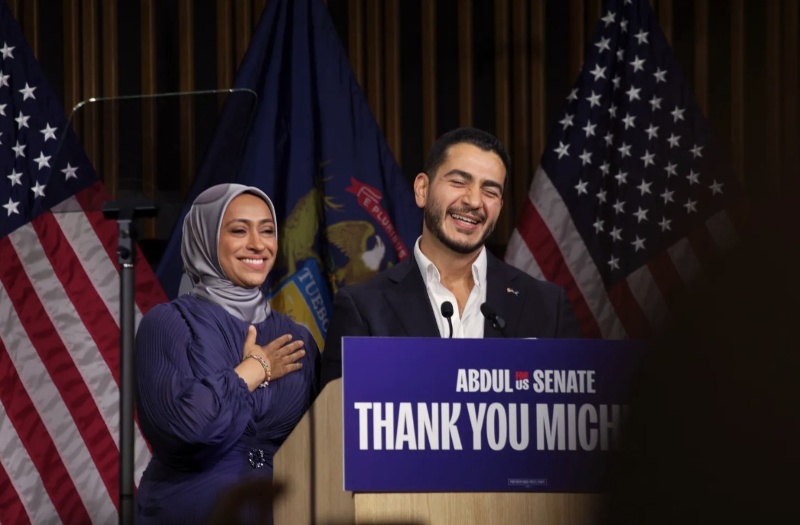
Abdul El-Sayed defeated Mike Rogers in Michigan's U.S. Senate race, keeping a pivotal seat in Democratic hands and demonstrating that even strident opposition to Israel is no barrier to winning competitive federal races.
El-Sayed won despite AIPAC spending more than $30 million to defeat him in the Democratic primary and another reported $9 million on behalf of Rogers in the general election.
He managed to turn this spending against the American Israel Public Affairs Committee, presenting its opposition to him as evidence that he was on the right side of history.
"They wanted to make an example out of me, and we've made an example out of them," he said after defeating Rep. Haley Stevens, a pro-Israel Democrat, in the primary.
This rhetoric rankled some members of the Jewish community, who felt that his focus on AIPAC and claims that U.S. aid to Israel was to blame for domestic issues were antisemitic.
Jewish leaders mobilized against El-Sayed, with some joining a group called Democrats for Rogers and others launching a campaign called Nonnegotiable that encouraged Jews to write in the poet Emma Lazarus rather than support El-Sayed.
Tuesday's resounding result demonstrated the limits of the organized Jewish community's political power. While El-Sayed appeared at Jewish events and met with leaders, he largely refused to alter his rhetoric or policy positions to appease pro-Israel voters.
Michigan Jews, who are overwhelmingly liberal, also seemed reluctant to jump ship despite some deep disagreements with El-Sayed.
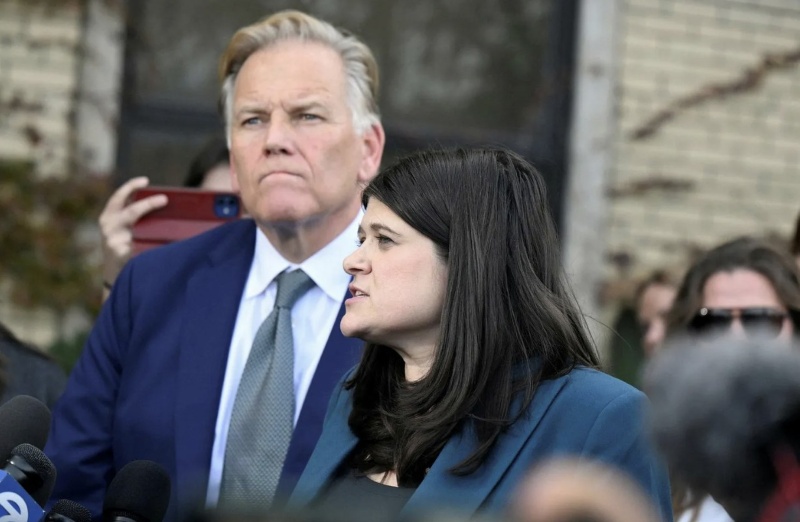
A poll of Jewish voters who cast early ballots, released by the Jewish Majority, a pro-Israel group, found that 60 percent voted for El-Sayed. That group also skewed older and more attached to Israel than the Jewish community at large.
Results from precincts in heavily Jewish neighborhoods outside Detroit, where most of the community lives, showed that El-Sayed won a solid majority of votes even as he underperformed other Democrats by as many as 30 percentage points.
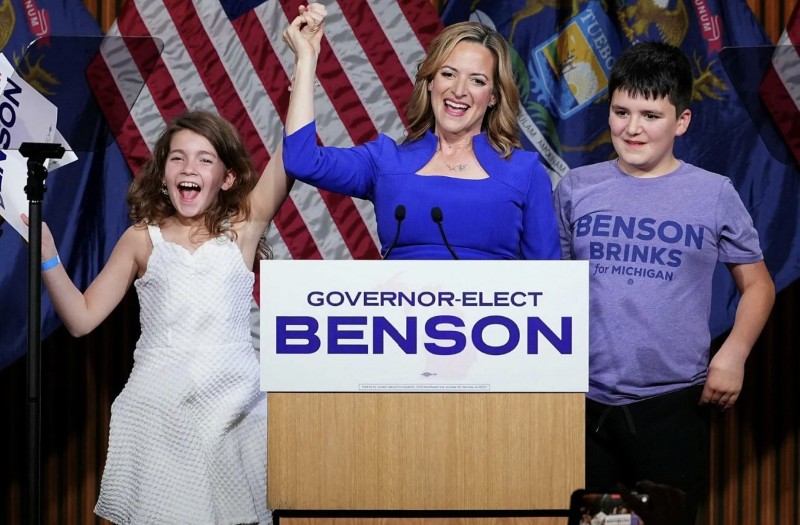
In one Huntington Woods precinct, home to many Jews, El-Sayed was running 31 points behind Jocelyn Benson, the Democratic candidate for governor, though he was still beating Rogers by roughly the same margin.
"The much-discussed, so-called 'exodus' of Jewish voters from the Democratic Party once again hasn't materialized," Jeremy Ben-Ami, the president of J Street, wrote on X.
But many Jewish voters who cast their ballots for El-Sayed still worried that his victory would demonstrate not only that strident criticism of Israel was no impediment to winning close races, but that it could be an asset.
"What was in his heart was not to try to garner our favor, but was to continue to use us as a punching bag, hoping to get more of the anti-Jewish vote or anti-Jewish sentiment in his favor," said Cantor Regina Lambert-Hayut, a founding member of Nonnegotiable. "It worked."
Other Jewish Democrats in the state had sought to push back against claims that El-Sayed posed a threat to Jews.
"We're going to have this young Jewish and young Muslim senator – it's gonna be something," said Andy Levin, a former member of Congress from the Detroit area who helped create a group called Michigan Jews for Democracy that campaigned for El-Sayed in the community.
"We see a candidate in Abdul who not only supports freedom, dignity, safety, and self-determination for all Jewish Israelis and Palestinians," said Rabbi Nate DeGroot, one of the few Jewish clergy members in Detroit to publicly back El-Sayed.
The aftermath of a March car-ramming attack on Temple Israel in the Detroit suburbs also shaped how many of the state's Jewish voters viewed the race. El-Sayed condemned the incident but also sought to contextualize it: "Hurt people hurt people," he said, referring to reports that several members of the attacker's family had been killed in an Israeli airstrike in southern Lebanon.
El-Sayed later told Jewish Democrats that he regretted making those comments so soon after the attack. But he struggled to placate critics who believed his rhetoric around AIPAC and Israel scapegoated Jews. These tensions resurfaced in the campaign's final days when a minor political action committee supporting El-Sayed released a digital advertisement blaming Israel for the high cost of groceries in the U.S.
El-Sayed's campaign distanced itself from the ad, but Stevens demanded that he condemn it more forcefully. That dispute culminated in one of the race's most dramatic incidents when Stevens made a surprise endorsement of Rogers just 48 hours before the election, unifying the Democratic establishment against her.
Even many Democratic critics of El-Sayed argued that backing Rogers, rather than simply withholding an endorsement of El-Sayed, legitimized Islamophobic and racist attacks against him. Rogers had linked El-Sayed to "the threats of radical Islam" and suggested, with little evidence, that he had ties to the Muslim Brotherhood.
Opponents of El-Sayed and what he represents for the future of Democratic politics can take some solace in the fact that, on a night when voters across the country swung dramatically toward Democrats, those in Michigan moved much more subtly.
In Texas, where James Talarico flipped a Senate seat for Democrats, many counties swung 20 points toward Democrats compared to the 2024 election. But in Michigan, the shifts in counties that had reported results by early Wednesday morning were roughly half as large.
[Arno Rosenfeld is an enterprise reporter at The Forward, America's largest Jewish newspaper, covering how antisemitism — and the politics swirling around it — shapes Jewish life. Since August 2026, he has been Washington correspondent for Haaretz.
My reporting centers on the debates over defining antisemitism, Jewish life on college campuses, how Jews have responded to antisemitism in different ways, and the rifts among national organizations over how to keep Jews safe. I've reported from Charlottesville, Colleyville, Tel Aviv, Berlin, and the West Bank, among other places.
Before The Forward, I covered state politics for the Casper Star-Tribune and I got my start in Jewish journalism at J., The Jewish News of Northern California, and have written for JTA, The Times of Israel, Maclean's, SF Weekly, and Washington Jewish Week.]