
No Other Animal Walks Like Us. Here’s Why.
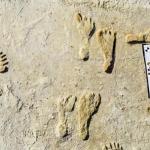
Most humans walk without thinking too much of it. We put our foot down, heel first, and keep moving. But new work suggests this adaptation could be a uniquely human trade-off.
A team of researchers captured high-speed, high-resolution videos of three chimps walking along a runway and analyzed existing walking data from 18 other chimps. When the animals walk on all fours, the team found, their foot position is variable—they might land heel first or touch down closer to their little toe. But when the chimps walk upright, they tend to favor midfoot strikes. In comparison, nine human study participants consistently walked heel first.
Other research on bonobos and orangutans suggests that those animals don’t consistently walk heel first. In fact, no other biped is known to walk that way, implying that “walking with a heel strike is a uniquely human thing,” says Pennsylvania State University and University of Buffalo anthropologist Nicholas Holowka, lead author of the study, published in Proceedings of the National Academy of Sciences USA.
The researchers then measured the impact forces on both humans’ and chimps’ feet and found a higher impact force with heel-first upright walking than with midfoot-first. But humans gained a measurable benefit from this movement strategy, too: walking midfoot first used 26 to 41 percent more energy than a heel-first gait.
Neelima Sharma, an evolutionary biologist at University College London who was not involved in the research, finds it interesting that human walking prioritizes energy savings, in contrast to running, during which humans typically avoid a heel-first stride “because your joints would be under much more impact force.” When we run, the peak load on the knee can be up to three times higher than it is while we’re walking.
By digging into the fossil record, the researchers tracked widening heel bones and growing lower-limb joints in bipedal human ancestors, beginning about three to four million years ago. By around two million years ago hominins consistently had wider heels and joints. Along with attributes such as longer legs and a modern pelvis, “the ability to heel strike safely is part of this suite of features that appears around two million years ago,” Holowka says. This time period also marks the emergence of hunting and gathering, with its long, energy-intensive journeys.
The human heel bone is the largest and “most remarkable bone in the foot,” says biomechanist Ali Yawar, who was not involved in the work. “We should look at our heel and think of it as what makes us, among many other things, uniquely human.”
Rohini Subrahmanyam is a biologist turned science journalist. She loves writing about interesting creatures on our planet. Subrahmanyam received a Ph.D. from the National Center for Biological Sciences at the Tata Institute of Fundamental Research in India. Follow her on X (formerly Twitter) @rohsubb and on LinkedIn, and see her portfolio here.
Founded 1845, Scientific American is the oldest continuously published magazine in the United States. It has published articles by more than 200 Nobel Prize winners.
Scientific American covers the most important and exciting research, ideas and knowledge in science, health, technology, the environment and society. It is committed to sharing trustworthy knowledge, enhancing our understanding of the world, and advancing social justice.
Sign up for the Scientific American daily newsletter.