
This Week in People’s History, August 19–25, 2026
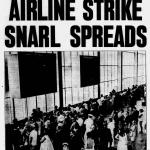
Big 6-Week Airline Strike Wins a Major Pay Hike (1966)
SIXTY YEARS AGO, ON AUGUST 19, 1966, the International Association of Machinists won a hard-fought strike that had shut down more than sixty percent of the U.S. airline industry for six weeks during what otherwise would have been the airlines’ most profitable season.
The strike pitted 35,000 workers against some of the country’s biggest and most profitable airlines – Eastern, Northwest, National, TWA and United – four of which have since disappeared as a result of mergers.
The union was not only fighting the employers, they were also up against the U.S. government, which was trying to control inflation with a “voluntary” wage-increase cap of 3.2 percent a year. The airlines, which were enjoying unprecedented profits, took the government’s lead and offered the union only 3.2 percent, claiming it was their patriotic duty to abide by the voluntary guideline.
The union and its members insisted on substantially more, both because their frozen wages were then below the pay of many machinists in other industries and because the airlines were posting unprecedented profits.
The airlines refused, so on July 8, 1966, picketlines went up at 230 airports. Roughly 150,000 people with tickets to fly that day had to make alternative travel arrangements or stay home. Seats on planes flown by other airlines were almost non-existent because in 1966 airline schedules were tightly regulated, so the carriers that were still flying didn’t have the legal option to add flights to their existing schedules. Over the next six weeks, some 6 million would-be air travelers were diverted to buses, trains, or automobiles.
The White House did what it could by hosting contract negotiations, which managed to reach a tentative agreement calling for an annual 4.5 percent wage increase. But union members rejected the deal by a 3-1 margin.
Finally, when the strike was nearly six weeks old, the airlines offered the machinists pretty much what they asked for before the strike began, an annual six-percent wage increase with a cost-of-living adjustment. The membership approved the deal by a 2-1 margin and the U.S. airline industry’s most disruptive strike was history. https://youtu.be/RKhT1cbxOXE?si=dZNXbxlE_yHx6aRY
When the 8-Hour Workday Was a Radical Idea (1866)
ONE HUNDRED AND SIXTY YEARS AGO, ON AUGUST 20, 1866, the first session of the 5-day National Labor Convention began in Baltimore. Before the convention was over, the delegates agreed to form the first U.S. labor federation, known as the National Labor Union.
The convention issued the historically significant call to establish the 8-hour day and put an end to the era’s standard practice of 10- or 12-hour days. Calling for an 8-hour day in 1866 was considered a very radical position. When the brand-new National Labor Union did so, they beat Karl Marx’s brainchild. the First International Working Man’s Association, to the punch by two weeks.
In 1868 the National Labor Union played a central role in getting the U.S. Congress to mandate the 8-hour day for all U.S. government workers. When President Andrew Johnson vetoed the 8-hour law, Congress overrode the veto, putting the law into effect without the President’s signature. https://guides.loc.gov/this-month-in-business-history/august/national-labor-union-8-hour-work-day
Haiti Gives Slavery and Colonialism the Boot (1791)
TWO HUNDRED AND THIRTY-FIVE YEARS AGO, ON AUGUST 21, 1791, hundreds of enslaved people in northern Haiti began a planned uprising to reclaim their freedom and destroy the society that held them in bondage The insurrectionists were inspired not only by the hatred of slavery, but by the 2-year-old French Revolution’s endorsement of the Declaration of the Rights of Man and the Citizen. Haiti soon became the world’s first Black republic. https://portside.org/2020-09-03/black-spartacus-epic-life-toussaint-louverture
A Jury’s Verdict Makes Freedom a Reality (1781)
TWO HUNDRED AND FORTY-FIVE YEARS AGO, ON AUGUST 22, 1781, a court in Massachusetts ruled that Elizabeth Mumbet Freeman could not legally be another person’s property under the terms of the state’s 10-month-old Constitution, therefore the man who claimed to own her had no right to do so and she was, in fact, no longer enslaved. When the court ruled that the 37-year-old Freeman was free, she had been enslaved since she was born.
The Massachusetts Constitution said nothing about slavery and did not expressly outlaw it. But the Constitution’s first sentence reads “All men are born free and equal and have certain natural, essential, and unalienable rights; among which may be reckoned the right of enjoying and defending their lives and liberties; that of acquiring, possessing, and protecting property; in fine, that of seeking and obtaining their safety and happiness.”
When Freeman overheard the man who claimed to own her discussing the new constitution with dinner guests, she realized that she, and thousands of other Bay State residents who were being treated as property, could not be enslaved in the eyes of the law, She, and a fellow worker who was being treated as property by the same man, found a lawyer, Theodore Sedgewick, who filed a suit on their behalf, pointing out that the claim the two were enslaved had no legal basis. Three months later, a County Court of Common Pleas jury ruled that Freeman and her fellow worker were, in fact, free. In addition to their freedom, the court granted each plaintiff 30 shillings, the approximate equivalent $150 today.
The jury’s verdict only applied to the two plaintiffs, but two years later the Massachusetts Supreme Court ruled that under the Constitution’s Declaration of Rights no Bay Stater had a legal basis to claim ownership of another person.
Freeman had this to say about her experience: “Any time, any time while I was a slave, if one minute's freedom had been offered to me, and I had been told I must die at the end of that minute, I would have taken it—just to stand one minute on God's airth a free woman—I would.” https://constitutioncenter.org/blog/elizabeth-freeman-her-case-for-freedom-and-the-massachusetts-constitution
The Greenhouse Effect? Forget About It! (1856)
ONE HUNDRED AND SEVENTY YEARS AGO, ON AUGUST 23, 1856, Eunice Newton Foote presented her study Circumstances Affecting the Heat of the Sun's Rays at the annual meeting of the American Association for the Advancement of Science. Foote had discovered and demonstrated that sunlight heated carbon dioxide more than the other gases making up the atmosphere. Hence, the higher the atmosphere’s concentration of carbon dioxide, the hotter the atmosphere.
For reasons not known for certain, but reasonably ascribed to sexism, Foote’s discovery was forgotten for nearly a century. https://www.zinnedproject.org/news/tdih/eunice-newton-foote-confirms-greenhouse-effect/
An Ugly Moment in an Uglier War (1636)
THREE HUNDRED AND 90 YEARS AGO, ON AUGUST 24, 1636, one of America’s “founding fathers,” Massachusetts Bay Colony leader John Endecott, departed Boston at the head of 90-man war party, setting a course for Block Island, off the coast of Rhode Island.
It was the beginning of the Pequot War. Endecott’s orders were to kill all Native American men on the island and make prisoners of all women and children. When the punitive expedition reached Block Island, some 40 Native Americans attempted to prevent them from coming ashore, but were forced to retreat by Endecott’s guns.
Once ashore, the colonists encountered no more Native Americans. They spent two days on the 10-square-mile island, during which "they burned sixty native wigwams in the two villages they found and destroyed seven canoes and close to two hundred acres of native corn." https://www.thecrimson.com/column/fight-the-power/article/2023/11/13/williams-dename-winthrop-house/
Workers Lose a Big Fight on Blair Mountain (1921)
ONE HUNDRED AND FIVE YEARS AGO, ON AUGUST 25, 1921, the 9-day Battle of Blair Mountain, in southwestern West Virginia, started. It was one of the largest episodes of deadly violence ever to occur in the U.S., yet it is unknown to the vast majority of the U.S. population.
It is likely that the bloody battle is so obscure today because it is a perfect example of class warfare in action, pitting a racially mixed army of more than ten thousand union members and and supporters of the United Mine Workers of America against a smaller, but much better armed, force of anti-union cops, most of them employees of open-shop coal companies.
The dominant ideology of the U.S. pretends class warfare doesn’t exist, so a clear example of workers taking up arms in the name of their class is consigned to the memory hole.
The shooting ended – thanks to the intervention of the U.S. Army – in the defeat of the union supporters, almost all of whom gave up when the troops arrived, rather than fight against U.S. soldiers doing their legal duty. Many if not most of the union supporters had been members of the Army less than five years before during World War 1, and they would not fire on men wearing the uniform that had been theirs so recently.
Before the battle, small-scale, but deadly, class war had been raging in West Virginia coalfields for more than a year, during which dozens of union activists had been killed, one or two at a time, by anti-union thugs. The mobilization of more than ten thousand armed workers had been sparked when company thugs murdered two well-known pro-union law-enforcement officials in broad-daylight, to prevent them from testifying in a case about anti-union violence.
After the killing of the officials, pro-union coal miners began an attempt to overrun the nearby non-union stronghold of Mingo County, where they hoped to oust the local anti-union government that was behind much of the violence. Their attempted invasion of Mingo was prevented by the much better-armed anti-union force, which used well fortified positions on the slopes of Blair Mountain to block the workers’ advance.
Even though many tens of thousands of shots were fired during the fighting, most of the gunfire took place at very long range, so the number of people killed was probably less than twenty. The exact number is not known.
The victory of the coal barons and their thugs with the help of the U.S. Army proved to be a demonstration that anti-union violence could be committed with relative impunity, particularly in places where organized labor was not already powerful. The legal clout of anti-union bosses kept most unions and many of the members on the defensive until 1933, when the union-friendly National Industrial Recovery Act became law. https://www.nps.gov/articles/000/the-battle-of-blair-mountain.htm
For more People's History, visit
https://www.facebook.com/jonathan.bennett.7771/