
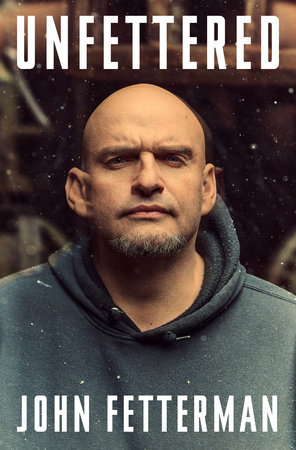
Unfettered
by John Fetterman
Crown
ISBN: 9780593799826
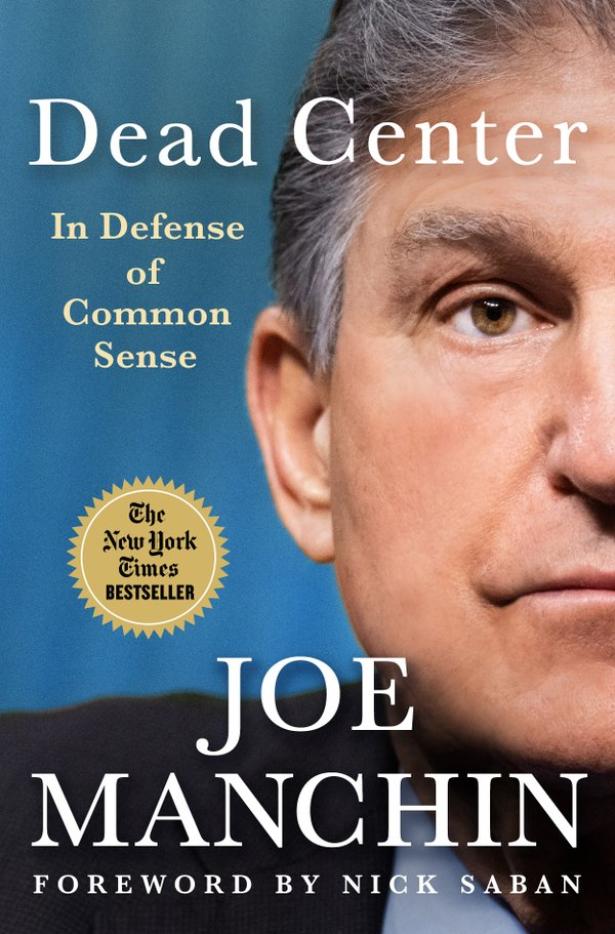
Dead Center: In Defense of Common Sense
by Joe Manchin
St. Martin’s Press
EAN/UPC: 9781250411655
In late 2023 the U.S. Senate ignited in a firestorm of controversy. Freshman senator John Fetterman had begun showing up to the job—and even presiding over the chamber—in nothing but shorts and a hoodie. A reaction quickly ensued. Backroom negotiations led by Senator Joe Manchin ended in the unanimous passage of the SHORTS (“Show Our Respect to the Senate”) Act, the first in the Senate’s history to mandate a dress code. Fetterman responded by tweeting a picture of the actor Kevin James shrugging. Three years later, Fetterman had still not forgotten Manchin’s treachery, commenting to a journalist that he hoped the West Virginia senator had “gotten over the way I dress.”
Despite their differences in preferred clothing, a pair of recent memoirs by Fetterman and Manchin—with their respective ghostwriters Buzz Bissinger and Heather Manchin, Joe’s daughter—have some things in common. Both are proud of the ire they’ve drawn from the left of the Democratic Party; both document the careers of self-declared mavericks from forgotten regions; both display a constant, almost pathological concern with promoting something they call “common sense.”
Though neither book transcends the cliches of political memoir, the myriad bromides and tired reminiscences offer some revealing insights into two figures who have been granted outsized importance by our political system. The Senate’s small size and baked-in disproportionality (sharpened by the maintenance of minoritarian rules and procedures like the filibuster) militate against the types of party discipline and popular accountability that in most democracies render personalities appendages to reliable representation. Combined with the disintegration of mass politics and the decline of grassroots political organizations, these problems mean that the idiosyncratic personalities of our senators are undisciplined by coherent, forward-looking political projects. Reading against the grain of Fetterman and Manchin’s memoirs, it is easy to see the ways in which the Senate’s dysfunction, downstream of this country’s claustrophobic politics, urgently needs remedying.
Joe Manchin served as a Democratic senator for West Virginia from 2010 to 2025. Before that, he was the state’s governor and secretary of state. As the most conservative Democrat in the chamber, his vote was often decisive—especially during Biden’s term, when the Senate was evenly split, and he chaired the powerful Committee on Energy and Natural Resources. In those days, Manchin’s word seemed to carry as much weight on Capitol Hill as the president’s. He single-handedly killed Biden’s ambitious Build Back Better (BBB) bill and replaced it with the pared-down Inflation Reduction Act, after arguing that the BBB would lead to inflation.
As a piece of writing, Manchin’s memoir is forgettable. Memories of a West Virginia childhood and his squeaky-clean coming of age are interspersed with comments on his congressional record. His treasured personal convictions emerge out of the sometimes contradictory experiences of his family and upbringing: his grandfather’s labor organizing efforts, his father’s ownership of a carpet store, and his family’s close ties with a once-ascendant Democratic Party machine. Despite these connections, Manchin dismisses any sign of party loyalty as rank factionalism. His aloofness from his colleagues in the party means he is held hostage to his own stubborn beliefs rather than the demands of a political organization.
Manchin’s recollections cover major attempts to reform the Senate, including bids to weaken the filibuster over the last two decades. The history as he tells it is most revealing when it is incoherent: when Manchin’s personal memory of negotiations clashes with the record, and when selective amnesia underplays his own role in the obstruction that has given the Senate the dubious distinction of the least effective legislative body in the world.
Manchin describes policy choices affecting millions in a folksy idiom. Deficit reduction is justified by his “Papa’s aphorisms,” and the filibuster is worth defending on the basis that the Senate would be “just another cup of hot tea” without it. The 2022 vote on filibuster reform, which I witnessed from the chamber’s floor when I served as one of the Senate’s pages, was a momentous occasion. Manchin is correct that Democratic leadership pursued a “full-court press”; it was a rare day when every senator was at their desk. The tension in the air rang false, though. The reform was dead in the water. Manchin, along with Senator Kyrsten Sinema of Arizona, strung leadership along with the possibility of reform, but negotiations stalled. By the time the vote was put up it was well-known that the two were going to vote no.
Manchin’s account of the filibuster’s origins is ahistorical: he argues that recent attempts to weaken it would kill a system that has held strong since 1789, and on the next page writes that the first real filibuster took place in 1837, even though the filibuster only took its modern form as an effective minority veto in the 1960s to block civil rights legislation. He also offers a completely contradictory account of its more recent history: he writes that Mitch McConnell “would die protecting the filibuster” but just two paragraphs earlier correctly notes that McConnell invoked the “nuclear option” (which is Senate lingo for overriding the filibuster by a simple majority) to secure the appointment of Trump-nominated judges. Even worse, Manchin egregiously claims that the rule change Chuck Schumer put on the Senate floor in 2022 was a vote to “kill the filibuster”; in reality, it maintained the maneuver but reduced it to its original role of a “talking filibuster,” where blocking cloture on a motion requires a senator to continually hold the floor. Maddeningly, it is that same “talking filibuster” that Manchin advocates for in this book. In Manchin’s clumsy hands, the arcane history of legislative procedure matters little; he seems interested in the “Holy Grail” of the filibuster only insofar as it justifies his approach to politics.
Among the values the filibuster supposedly instills is consensus: “broad-based,” “long-term” policymaking over the “brute force” of narrow majorities. Manchin is right that narrow majorities aren’t ideal for good politics. What is worse are rules that make it impossible for that narrow majority to govern. The brand of institutional nostalgia that Manchin displays through his incoherent defense of the filibuster is one that hankers for a form of consensus that has only ever existed under durable governing majorities. Consensuses are not the half-measures produced by appeasing an obstructive minority. They are something more expansive: the construction of a durable political majority. Manchin’s nostalgia is misplaced onto the empty totem of institutions, while the majoritarian values he claims to treasure were products and characteristics of a flawed but sweeping New Deal era that he never mentions.
Manchin’s blinkered understanding of history is not surprising, since the New Deal is exactly the kind of hegemonic project he has made it his career’s work to thwart. But without serious engagement with the actual history of majoritarian politics, Manchin’s ideas collapse into an empty and sentimental attachment to rules and institutions. These rules and institutions—including the increasing power of the Senate and the filibuster—were themselves the death rattles of last century’s political order, as the dominant New Deal coalition fractured over civil rights. The modern Senate emerged more out of the machinations of Dixiecrats and the belated attempts by northern Democrats to appeal to them than from the period of partial consensus (albeit achieved in part through the suppression of the black vote) that came before the 1960s. The filibuster was a product of heightened political conflict.
From the time Manchin entered the Senate in 2010 to the time he finished his last term in 2025, the chamber had transformed. Despite a few holdouts—most prominently Manchin and Sinema—the Senate Democratic caucus had become more liberal, party-line votes had become more frequent, and the filibuster was weakened in 2013 and 2017 under both Democratic and Republican control. Long-term patterns—like the shrinking margins of party control—grew more entrenched. An increase in polarization could have led to a concurrent strengthening of Senate leadership; this had been the pattern in the House of Representatives, where Nancy Pelosi wielded the position of speaker in a historically unprecedented manner to pass the BBB with only one defection. Stronger Democratic leadership, shorter terms, greater proportionality, and the House’s larger size have all prevented the House Democratic rank-and-file from going the way of the Senate (the same cannot be said for the Republican caucus, where a feeble House leadership is constantly fending off attacks from the margins).
Manchin and Sinema both retired after the 2024 election, neither standing a chance of reelection, and Democrats lost control of the Senate. But even if the party returns to trifecta control in Washington in 2028, there is no guarantee that an ambitious legislative agenda wouldn’t be shot down by another hostile Democratic senator.
Which brings us to John Fetterman. The senator first served as mayor of the small borough of Braddock outside of Pittsburgh, where he devoted himself to reversing the town’s long postindustrial decline. Though his tenure was not uncontroversial (during his mayoralty, he held a black jogger at gunpoint; he says he believed the jogger could have been on his way to commit a school shooting), he attracted plenty of media attention, including a glowing profile in the New York Times. Inspired by Bernie Sanders’s 2016 campaign, and taking advantage of the electoral infrastructure and mass enthusiasm that campaign left in its wake, Fetterman ran and won the 2018 race for lieutenant governor, before winning a Senate seat in 2023.
His memoir quickly departs in form and content from Manchin’s. Where Manchin venerates the Senate’s hallowed chamber, Fetterman fumes at tradition; while Manchin sedately and mechanically recalls episodes in his life, Fetterman experiments with multiple narrators and engages in apologia that borders on mania. Manchin’s endless procedural nostalgia is conjured from an organizational void. Fetterman’s politics are too, but his perspective on the country’s ailments seems downstream from a personal void.
When Fetterman was elected to the Senate in 2022, he was hailed by many as a kind of anti-Manchin, or possibly an anti-Trump: a populist firebrand that presented as working class and would vote solidly with the party, and even push the Democrats left. But after a stroke, inpatient care for depression, and the October 7 attacks in Israel, Fetterman began to show a more volatile side. It is hard to tell how much of Fetterman’s opposition to the “woke mob” and diehard support for Israel’s genocidal assault on Gaza was simply overlooked by hopeful progressives prior to his candidacy and which of his beliefs were born out of his tumultuous period of personal crisis and a Twitter addiction. In the end it doesn’t matter; that the fate of major policy under a future trifecta could lie in the personal vendettas and nervous ramblings of John Fetterman is enough to warrant a hard look at the Senate’s perverse incentives.
Fetterman’s first chapter recounts the SHORTS Act with genuine anger, despite it being a parodic conflict over empty proceduralism. To Fetterman, the bill serves as a cardinal example of Congress’s unseriousness; it is the reader’s first glimpse at a formidable persecution complex. Fetterman spends much of the book rehashing feuds—like his long-standing rivalry with Pennsylvania governor and 2028 hopeful Josh Shapiro—reflecting on his campaign’s best takedowns, and criticizing his treatment in the media and online (an entire page is devoted to tweets, spanning the political spectrum, that Fetterman believes are unfair). That complex is so extreme that it nullifies the intended effect of Fetterman’s attempt to integrate the voices of his family members, friends, and colleagues into the book; it becomes hard to separate Fetterman’s own stream-of-consciousness (“Why can’t this depression leave me alone . . .” “Could this actually be happening?”) from other individuals. Rather than a symphony of voices, we get a confused peek into an injured, divided ego.
Last May, New York Magazine published a profile of the senator alleging that his volatile behavior had returned in the months following his discharge from Walter Reed hospital and that Fetterman had ignored the treatment regimen prescribed by his doctors, which included staying off social media. The article alleged that he distanced himself from the party, leaving the caucus group chat and failing to show up at the weekly caucus lunch. While the memoir contradicts many of Fetterman’s own comments in the New York piece, it doesn’t substantively dispute most of the claims, besides stating that Fetterman feels “great” and that a Walter Reed cardiologist had pronounced his outcome “near perfect.” He argues that the media and the staffers quoted in the piece turned on him because of his support for Israel.
One of the staffers who went on record in the New York article was former close ally Adam Jentleson. Given his key role in the campaign, mentions of Jentleson in the book are surprisingly sparse. Jentleson’s polemic against the filibuster, Kill Switch, was probably the single most circulated book among Democratic staffers in the months leading up to the 2022 filibuster reform push. Jentleson himself participated in the 2013 decision to invoke the nuclear option for executive nominations in his role as Harry Reid’s deputy chief of staff. Though Jentleson and Fetterman fell out just before the New York article’s publication, Fetterman continues to oppose the filibuster (which goes unmentioned in the memoir), an admirably principled position that puts him on the opposite side of Manchin.
While institutional reforms like abolishing the filibuster are necessary, they aren’t sufficient, even on Fetterman’s own terms. Breaking through the depression and reruns of Twitter highlights in Unfettered is an anachronistic and possibly chimeric vision of reindustrialization that would require a broad and deep political coalition to realize. Fetterman reports being mesmerized by the sight of “endless knots of pipe” in steel plants and calls for returning Pennsylvania to the “envy of the world,” but he doesn’t connect these ambitions to any kind of coherent political vision—nor with any kind of reckoning with the Senate’s role in blocking such policies. Biden’s BBB plan was to be passed through reconciliation, which allows for budgetary bills to squeak through with a bare majority; it failed in the end not because of the filibuster but because of Manchin’s opposition. (The Inflation Reduction Act, the compromise that followed and Biden’s most significant stab at industrial policy, has been progressively neutered by the Trump administration.) Without the filibuster, a bare Democratic majority could govern—meaning the marginal vote for most legislation would shift from deep-red states to ones where Democrats at least stand a chance—but individual senators could still grind ambitious bills to a halt.
Fetterman’s lack of serious attention to political solutions is enabled by a Democratic Party geared toward fundraising and poll-tested, sterile platforms. The past coalitions that realigned the electorate did much more than appeal to voters’ existing beliefs; they appealed to and transformed their instincts. The Democratic Party brought political dialogue into voters’ everyday lives and shaped their political preferences. In the absence of such party influence, we are left with the aggrieved egos of individuals like Manchin and Fetterman, morbid symptoms of an atomized electorate.
The inability of the current Democratic Party to build broad support for its more ambitious programs has much to do with how it has been hollowed out into a fundraising machine. The growth of a grassroots base without disciplined vehicles for mobilizing that base has meant the prospect of holding senators accountable for their votes has diminished. Activists ambushing Manchin to plead for climate provisions or protesters greeting Fetterman with Palestinian flags hold little sway; both senators know that the organizations the activists represent are unlikely to mobilize more than a handful of voters, and Manchin always relied more on Republican ticket-splitters. The Senate Democratic caucus has become more homogeneously liberal in recent years, but the change is due more to party polarization than a revivified mass politics. Fetterman and Manchin appear as aberrations in the current Democratic Party, but they are the living embodiments of an outmoded politics that has—so far—refused to give way, because no group has gathered the political power necessary to topple their arbitrary rule.
Charlie Goldberg is a second year at the University of Oxford, where he studies history and politics and edits Folly magazine.
Spread the word