
“All the other wonderful inventions of the human brain sink pretty nearly into commonplaces contrasted with this awful mechanical miracle.”
Such was Mark Twain’s verdict on the Paige Compositor, a typesetting device which was among the most complex machines ever built up to that point in history. It was also a ruinous disaster for everyone involved — despite being a good idea.
Twain came to see Paige’s machine as an “immense historical birth”: the point of origin for new mechanical lifeforms that would someday mimic the human mind. In a 1889 letter to his invention-mad brother Orion, Twain called the Paige machine “a cunning devil, knowing more than any man that ever lived” and claimed it would make “telephones, locomotives,” even “Babbage calculators” seem like “mere toys, simplicities!”
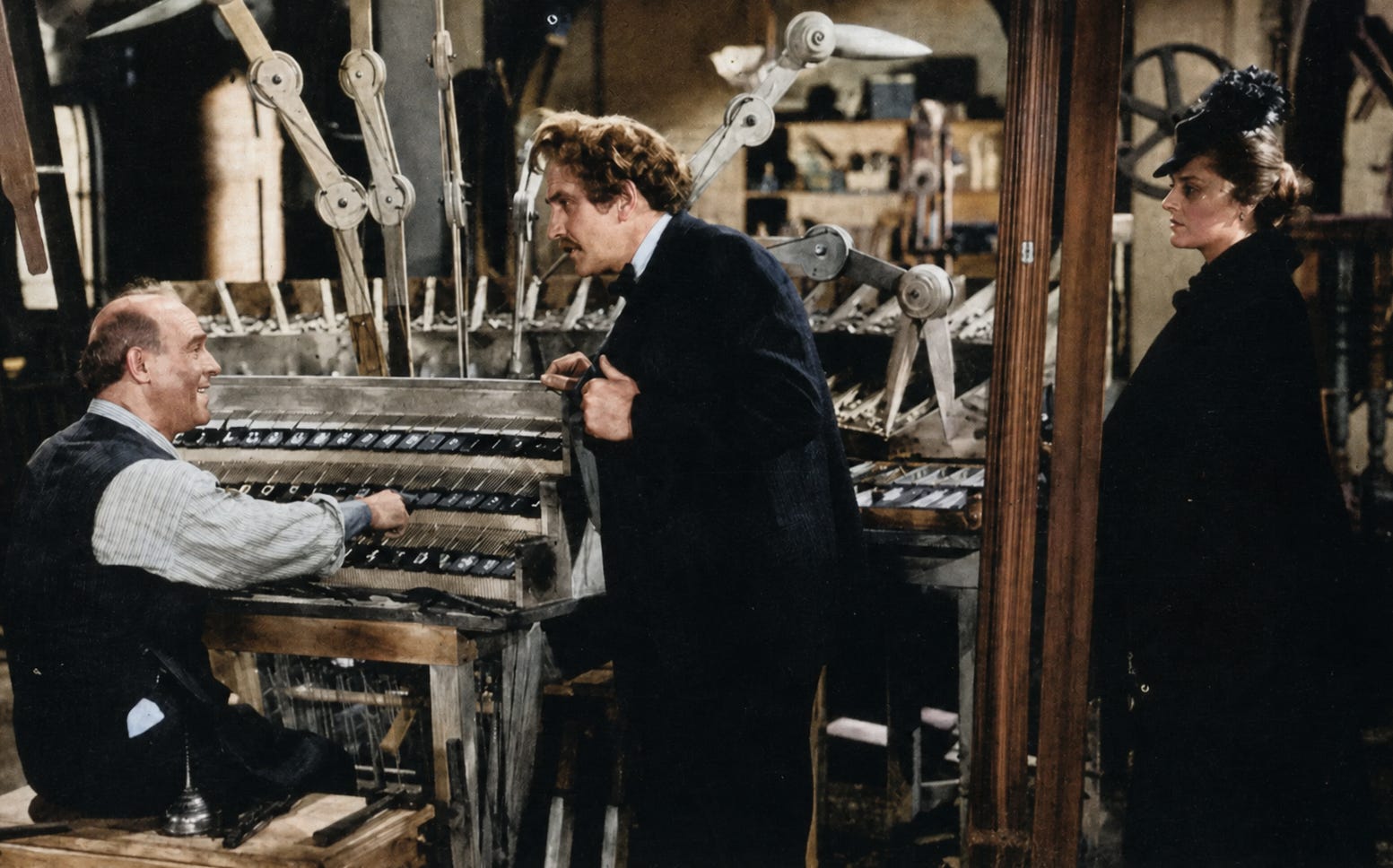
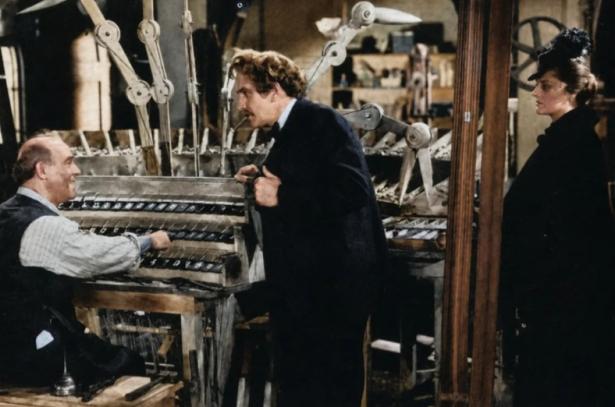
Twain visiting Paige and his machine, as depicted in the 1944 film The Adventures of Mark Twain (colorized).
The verdict of Twain’s biographers is that the author’s decade-long quest to automate the printing industry basically destroyed his life. One calls the Paige machine “a remorseless Frankenstein monster.” Twain’s most recent biographer, Ron Chernow, labels his obsession “a full-blown monomania,” and I find it hard to argue otherwise.
Reading Chernow’s biography, I was shocked at the degree to which “the Machine” took over the life of Twain’s family during his prime creative years following Huck Finn, and the extent to which its failure was responsible for both his financial ruin and subsequent depression.
So what was the machine actually trying to do?
It began in 1880, when Twain met a “little bright-eyed, alert, smartly dressed inventor” named James W. Paige. Twain had once been a “printer’s devil” himself, and although he was initially skeptical Paige’s new machine would automate away much of the costly human labor involved in setting the metal type of books and periodicals, he soon became a convert. The machine, Twain concluded, was not just a mechanical wonder but a surefire path to riches: “I never saw such an inspired bugger of a machine. Anybody can set type with it... I reckon it will take about a hundred thousand machines to supply the world, and I judge the world has got to buy them.” The financial advantages of a machine that “does not get drunk” and “does not join the printer’s union” were simply too vast for anyone to ignore.
As you can probably guess, Paige was not quite the towering hero-inventor that Twain believed him to be. He was clearly a person of real ability, but his main talent appeared to have been his skill at raising money by promising the impossible — the 19th century version of Steve Job’s reality distortion field. (“When he is present I always believe him — I cannot help it,” Twain admitted. “When he is gone away all the belief evaporates. He is a most daring and majestic liar.”)1
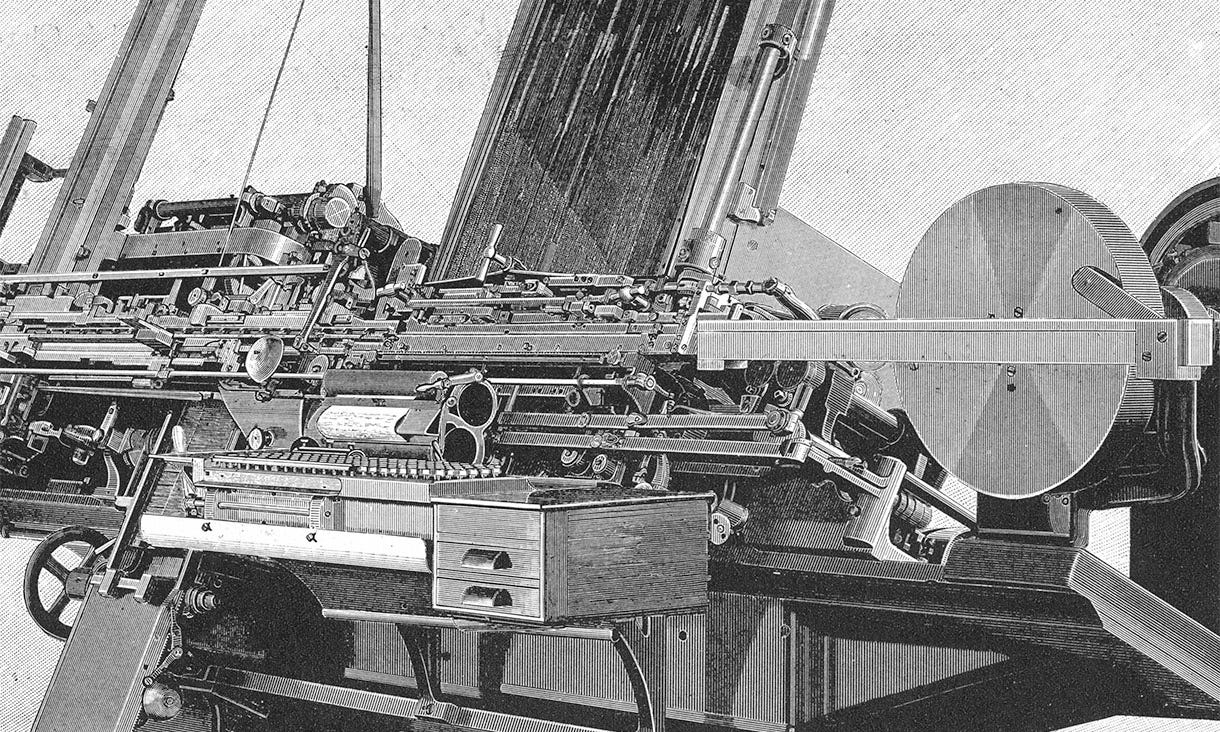
A detail of the most high-resolution surviving image of the compositor.
Twain ultimately invested the equivalent of roughly ten million dollars toward the machine: not just the bulk of his earnings from his books, but also of his wife’s inherited fortune, all of which he lost.
The issue was complexity. According to his long-suffering patent attorney, Paige “became lost in the wilderness of appalling details” as his device grew to over 18,000 distinct parts. Paige’s patent application was known internally at the United States Patent Office as “The Whale.” It took patent examiners a full 30 days just to read the initial application (you can try it yourself here).
When, at last, they requested a functioning machine, none could be found.
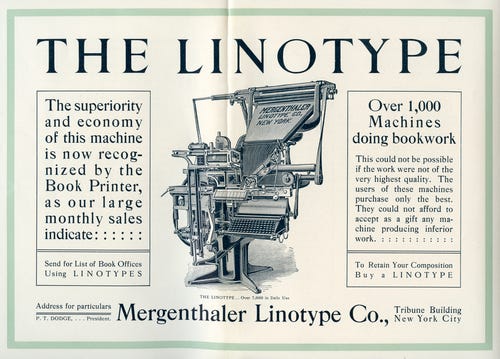
This was the crux of the problem: Paige’s typesetter was, in theory, superior to its simpler and cheaper competitor, the Linotype. But the Linotype was far easier to mass produce and repair.
The Linotype’s core advantage was that it did not attempt to mimic the human compositor’s every movement. Instead, it simplified the problem by casting complete lines of type. Paige sought to automate what humans were already doing, whereas the Linotype redesigned what the work was in the first place.
For Twain, though (and one suspects for Paige himself), the dream of mechanically mimicking human actions was what fascinated him most. Twain’s writings from the 1880s almost make it sound like he was imagining something like the contemporary concept of AGI. He came to see the Paige machine as a “creature” in its own right. When developed to perfection, it would be as “complex as that machine which it ranks next to”: the human mind.2 And it would bring immense power to those who controlled it. Twain’s housemaid later recalled: “he was expecting such wonderful things from it... he thought he’d make millions and own the world.”
Instead he went bankrupt, and Paige died a complete unknown.
Today, only one Paige machine survives. A second model “was donated to Cornell University and was later donated to a scrap metal drive during World War II.”
Twain’s vision of hundreds of thousands of human-like language machines taking over the world would have to wait a century or two.
Benjamin Breen is an associate professor of history at UC Santa Cruz and the author of The Age of Intoxication: Origins of the Global Drug Trade (Penn, 2019) and Tripping on Utopia: Margaret Mead, the Cold War, and the Troubled Birth of Psychedelic Science. Res Obscura is a reader-supported publication. To receive new posts and support this work, consider becoming a free or paid subscriber.
Spread the word