
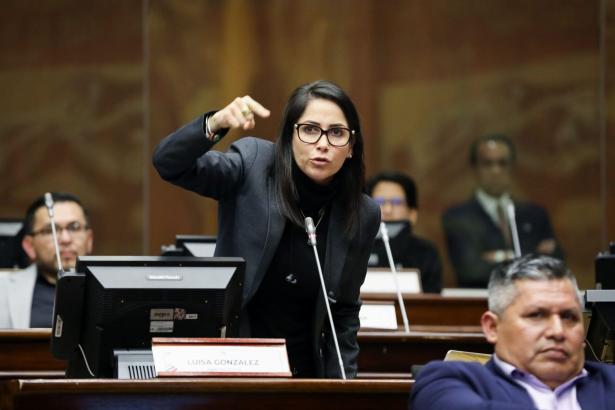
On May 30, 2026, supporters of Revolución Ciudadana, Ecuador’s largest left-wing opposition party, gathered in Canuto, a farming parish in the western province of Manabí, to raffle off a motorcycle, household appliances, and farm animals for $5 a ticket. Canuto is home to Luisa González, the party’s presidential candidate in 2023 and 2025. The money went toward an $18,000 fine that the country’s electoral court imposed on her 2023 campaign treasurer, Estefanía Molina, and for which González and her 2023 running mate, Andrés Arauz, were held jointly liable. On June 5, González announced that she had paid the fine, and on June 24, the court declared the case settled.
Months later, before dawn on October 22, armed police entered González’s home in Canuto and arrested her on charges stemming from the same 2023 campaign. That night, at a closed-to-the-public hearing held by video link, prosecutors formally charged her with money laundering tied to campaign financing before Quito’s specialized court for corruption and organized crime. On October 23, Judge Harry Navarrete granted the prosecution’s request to hold her in pretrial detention for the 90-day investigation. González was taken under armed guard to the women’s prison in Riobamba, although, her lawyer says, the judge had granted the defense’s request to hold her in Quito, near her young son and her father, who has kidney disease.
Three others were charged alongside González. Wendy Onofre turned herself in to authorities in Guayas the same day, and the judge ordered her held as well. She is secretary of the Movimiento Renovación Total (RETO), a party allied with Guayaquil Mayor Aquiles Alvarez, who was himself arrested in February in a separate case. The judge gave the same order for Santiago Díaz Asque, González’s former campaign manager, who is already in prison serving a 29-year sentence. Estefanía Molina, the campaign treasurer, was detained on October 22 but released with an ankle monitor; she cares for a child who is ill. Andrés Arauz, González’s 2023 running mate, is also named in an arrest warrant, but he had left the country on October 8. “It is not a case of illegal campaign financing,” he told me in a voice message from abroad. “It is a case of political persecution.”
The arrests came five weeks before the November 29 elections for mayors, prefects, councils, and parish boards; Revolución Ciudadana, suspended in March, is already barred. The arrests cap a year of lawfare against Ecuador’s left and its popular movements: legal process used for ends the law does not authorize, in this case, clearing the opposition from the ballot.
From Campaign Fine to Organized-Crime Case
The case, known as caso Laberinto (“Labyrinth”), began at the Electoral Disputes Tribunal (TCE). In November 2025, Diana Atamaint, then president of the National Electoral Council, filed a complaint over the 2023 Revolución Ciudadana campaign accounts. Using its own roadside monitoring, the council estimated the campaign had not reported $174,930 in advertising and questioned two small contributions that lacked supporting documents. Even counting that sum, the ruling found, the campaign spent far less than the legal limit. On April 7, TCE judge Guillermo Ortega fined Estefanía Molina $18,000 and held Luisa González and Andrés Arauz jointly liable. He also referred the file to the Attorney General’s office, asking it to investigate the source of the two unsupported contributions and how the council arrived at the $174,930 figure.
Prosecutors went far beyond that referral. At the time of the arrests, the Attorney General’s office said it was investigating approximately $500,000 allegedly channeled into the campaign through a web of companies. At the hearing, it said the campaign had been financed with “illicit resources from the illegal commercialization of hydrocarbons.” By the next morning, the news site Primicias, citing the case file, reported that an internal spreadsheet assigned the campaign $725,933 from Ternape Petroleum, a fuel company owned by the family of Guayaquil Mayor Aquiles Alvarez.
That is where Alvarez’s case becomes intertwined with González’s. The “hydrocarbons” are subsidized diesel, not drugs. In August, a Quito court convicted Alvarez of diverting subsidized diesel through his family’s companies, a conviction he can still appeal. Prosecutors now say money from those companies paid for González’s campaign. The electoral court settled a dispute with a fine, but prosecutors rebuilt it as organized-crime money laundering, a charge that carries prison time and is heard behind closed doors in a special court set up for organized crime and corruption.
The evidence in the González file comes from José Ricardo Cevallos, a former state fuel regulator who, in 2021, became financial manager of the Alvarez companies he had once overseen. In December 2025, Cevallos turned over his phones and laptop to prosecutors and became a protected witness. In August, a court convicted him as an accomplice in the diesel case; on October 6, a judge suspended his sentence, and he is free. His testimony, as El Universo reported it on October 26, describes chat groups among Alvarez’s staff and suppliers. It does not place González in any of them.
The second witness is Santiago Díaz Asque, the former campaign manager, sentenced in May to 29 years in prison for raping a 12-year-old girl. Since January, he has given statements to prosecutors in a separate case, “Caja Chica” (Petty Cash), which holds that the same 2023 campaign ran on cash from Venezuela. While González’s hearing was still underway, presidential spokesman José Julio Neira said that hypothesis was still alive. The state now has two stories about the money’s origin, Venezuela or a Guayaquil fuel company, and two witnesses with a stake in cooperating. One has already gone free. The other is serving 29 years.
Ecuadorian law has a remedy if an allied mayor’s company paid for campaign material, and the electoral court applied it in April. The same court has never sanctioned President Daniel Noboa. The outlet Wambra counts 20 electoral complaints against him: 19 have been archived, and one was not admitted. Against one side, campaign finance is now a matter for the organized-crime court. Against the other, the complaints are filed away.
Clearing the Field
The arrests in caso Laberinto are the latest in a string of moves the government has taken against the opposition over the past year. Local elections were set for February 2027, but the National Electoral Council moved them forward to November 29. On March 6, TCE judge Joaquín Viteri suspended Revolución Ciudadana on a complaint from the acting Attorney General in the Caja Chica money-laundering case. On April 26, the council canceled Unidad Popular—a left-wing party—and Construye—the movement that ran Fernando Villavicencio, the presidential candidate assassinated in 2023. A court restored Unidad Popular in June. On July 17, the TCE suspended Amigo, the movement through which Revolución Ciudadana’s candidates had planned to run in the local elections, and the council kept González off the ballot for prefect of Manabí. On October 21, prosecutors raided the offices of Quito Mayor Pabel Muñoz, a Revolución Ciudadana member running for reelection, over an embezzlement complaint against his staff.
The government previewed the case. On October 19, three days before the arrests, presidential spokesman José Julio Neira went on the radio and, citing investigations by the Attorney General’s office, tied Revolución Ciudadana to organized-crime financing. Pabel Muñoz described the pattern in a social media post: “What they cannot win at the ballot box, they try to win in the courts.” González had been warned. In June, she said Interior Minister John Reimberg told a meeting at the Manabí governor’s office that if she ran for prefect, she would lose her political rights and go to prison. The day after the arrest, Reimberg made the next step plain: “There are a few more still to come.”
Lawfare Against the Movements
The same instruments of judicial persecution have been used against movements that fought former President Rafael Correa; their response shows the national stakes of González’s case. CONAIE, the Confederation of Indigenous Nationalities of Ecuador, spent a decade in open conflict with Correa’s government. On the afternoon of González’s arrest, its governing council issued a statement titled “Without an independent judiciary, there is no democracy.” “Today it may be one political organization,” it said; “tomorrow, any other party or movement.”
Simón Velasco, the council’s communications leader, told me the statement was deliberate. Many in CONAIE’s bases, including several of its leaders, remain anti-correísta, he said, but younger, left-wing cadres believe that in times “beginning to border on the fascist,” the movement must “at least attempt to build a framework of unity with other sectors of the country’s left.” “We have had problems with RC [Revolución Ciudadana], and many issues remain unresolved between us,” he said. “This statement shows the political will to seek that unity.”
CONAIE has its own reasons. Police and soldiers broke its national strike in September and October 2025 against ending the diesel subsidy. Ecuador’s Alliance of Human Rights Organizations counted three protesters killed and 473 injured, and in three of every four incidents it documented, complaints named the police or the armed forces. In August, a judge in Ibarra ordered the arrest of Guido Perugachi, the president of Fenocin—a national federation of peasant, Indigenous and Black organizations—for paralyzing public services during the strike. On October 23, Edwin Bedoya, president of the FUT labor federation, cited Perugachi and González together: pretrial detention, he said, “cannot become an instrument of advance punishment.”
YASunidos, the collective that fought Correa over drilling in Yasuní National Park and won the 2023 referendum to keep that oil in the ground, has been hit too. In April, the TCE fined two of its leaders $9,000 each over a 39-cent discrepancy that the collective says was accounted for. In November 2025, the Financial Intelligence Unit—then headed, according to Wambra, by Neira—froze the bank accounts of social, Indigenous, and environmental organizations and leaders—including YASunidos coordinator Pedro Bermeo—on suspicion of money laundering. Two anti-corruption judges ordered 19 of them released, CONAIE among them, because the unit had shown no concrete sign of suspicious transactions. On the day of González’s arrest, YASunidos denounced “the political use of justice against the Revolución Ciudadana.”
Whose State, Whose Law
President Noboa is the heir to the country’s largest banana-export fortune. He governs under a $5 billion IMF program that demands fiscal adjustment, and he cut the diesel subsidy that brought the Sierra into the streets. The organized opposition to that program has two bodies: Revolución Ciudadana at the ballot box and CONAIE on the roads. This year, prosecutions have struck both.
The government calls it all crime. On October 26, Noboa told Radio Sucre that there are “indications” against González and that drug and organized-crime money is used “to finance the opposition to this government.” The vocabulary turns a dispute over campaign accounts and fuel subsidies into “narcoterror,” and narcoterror into grounds for closed hearings and pretrial detention.
A different standard applies to the president’s family. In late 2020 and early 2021, according to an investigation by OCCRP and its partners, traffickers hid 535 kilograms of cocaine in banana containers shipped to Europe by Noboa Trading, a company owned by the president’s family. OCCRP found no evidence that the company knew of the drugs. Noboa says it cooperated with investigators and its officials were cleared. His family’s company was presumed innocent. González, on the word of two compromised witnesses, was jailed.
What Comes Next
The Inter-American Commission on Human Rights, meeting in Panama this week, took up democratic institutions and civic space in Ecuador on October 27 and judicial independence on October 28. Revolución Ciudadana has asked the Commission for precautionary measures. At home, González appealed the detention order at the hearing, and her lawyer confirmed the appeal in writing on October 25; no hearing date has been set. Arauz says he will file a constitutional action for her release. His argument, which defense lawyers raised at the hearing, is that, as a registered opposition spokesman, he can be tried only in a provincial court, which would take the case away from Judge Harry Navarrete. The judge went ahead against her anyway, though he ruled that only such a court could bring Arauz in.
Abroad, the left has responded. The Grupo de Puebla, a forum of Latin American progressive leaders, warned that a democracy that persecutes its opposition “risks becoming a disguised dictatorship.” Servicio Paz y Justicia, led by the Nobel laureate Adolfo Pérez Esquivel, called the arrest arbitrary and unconstitutional, and parties including Mexico’s Morena and Chile’s Frente Amplio condemned it. In Washington, Representative Chuy García called it “a shameful escalation of repression.” Human Rights Watch has voiced its concern. However, as of October 27, no government had spoken, not even the left-led governments of Mexico and Brazil.
On November 29, Ecuadorians will elect mayors and prefects. Luisa González and her party will not be on the ballot. Unless a court frees her first, the woman who twice ran for president will spend election day in a cell in Riobamba. Noboa’s government will not have to beat her at the ballot box; the courts have kept her off it.
Blair Goodman is a writer and researcher based in Cotacachi, Ecuador. He writes on Ecuadorian politics and U.S. policy in the hemisphere at blairgoodman.substack.com.
The North American Congress on Latin America (NACLA) is an independent, nonprofit organization founded in 1966 to examine and critique U.S. imperialism and political, economic, and military intervention in the Western hemisphere. In an evolving political and media landscape, we continue to work toward a world in which the nations and peoples of Latin America and the Caribbean are free from oppression, injustice, and economic and political subordination.
Spread the word