
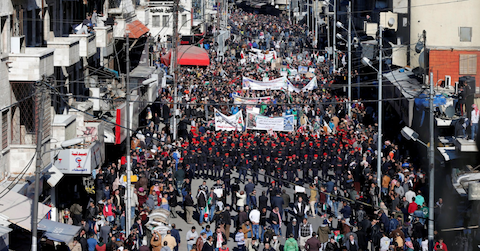
As protests and violence intensified in the Middle East on Friday in response to President Donald Trump's decision to flout international law and recognize Jerusalem as the capitol of Israel earlier this week, more than 120 Jewish studies scholars from universities across the United States condemned the move and urged the Trump administration to take responsibility for the fallout.
"A declaration from the United States government that appears to endorse sole Jewish proprietorship over Jerusalem adds insult to ongoing injury and is practically guaranteed to fan the flames of violence," wrote the scholars in their petition.
At least one Palestinian protester has been killed in the demonstrations that followed Wednesday's announcement. The Israeli military launched air strikes on Gaza as Palestinians took part in a "day of rage," called for by Hamas leader Ismail Haniyeh. At least 25 people were injured in the air strikes, including six children.
The Jewish studies scholars called on the U.S. government "to take immediate steps to deescalate the tensions resulting from the President's declaration and to clarify Palestinians' legitimate stake in the future of Jerusalem."
Trump's decision reversed decades of U.S. policy supporting a move toward a two-state solution, and has been viewed as a firm stance in support of Israel—even as the State Department has attempted to assure observers that the U.S. hasn't changed its policy on future negotiations between Israeli and Palestinian leaders and an end to Israel's occupation of Jerusalem.
The scholars argued that the president's declaration will embolden Israeli leaders who have oppressed Palestinians for decades.
"Palestinian residents of Jerusalem endure systematic inequalities, including an inequitable distribution of the city's budget and municipal services, routine denial of building permits that are granted to Jewish residents, home demolitions, and legal confiscation of property for Jewish settlement," wrote the scholars.
The petition was circulated as the U.N. Security Council issued its own condemnation of Trump's action.
At an emergency meeting of the panel, Nickolay Mladenov, the U.N.'s special coordinator for the Middle East peace process noted that Trump made his announcements against the guidance of the international community.
"The United Nations has repeatedly declared that any unilateral decision that seeks to alter the character and status of Jerusalem or that may alter these long-standing principles could seriously undermine current peace efforts and may have repercussions across the region," Mladenov said.
Jerusalem is of immense religious and thus emotional significance to Jews, Muslims, and Christians alike. It is the focus of national aspirations for both Israelis and Palestinians. We hope one day to see a world in which all inhabitants of the land enjoy equal access to the city’s cultural and material resources. Today, unfortunately, that is not the case.
As the Israeli human rights organization B'Tselem* has documented, Palestinian residents of Jerusalem endure systematic inequalities, including an inequitable distribution of the city's budget and municipal services, routine denial of building permits that are granted to Jewish residents, home demolitions, and legal confiscation of property for Jewish settlement. In addition, Palestinians in the West Bank, unlike Jewish Israelis resident in that territory, require a special permit to visit Jerusalem’s holy sites.
In this context, a declaration from the United States government that appears to endorse sole Jewish proprietorship over Jerusalem adds insult to ongoing injury and is practically guaranteed to fan the flames of violence. We therefore call on the U.S. government to take immediate steps to deescalate the tensions resulting from the President’s declaration and to clarify Palestinians’ legitimate stake in the future of Jerusalem.
1. Beverly Bailis, Brooklyn College
2. Mark Baker, Monash University
3. Elissa Bemporad, Queens College and The CUNY Graduate Center
4. Mara Benjamin, Mount Holyoke College
5. Matthew Berkman, University of Pennsylvania
6. Joel Berkowitz, University of Wisconsin-Milwaukee
7. Lila Berman, Temple University
8. David Biale, University of California, Davis
9. Jeffrey Blutinger, California State University, Long Beach
10. Ra'anan Boustan, Princeton University
11. Zachary Braiterman, Syracuse University
12. Francesca Bregoli, Queens College and The Graduate Center, CUNY
13. Emma Brodeur, Syracuse University
14. Samuel Brody, University of Kansas
15. Jeremy P. Brown, University of San Francisco
16. Debra Caplan, Baruch College, CUNY
17. Jessica Carr, Lafayette College
18. Flora Cassen, UNC Chapel Hill
19. Geoffrey Claussen, Elon University
20. Aryeh Cohen, American Jewish University
21. Rebecca Davis, University of Delaware
22. Laura Duhan-Kaplan, Vancouver School of Theology
23. Barat Ellman, Fordham University
24. Barbara Epstein, University of California, Santa Cruz
25. Robert Erlewine, Illinois Wesleyan University
26. Sara Feldman, University of Illinois
27. Sandy Fox, New York University
28. Ben Freeman, Harvard Divinity School
29. Joshua Friedman, Duke University
30. Olga Gershenson, University of Massachusetts
31. Shai Ginsburg, Duke University
32. Evan Goldstein, Yale University
33. Andrew Gordon, University of Florida
34. Erin Graff Zivin, University of Southern California
35. Ronnie Grinberg, University of Oklahoma
36. Atina Grossmann, Cooper Union
37. Chaya Halberstam, Western University
38. Rachel Havrelock, University of Illinois Chicago
39. Tim Hegedus, Wilfrid Laurier University
40. Elizabeth Heineman, University of Iowa
41. Susannah Heschel, Dartmouth College
42. Jonathan Hess, UNC Chapel Hill
43. Curtis Hutt, University of Nebraska at Omaha
44. Daniel Itzkovitz, Stonehill College
45. Claire Katz, Texas A&M
46. Gwynn Kessler, Swarthmore College
47. Rebekah Klein-Pejsova, Purdue University
48. Michal Kofman, University of Louisville
49. Rachel Kranson, University of Pittsburgh
50. Chana Kronfeld, University of California, Berkeley
51. Jacob Labendz, Youngstown State University
52. Yitz Landes, Princeton University
53. Timothy Langille, Arizona State University
54. Nitzan Lebovic, Lehigh University
55. Daniil Leiderman, Texas A&M
56. Brian Leonard, Boston College High School
57. Rebecca Lesses, Ithaca College
58. Maggie Levantovskaya, Santa Clara University
59. Daniel Levine, University of Alabama
60. Laura Levitt, Temple University
61. Lital Levy, Princeton University
62. Andrea Lieber, Dickinson College
63. Ari Linden, University of Kansas
64. Joe Lockard, Arizona State University
65. Ian Lustick, University of Pennsylvania
66. Lindsay Macumber, Saint Mary's University
67. Shaul Magid, Indiana University
68. Charles Manekin, University of Maryland
69. Barbara Mann, Jewish Theological Seminary
70. Samira Mehta, Albright College
71. Jeffrey Melnick, University of Massachusetts Boston
72. Ibrahim Miari, University of Pennsylvania
73. Michael Miller, Liverpool Hope university
74. Sarah Anne Minkin, UC Berkeley
75. Leslie Morris, University of Minnesota
76. Eva Mroczek, UC Davis
77. Rachel Neis, University of Michigan
78. Judith Newman, University of Toronto
79. Anita Norich, University of Michigan
80. Jess Olson, Yeshiva University
81. Ranen Omer-Sherman, University of Louisville
82. Annelise Orleck, Dartmouth College
83. Riv-Ellen Prell, University of Minnesota
84. Vadim Putzu, Missouri State University
85. Shari Rabin, College of Charleston
86. Randi Rashkover, George Mason University
87. Elliot Ratzman, Lawrence University
88. Emily Rogal, Harvard Divinity School
89. Na’ama Rokem, University of Chicago
90. Kate Rosenblatt, Emory University
91. Jordan Rosenblum, University of Wisconsin-Madison
92. Bruce Rosenstock, University of Illinois at Urbana-Champaign
93. Michael Rothberg, UCLA
94. Adam Rovner, University of Denver
95. Nora Rubel, University of Rochester
96. Elias Sacks, University of Colorado Boulder
97. Alison Schofield, University of Denver
98. Benjamin Schreier, Penn State University
99. Joshua Schwartz, New York University
100. Naomi Seidman, Graduate Theological Union
101. Sasha Senderovich, University of Washington, Seattle
102. Joshua Shanes, College of Charleston
103. Nathaniel Shils, University of Pennsylvania
104. Anne Shlay, Georgia State University
105. David Shneer, University of Colorado Boulder
106. Maeera Shreiber, University of Utah
107. Larry Silver, University of Pennsylvania
108. Shana Sippy, Centre College
109. Andrew Sloin, Baruch College, CUNY
110. Rachel Smith, UCLA
111. Scott Spector, University of Michigan
112. Loren Spielman, Portland State University
113. Gregory Spinner, Skidmore College
114. Neta Stahl, Johns Hopkins University
115. Deborah Starr, Cornell University
116. Richard Steigmann-Gall, Kent State University
117. Mira Sucharov, Carleton University
118. David Teutsch, Reconstructionist Rabbinical College
119. Irene Tucker, University of California, Irvine
120. Alana Vincent, University of Chester, UK
121. Burton Visotzky, Jewish Theological Seminary
122. Anika Walke, Washington University in St. Louis
123. Kerry Wallach, Gettysburg College
124. Mira Wasserman, Reconstructionist Rabbinical College
125. Dov Waxman, Northeastern University
126. Liliane Weissberg, University of Pennsylvania
127. Beth Wenger, University of Pennsylvania
128. Barry Wimpfheimer, Northwestern University
129. James Young, University of Massachusetts Amherst
130. Michael Zank, Boston University
131. Saul Zaritt, Harvard University
132. Sarah Zarrow, Western Washington University
-----
* See http://www.btselem.org/jerusalem
If you wish to add your signature to this statement, fill out the form below. If your name appears on this statement in error, please write to jewishstudiesstatement@gmail.com from your institutional email address.
Spread the word