
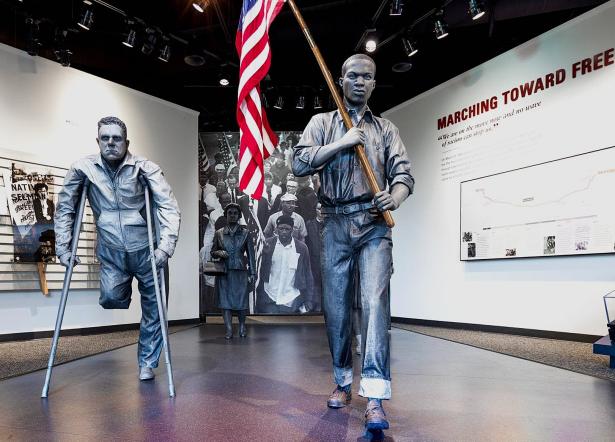
Black Power Grows in a Tent City
DECEMBER 31 IS THE 60TH ANNIVERSARY of the day in 1965 when civil rights activists started to build a refugee camp for the families of Alabama sharecroppers and tenant farmers who had been forced off their land and fired from their jobs for having registered to vote.
Five months earlier, when the Civil Rights Act of 1965 went into effect, there had been no Black registered voters in Lowndes County, where the population was 81 percent Black. There were hardly any Black registered voters in nearby Wilcox and Dallas counties, each of which had a majority-Black population.
Already by the end of 1965, the number of Black registered voters in Lowndes County was almost equal to the number of registered white voters. Thousands more Black voters were in line to register. The newly registered were creating a new political formation – Lowndes County Freedom Organization – that would be able to choose its own candidates, who would be shoo-ins to win county elections in late 1966.
With federal officials in charge of the voter registration process, the only hope for the county’s dominant whites was to force Blacks to leave the county by evicting them from the homes they rented and by firing them from their jobs.
Many of the eviction victims doubled up in Black-owned housing, but there was not space for all the dispossessed, so the Lowndes County Christian Movement for Human Rights, in collaboration with Student Nonviolent Coordinating Committee staff members and students from the nearby Tuskegee Institute, erected a tent city on Black-owned farmland about five miles west of Lowndesboro.
Today, the National Parks Service’s Lowndes Interpretive Center occupies the land where the tent city stood. The Center, which is a unit of the Selma to Montgomery National Historic Trail, contains many exhibits that incorporate artifacts, news footage, photographs and interviews with civil right activists. Visitors to the Center can make use of its shaded picnicking facilities while they contemplate the struggle to put Jim Crow where he belonged. https://www.zinnedproject.org/materials/bloody-lowndes/
Lead Pollution Is Profitable, So Shut Up!
JANUARY 1 IS THE 30TH ANNIVERSARY of the first day that it became illegal to sell leaded gasoline in the U.S.
When oil refiners began to add lead to gasoline in 1924 in order to improve engine performance, many public health experts warned that the lead-contaminated exhaust from leaded gasoline was a serious environmental hazard, particularly for the large and growing proportion of the population living in cities.
Their warning was drowned out by a well-financed corporate disinformation campaign, which ensured tens of millions of dollars of profit for the campaign’s principal funders, Standard Oil, General Motors and DuPont Chemical.
Even by the time the Environmental Protection Agency acknowledged in 1973 that millions of children were suffering from the toxic effect of exposure to lead in auto exhaust, the corporate pushback prevented the proposed ban from going into full effect for more than two decades. https://www.thenation.com/article/archive/secret-history-lead
‘Two, Three, Many Vietnams’
JANUARY 3 IS THE 60TH ANNIVERSARY of the opening day of the 2-week long Tricontinental Conference in Havana, which was attended by some 500 delegates from 82 countries. On the meeting’s first day, a letter from Che Guevara (who was unable to attend) was read, including his memorable call for "two, three, many Vietnams" to fight against imperialism. https://www.marxists.org/archive/guevara/1967/04/16.htm
No Responders Left Behind
JANUARY 5 IS THE 20TH ANNIVERSARY of the death of New York City police officer James Zadroga, who died because his lungs were full of dust particles created by the collapse of the World Trade Center in September 2001. He was the first police officer whose death was attributed to exposure to the toxic air near the World Trade Center.
Zadroga’s life and his untimely death became rallying cries for the movement to provide free health-care to the tens of thousands of people whose health has been compromised as a result of the World Trade Center’s collapse. https://en.wikipedia.org/wiki/Health_effects_arising_from_the_September_11_attacks
Protecting Kahoʻolawe from Bombs
JANUARY 6 IS THE 50TH ANNIVERSARY of a militant demonstration by native Hawaiians and their supporters against the U.S. Navy’s refusal to abide by federal environmental laws on Kahoʻolawe, the smallest Hawaiian island, which was then entirely occupied by a Navy gunnery range.
In 1976 some 50 activists, who organized themselves as Protect Kahoʻolawe ʻOhana (PKO), made a successful (but tragic) effort to defy the Navy by “invading” Kahoʻolawe. The Navy prevented almost all of their small craft from reaching the island, except for the “Kahoʻolawe Nine”, who landed in spite of the Navy’s effort. Sadly, two of the nine successful blockade runners were lost as a result of heavy weather before they could return to Maui.
After decades of protests, the Navy ended live-fire training exercises on Kahoʻolawe in 1990, and the whole island was transferred to the jurisdiction of the state of Hawaii in 1994. Since then the Hawaiian State Legislature established the Kahoʻolawe Island Reserve to restore and to oversee the island and its surrounding waters. Today Kahoʻolawe can be used only for native Hawaiian cultural, spiritual, and subsistence purposes, fishing, environmental restoration, historic preservation, and education. https://www.hawaiipublicradio.org/local-news/2022-10-05/native-hawaiian-activists-stopped-military-bombing-on-kahoolawe-32-years
For more People's History, visit
https://www.facebook.com/jonathan.bennett.7771/
Spread the word