
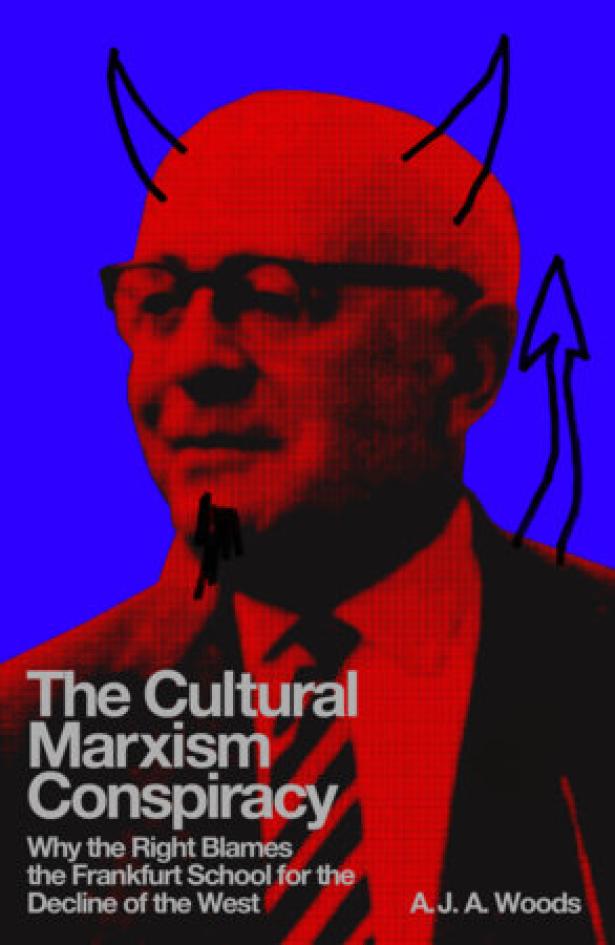
The Cultural Marxism Conspiracy: Why the Right Blames the Frankfurt School for the Decline of the West
A.J.A. Woods
Verso
ISBN: 9781804296967
FIRST AS TRAGEDY, then as farce … then as neurosis, then as crazed obsession, then as ironic pose, then as weaponized absurdity. We’ve lost track of the modes in which history repeats itself. We know it’s bad, we know it’s violent and cruel, and we know it will continue unless something is done. Still, analysis escapes us: the cycles are getting too rapid to grasp. Every idea and gesture is memed to death by the time it reaches our brains, either defanged and sterilized or part of a tidal wave of banality bowling us over.
So it is with “Cultural Marxism.” Over the past 15 years—in particular the last decade—the concept has become so overused by the American Right that we almost tune out when we hear it. The same can be said for so many Trumpian talking points—“DEI,” “radical Left,” “Trump derangement syndrome”—that we brush it aside. As with anything so overused, we forget what made the idea potent in the first place.
This, naturally, is the point, and it ultimately works in the Right’s favor. Of course they see Marxists around every corner, we tell ourselves. It’s ridiculous. And it is. But when the ridiculous idea is believed and promoted by the most powerful man in the world (he who is currently and enthusiastically bombing Iran on the flimsiest of pretenses), what does its “truthiness” matter? If, eventually, you are forced to publicly declare I am not a Marxist just to sidestep the furor, haven’t they already won?
Against all this, A. J. A. Woods’s The Cultural Marxism Conspiracy: Why the Right Blames the Frankfurt School for the Decline of the West (2026) offers a welcome corrective. The short book—Woods’s first—traces the genealogy and evolution of this right-wing bugbear. Of course, Woods points out, Cultural Marxism isn’t real, at least in the way the Right thinks of it. The idea that Marxists have taken over the educational and cultural apparatus of the United States, of the entire world, is ludicrous on its face. The real question, as Woods frames it, is what kind of society, what course of history, makes it possible for such a flagrantly silly idea to take root and spread so thoroughly?
Highlighting the oddity of answering this question is that most proponents of the Cultural Marxism conspiracy theory couldn’t name a real Marxist if they tried. The typical American conservative has never heard of Antonio Gramsci, Theodor Adorno, Walter Benjamin, or Herbert Marcuse. And yet, it is to the work of these theorists that the prime architects of the conspiracy theory repeatedly return, even if they have never bothered to read a word by them.
Woods’s book is not intended as a defense of these left-wing thinkers’ ideas, at least not primarily. Defending anyone against the charges of the tinfoil-hat brigade is obviously a waste of time, even if that brigade is most of the president’s cabinet. But Woods is working in the vein of cultural studies, influenced by Stuart Hall and Raymond Williams, as well as Gramsci and the Frankfurt School. In other words, rather than dodge the shrill accusations of “Marxist,” Woods leans in. Indeed, Woods argues that “it is more appropriate to discuss plural Cultural Marxisms,” and that these form “not a generic conspiracy theory but, rather, an ever-changing combination of narrative elements that possesses different meanings and functions in various political contexts.”
Depending on the era, the writer, or the circumstances, shrieks about the dangers of Cultural Marxism might emerge from wildly different, often contradictory, positions. Cultural Marxism is part of virtually every moral panic since the 1960s; it is a motivating factor behind attacks on “political correctness” and “wokeness.” It is at once a danger to the glories of American capitalism and a plot that reaches to the highest echelons of corporate America. It is both powerful and a threat to power itself. Like many ideas and memes today, it is prolific because it makes no sense. Its incoherence is its durability.
¤
That these narratives of Cultural Marxism(s) have their origins in a sect that used to call itself Marxist may or may not come as a surprise, though it certainly adds to the absurdity. The organizations of the late crackpot and fringe political gadfly Lyndon LaRouche came out of the fractured remnants of Students for a Democratic Society (SDS). These origins bear little mark on what the movement became, however, as anyone who has had any brush with real-world LaRouchites can attest.
Woods’s narrative starts here. Within a decade of the implosion of SDS, LaRouche’s group—which went through several different names and iterations—ended up a full-on cult, complete with purges, antisemitic conspiracy theories, and “ego-stripping” rituals for its membership. LaRouchites stormed meetings of the Communist and Socialist Workers parties to assault attendees. With LaRouche himself at their helm, they built a prolific publishing fiefdom and developed a mode of analysis so idiosyncratic and self-referential as to rival Scientology.
The movement’s lurch to the right was evident in its myriad publications. In the late 1960s, Herbert Marcuse was just a thinker against whom the egotistical LaRouche bore a particular grudge for supposedly getting him and his “National Caucus of Labor Committees” (NCLC) expelled from SDS. By the late 1970s, the Frankfurt School writ large were responsible for young people’s loose sexual mores and their affinity for loud, dissonant music. Through the promotion of an insidious consumer culture, hedonistic movies, and formulaic soap operas, the thinkers of the Frankfurt School were tearing at the very fabric of Western culture and civilization.
Of course, anyone familiar with the work of the Frankfurt School, even in passing, will immediately recognize the problem. Put simply, the Frankfurt School—Adorno and Max Horkheimer especially—expressed outright disdain for most expressions of popular culture. To them, the mass industrial production of films, pop music, and TV shows—the dreaded “culture industry”—served to colonize human leisure, metabolizing free time into a kind of work.
Before the war, the Frankfurt-based Institute for Social Research had been dedicated to answering why the socialist revolution hadn’t succeeded in Germany. Answers weren’t going to be found only in political economy or revolutionary strategy but also in culture, in psychoanalysis, in the shape of everyday life itself. After the institute’s thinkers—all Marxists, almost all Jewish—had fled the Third Reich, their original preoccupation began to move in tandem with an attempt to understand the success of fascism, and how it might return. Echoes of fascist domination were woven into the fabric of postwar consumer capitalism, and the Frankfurt School sought to highlight these in their research, their scholarship, their philosophical work, and their cultural criticism. This purpose is plain to anyone who reads Adorno et al.’s The Authoritarian Personality (1950), Horkheimer’s Critique of Instrumental Reason (1967), or Marcuse’s One-Dimensional Man: Studies in the Ideology of Advanced Industrial Society (1964).
How LaRouchites—or their soon-to-be inheritors—came to see these ideas as promoting their exact opposite is peculiar, to say the least. In the pages of New Solidarity, Executive Intelligence Review, and other LaRouche publications, the New Left and the Frankfurt School were both transformed into fascist sleeper agents on the payroll of the Rockefellers, conspiring with the likes of Henry Kissinger and Queen Elizabeth II. But, as Woods shows, the concern is largely with how this movement conceived of itself as a kind of intellectual vanguard, capable of insights no one else could produce:
These special “geometric” readings of the Frankfurt School produced an image of “the enemy” against which the LaRouche movement could continually define itself as an intellectual elite. In the 1970s and 1980s, NCLC would expand this notion of an elite to include their new radical right-wing and conservative allies. These shifting political affiliations would affect the tone and scale of their polemics against the Frankfurt School.
Thus, Cultural Marxism. Though the LaRouche movement never used the term itself, its publications and ideas found their way into the hands of paleoconservative thinkers like Paul Weyrich and William S. Lind, foundational figures in the Center for Cultural Conservatism, the Free Congress Foundation, and the formation of the New Right during the Reagan years. From there, it has wound its way through the ranks of the Tea Party and the enactments of Project 2025. It has shown up in the manifestos of terrorists including Anders Breivik, in the tweets of Elon Musk, and in the doctrine of “legitimate” think-tankers like Christopher Rufo. It has been adapted and adopted by the likes of Reform UK’s Nigel Farage, the Bolsonaristas in Brazil, and Argentina’s Javier Milei. For all their purported fear that the Marxists have undertaken a long march through our institutions, it is clearly the Right who is in control of them. Indeed, right now, the latter group is in the process of hollowing these institutions out entirely.
One could argue that this conspiracy theory has come a long way from its LaRouchian origins, but as Woods writes, all iterations and uses of the Cultural Marxism trope contain a core characteristic. For all their anti-elitist rhetoric, for all their appeals to tradition and “human nature,” their ultimate aim is to simply replace one elite with another: a multiracial elite with a white one, sex-positive consumerism with the patriarchal family, a “woke” capitalism with one that has entirely given up any pretense of social equality.
¤
It’s all quite grim, as most things are these days. It isn’t the only narrative weaving its way through Woods’s book, however. Like every poisonous idea, this conspiracy theory exists in the context of a larger culture. And like a good Gramscian, Woods sees this culture as more than just a one-sided story of domination. There is a democratic side too, even a radical one. While politics aren’t “downstream from culture,” as many conservative culture warriors argue, Woods also insists that we cleave culture from politics at our own peril. “The practices of art, culture, and education are not mere adjuncts to human existence,” Woods writes; “they are integral to our ways of life.”
We therefore face a daunting task: building a culture that seeks not just to transform ideas but also to make daily life an experiment in radical democracy. That the Right can glibly slap the label Marxist onto what is basically the cultural politics of liberalism speaks not to the Left’s strength over the past 50 years but to its weakness. Despite meaningful victories and a growth in the number of people who identify as socialists in recent years, this weakness persists. The Marxism the Right speaks of is spectral, there but not there, anticommunism without communism, a mere potential overblown to the level of real, concrete power.
But why does this fantasy specter haunt so effectively? To take the fever dreams of anticommunist panic seriously is inevitably to wonder why the Right is still trying so hard to exorcise the ghosts of the 1960s. It wasn’t just far-right crackpots who feared what questioning the glories of postwar capitalism might do to youth. No less a figure than Ronald Reagan, during his tenure as California’s governor, vociferously pushed for Marcuse to be fired from his teaching position at the University of California. Two decades before, in his capacity as head of the Screen Actors Guild, Reagan had eagerly helped purge communists from Hollywood. Which is to say nothing of the vicious union-busting, the rollbacks of the rights gained during the 1960s, that characterized his time as president and paved the way for even nastier imitators.
Misbehaving students weren’t what really scared the establishment, though. It was the potential that their ideas might spread beyond their ranks. The 1960s are too commonly thought of as just a student thing, a wave of kids rebelling against their own privilege. But the “hippies” versus “hardhats” dichotomy was never as cut-and-dried as it’s been made out to be. The further you fell down the income ladder, the more likely you were to oppose the Vietnam War. And high rates of poverty and deprivation drove many people of color to support groups like the Black Panthers or the Brown Berets.
Nor was Marcuse—by then just about the only member of the Frankfurt School worth a damn to the New Left—quite as dismissive of the working class as caricatures of his work would lead us to believe. His Essay on Liberation (1969) explicitly states that the students couldn’t do it on their own, that the working class is essential to any meaningful revolution. If they, the people most able to materially shut down the flows of capital, could be won over, then what Marcuse called the “new sensibility”—the collective aspiration for utopia—might gain more widespread hold. And thus people might stop fighting for their own servitude as if it were their freedom.
The logic behind this impulse is, if anything, even more pressing in the current moment. It almost seems as if, before addressing anything like Cultural Marxism, we first need to reckon with cultural capitalism. Today, the ideologies that create consent and even enthusiasm for capitalist domination are kept alive by a cultural-technological infrastructure more complex, more diversely ramified, and more subtly influential than ever. At the same time, those who hold that infrastructure together are acutely proletarianized, subjected to a precarity that bears more resemblance to the conditions of itinerant industrial workers in the 1900s. We need only look to striking writers, casualized university professors, and traumatized content moderators to see as much. And this doesn’t even begin to address the devastations that AI is beginning to exact on these occupations, or the ecological impacts on many communities.
These developments raise more chilling specters—of a future atomized and broken, starved of human enjoyment or even basic necessities. If the idea of Cultural Marxism is mostly a myth, it urgently needs to be made real.
LARB CONTRIBUTOR
Alexander Billet is a writer and critic based in Los Angeles. He is the author of Shake the City: Experiments in Space and Time, Music and Crisis (2022; second edition forthcoming 2026), and has contributed to Los Angeles Review of Books, Salvage, Jacobin, Protean, and other outlets.
Spread the word