
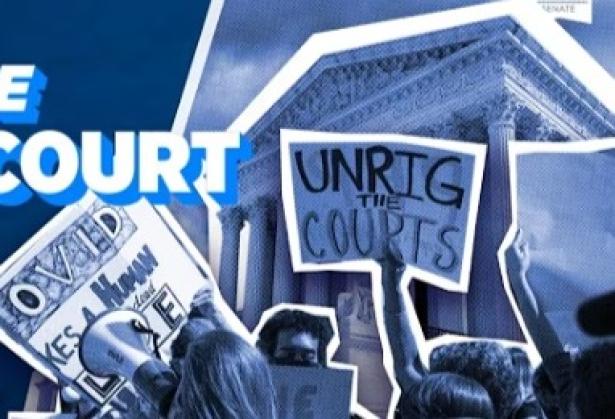
Was Thursday among the darkest days in the history of the Supreme Court? You could make a case. First, a majority cleared the way for a pesticide manufacturer to get thousands of lawsuits off its books from farmers who’d used its product and gotten cancer. Next, it ruled that the administration could turn away asylum-seekers at the border. And then it held that gun owners could now freely carry their weapons into private establishments that serve the public.
Let’s pause over that one for a paragraph. Here’s a good description of the particulars of the gun case and the legal arguments on both sides. But the upshot is this: Everywhere in America, gun owners will presumably be able to take their guns to shops, stores, malls, movie theaters, restaurants, bars, amusement parks, Baby Gaps, you name it. Does any rational person think that the Founders, who simply wanted men to have muskets to protect themselves from invaders, would want someone to be able to take a military-style semiautomatic rifle and 600 rounds of ammo into a Chuck E. Cheese?
But the worst of Thursday’s big four decisions was Mullin v. Doe, which will allow the Trump administration to begin deporting Haitians and Syrians who were granted Temporary Protected Status by the Obama administration in 2010 and 2012, respectively. My colleague Matt Ford shredded the decision in his piece, writing that the court “effectively blessed Trump’s bigotry toward Haitians and dealt potentially catastrophic damage to federal civil rights laws.”
The cases combine to give the executive branch more power. They turn several lower court decisions on their head (as The New York Times notes today, immigration hard-liners had lost case after case on TPS until yesterday). And in the case of Mullin, in particular, the highest legal authority in the land—namely, Samuel Alito, writing for the majority—pretends that Donald Trump’s blatant racism toward Haitians doesn’t exist; that there was nothing “overtly racial” in Trump’s many disgusting and false comments about the Haitian community of Springfield, Ohio, and beyond.
This conservative court is out of control—blatantly partisan and ideological, the six-member majority scarcely even pretends otherwise anymore.
Some major decisions about executive power—Trump’s power—are yet to be handed down this term, involving the firing of Fed Governor Lisa Cook, the removal of Democratic appointees from independent agencies, and of course the birthright citizenship case. If the court rules predictably on two of these three, or certainly on all three, it will have completed a term—with the aforementioned four decisions already on the books, as well as Callais v. Louisiana, which did away with Section 2 of the Voting Rights Act—that might well be the most reactionary in its history. And all this is on top of the earlier reversal of a 49-year-old precedent in 1973’s Roe v. Wade and the handing to Trump of sweeping immunity for all “official” acts.
It’s now unavoidable: This has to be a front-and-center issue in 2028. Democratic presidential contenders will have to answer the question: What do you plan to do about the Supreme Court?
Many of them will be afraid to dip a foot into these waters. They shouldn’t be. Poll after poll shows us that majorities disapprove of the court and think of its decisions as being more political than jurisprudential. According to Gallup, disapproval of the court topped 50 percent five years ago and has stayed there ever since (in contrast, that number was just 29 percent as recently as 2010). So the public—not just the progressive base of the party—is ready to hear ideas.
Some major decisions about executive power—Trump’s power—are yet to be handed down this term, involving the firing of Fed Governor Lisa Cook, the removal of Democratic appointees from independent agencies, and of course the birthright citizenship case. If the court rules predictably on two of these three, or certainly on all three, it will have completed a term—with the aforementioned four decisions already on the books, as well as Callais v. Louisiana, which did away with Section 2 of the Voting Rights Act—that might well be the most reactionary in its history. And all this is on top of the earlier reversal of a 49-year-old precedent in 1973’s Roe v. Wade and the handing to Trump of sweeping immunity for all “official” acts.
It’s now unavoidable: This has to be a front-and-center issue in 2028. Democratic presidential contenders will have to answer the question: What do you plan to do about the Supreme Court?
Many of them will be afraid to dip a foot into these waters. They shouldn’t be. Poll after poll shows us that majorities disapprove of the court and think of its decisions as being more political than jurisprudential. According to Gallup, disapproval of the court topped 50 percent five years ago and has stayed there ever since (in contrast, that number was just 29 percent as recently as 2010). So the public—not just the progressive base of the party—is ready to hear ideas.
Some major decisions about executive power—Trump’s power—are yet to be handed down this term, involving the firing of Fed Governor Lisa Cook, the removal of Democratic appointees from independent agencies, and of course the birthright citizenship case. If the court rules predictably on two of these three, or certainly on all three, it will have completed a term—with the aforementioned four decisions already on the books, as well as Callais v. Louisiana, which did away with Section 2 of the Voting Rights Act—that might well be the most reactionary in its history. And all this is on top of the earlier reversal of a 49-year-old precedent in 1973’s Roe v. Wade and the handing to Trump of sweeping immunity for all “official” acts.
It’s now unavoidable: This has to be a front-and-center issue in 2028. Democratic presidential contenders will have to answer the question: What do you plan to do about the Supreme Court?
Many of them will be afraid to dip a foot into these waters. They shouldn’t be. Poll after poll shows us that majorities disapprove of the court and think of its decisions as being more political than jurisprudential. According to Gallup, disapproval of the court topped 50 percent five years ago and has stayed there ever since (in contrast, that number was just 29 percent as recently as 2010). So the public—not just the progressive base of the party—is ready to hear ideas.
It would all be completely constitutional and completely legal. Which is more than can be said for a lot of the things Trump and the Republicans are getting up to, as they try to find new and blatantly illegal ways to stop mail-in voting and otherwise take the franchise away from citizens.
But the big door-opener here by Trump and the GOP is their rancidly unconstitutional mid-decade redistricting move. The Constitution clearly and plainly states that districts will be redrawn every 10 years, after the decennial census. What Trump and his party are doing with this redistricting is completely lawless.
Once they’ve done that, all bets are off. Democrats should do whatever they need to do to rebalance power. But—they should stay within the law. What I’m talking about here, what Johnson’s bill would accomplish, would be entirely within the law. Congress can set the size of the Supreme Court. And I believe that a smart Democrat, framing the argument the right way, can take that case to the American people and win it. He or she can convince the voters that far from destroying the court, such an action would constitute saving it from its own extremism—and saving the rights we cherish that these ideologues are stripping away.
Spread the word