
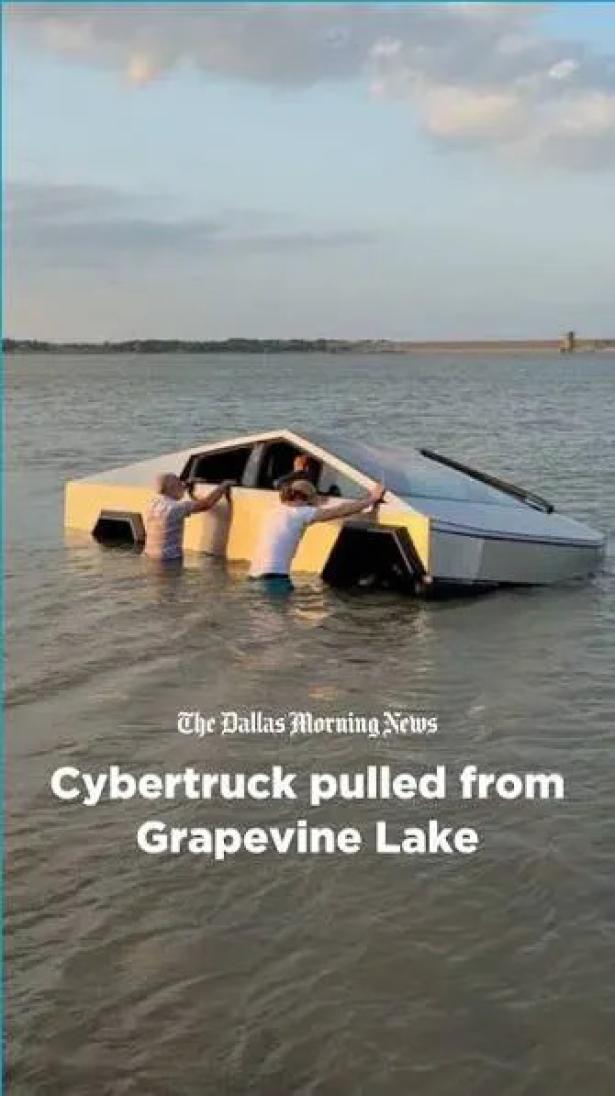
A few years ago my wife and I were driving in New Jersey, when she suddenly exclaimed, “What’s that incredibly ugly car?” It was her first sighting of a Cybertruck in the wild.
Now Tesla is finally pulling the plug on the vehicle, which one person quoted in a New York Times report describes as looking like a mechanical cockroach — an image one can’t unsee.
So what’s the big deal? Businesses make bum investments all the time. It’s true that the Cybertruck’s failure was spectacular — Dave Phillips, the author of the piece, who was clearly having fun, pointed out that it’s unfair to compare the Cybertruck to the Edsel, which had much bigger sales.
Beyond that, however, the Cybertruck was, as the article says, “a culture war on wheels.” The 7-year arc of the Cybertruck coincided with the transformation of Musk’s public image from that of a planet-friendly innovator to that of a racist, conspiracy-theorizing, African-children-killing oligarch. Once upon a time driving a Tesla was a way to signal that you were rich but environmentally conscious. But driving a Cybertruck became a signal of MAGA fealty.
Yet there is an even wider cultural context here. The Cybertruck was the physical embodiment of a dystopian ideology that has become dominant among billionaire tech bros — an ideology that draws heavily from cyberpunk novels and movies.
Wait, can fiction really have major political consequences? Of course it can. Fifteen years ago, you couldn’t really understand the behavior of many right-wing influencers until you realized how their thinking about the world was shaped by reading Ayn Rand’s Atlas Shrugged in their youth. Well, today’s tech billionaires grew up reading William Gibson and watching Blade Runner. But rather than taking cyberpunk’s visions of dystopia as cautionary tales, they saw them as manifestos. And with the great power that flows from great wealth, they have been trying to turn their adolescent dreams into reality.
For those unfamiliar with the term, cyberpunk is a subgenre of science fiction usually set in a not-too-distant future that combines advanced technology with social collapse. Predatory corporations and artificial intelligences rule the world — challenged only by morally ambiguous hackers, who live mainly in the virtual world of what Gibson called cyberspace — while homeless people sleep in piles of trash.
On immediate reflection, the cyberpunk influence on the tech broligarchs is obvious and overwhelming. For example, Elon Musk wasn’t trying to design a mechanical cockroach; he was clearly trying to build a car that looked like the vehicles in Blade Runner. Mark Zuckerberg wasted $80 billion — 40 times what Musk wasted on the Cybertruck — trying to sell the world on his Metaverse, a virtual space modeled on Gibson’s cyberspace. He even changed the name of his company to promote the doomed venture. Should we be surprised that Zuckerberg’s wild spending spree on AI is running into serious headwinds and that even the WSJ believes that Meta is doubling down on loss-making AI bets?
Furthermore, the cyberpunk influence on tech bros goes beyond bad investments. It’s also crucial for understanding the seemingly bizarre public relations strategy of the AI frontier labs: “Our technology will lead either to mass unemployment or to the extinction of the human race. Now, invest in our IPO.” To some extent this is a way of hyping the potential of what they are selling. But it also, I believe, reflects the mindset of middle-aged guys who grew up on cyberpunk and believe that it truly predicts our inevitable future.
Crucially, while you or I might read Neuromancer or watch Blade Runner and shudder at their visions of the future, billionaire tech bros surely picture themselves living in that future not as unemployed and homeless, but as edgelords ruling the world. Technological dystopia may sound like a nightmare to most of us, but for the broligarchs — despite their occasional expressions of concern and mumbling about Universal Basic Income — it’s basically a dream, which they are trying to use their financial and political power to make come true.
But the public isn’t buying it — literally in the case of Cybertrucks and the Metaverse, figuratively in the form of overwhelming voter opposition to data centers and AI in general.
So, will public opposition be enough to stop the cyberpunking of America? Stay tuned.
Paul Krugman is a Professor, CUNY Grad Center, Nobel laureate and former columnist, NY Times. Also, according to Donald Trump, a “Deranged BUM.”
Spread the word