
Better than Redistributing Income

Richard D Wolff Truthout
Bringing democratic decision-making into the core organization of enterprises provides the best chance for a less unequal initial distribution of income than is now common in most societies. Transition to an economy where many enterprises were organized as WSDEs would likely proceed further in reducing income inequality.
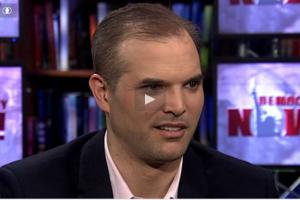

Matt Taibbi: The SuperRich in America Have Become 'Untouchables' Who Don't Go to Prison

Amy Goodman, Matt Taibbi Democracy Now!
Matt Taibbi discusses his new book, "The Divide: American Injustice in the Age of the Wealth Gap." The vast majority of white-collar criminals have avoided prison since the financial crisis began, while an unequal justice system imprisons the poor and people of color on a mass scale. Taibbi explores how the Depression-level income gap between the wealthy and the poor is mirrored by a "justice" gap in who is targeted for prosecution and imprisonment.

Today's Jobs Report and the Supreme Court's "McCutcheon" Debacle

Robert Reich RobertReich.org
The vast middle class and poor don't have enough purchasing power, as 95 percent of the economy's gains go to the top 1 percent. Some wealthy people and big corporations have a strangle-hold on our politics. "McCutcheon" makes that strangle-hold even tighter. Connect the dots and you see how the big-money takeover of our democracy has lead to an economy that's barely functioning for most Americans.

labor

The Insanity of Our Food Policy

Joseph Stiglitz The New York Times
FARM subsidies were much more sensible when they began eight decades ago, in 1933, at a time when more than 40 percent of Americans lived in rural areas. Farm incomes had fallen by about a half in the first three years of the Great Depression. In that context, the subsidies were an anti-poverty program. Now, though, the farm subsidies serve a quite different purpose.

The Income Tax Turns 100 — Who Pays What?

Joshua Holland Bill Moyers and Company
How is it that American corporations are paying a smaller share of federal income taxes when the rates paid by individuals dropped much further? It’s simple: ordinary American families don’t have teams of lobbyists to win them loopholes or armies of tax accountants and attorneys to exploit them.

labor

Employment Gap Between Rich, Poor Widest on Record

Hope Yen AP
"The people at the bottom are going to be continually squeezed, and I don't see this ending anytime soon," said Harvard economist Richard Freeman. "If the economy were growing enough or unions were stronger, it would be possible for the less educated to do better and for the lower income to improve. But in our current world, where we are still adjusting to globalization, that is not very likely to happen."

Wealth Inequality in America

The distribution of wealth in America is way more unequal than we think it is or than we think it should be. These are the real numbers, and they're hard to believe.

Subscribe to Income Inequality