
‘Do As We Say, Not As We Do’ (1981)
MARCH 18 IS THE 45th ANNIVERSARY of the first appearance before a Congressional committee by Alexander Haig, Ronald Reagan’s recently appointed Secretary of State. For a curtain-raiser, Haig put on a headline-making show.
Haig, who was asked to talk about the Reagan administration’s foreign policy plans, used his appearance before the House Foreign Affairs Committee to fiercely attack the Soviet Union’s approach to the third world. He said that “Soviet illegal interventionism . . . is increasingly placing world peace in jeopardy,” and that the U.S., in contrast, sought nothing but “peace and peaceful change, and above all by rule of law, and not use of bloodshed, terrorism and so-called wars of national liberation.”
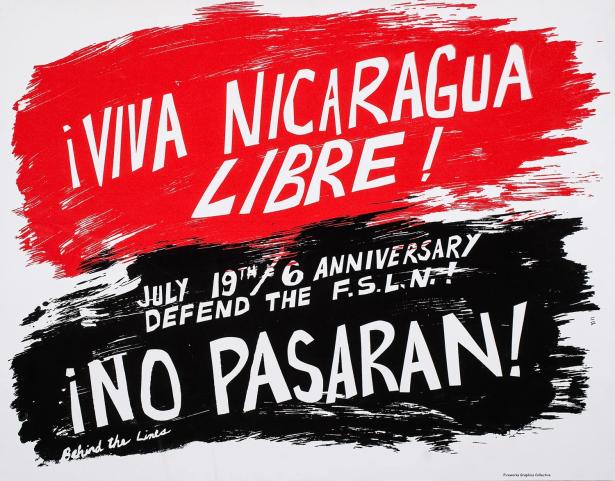
Haig’s 1981 praise for the rule of law contrasted sharply with the Reagan administration’s actions in the months and years to follow. Less than 10 months after Haig spoke, Reagan secretly ordered the CIA to recruit, equip, and pay for an army of terrorists, known as the Contras, with the objective of overthrowing Nicaragua’s progressive, anti-imperialist government. The Contras’ terrorist activities quickly became public knowledge, but the CIA’s crucial support for the Contras remained hidden for a long time.
At the same time the CIA was secretly bankrolling the Contras, the Pentagon was openly spending tens of millions of dollars staging month after month of well-publicized military and naval maneuvers involving more than 100,000 troops and sailors just outside the borders of Nicaragua.
Apparently not satisfied with the combined effect of Contra terrorism inside Nicaragua and saber-rattling maneuvers nearby, in 1983 Reagan secretly ordered the U.S. Navy to facilitate hit-and-run attacks on Nicaraguan shore facilities. The Navy’s role in the attacks was to transport small speedboats that had no identifying insignia close to Nicaraguan ports. The speedboats, with crews of Contra fighters, would attack the ports and quickly return to the larger ships to be hoisted aboard. Even though the Navy attempted to keep its role in the attacks under wraps, the Nicaraguans were able to collect proof of the Navy’s involvement.
After the seventh such sea-borne attack, the Nicaraguan government went to the International Court of Justice (ICJ), where it charged the U.S. with violating international law and asked the court to order the U.S. to pay for $370 million for the damage it had illegally inflicted on Nicaragua.
The ICJ took more than 26 months to decide the case, but it finally determined that the U.S. had violated international law by attacking Nicaraguan facilities and naval vessels, laying mines in approaches to Nicaraguan ports, invading Nicaraguan air space, and training, arming, equipping, financing and supplying the Contras.
Even though the ICJ’s decision was final, it had no concrete effect on the U.S. As the judicial arm of the United Nations, ICJ decisions are enforced by the UN. Even though the US could not erase the ICJ’s ruling that the US was violating international law, the US could, and did, veto a UN resolution that would require the US to abide by it. https://libcom.org/article/contra-war-nicaragua-noam-chomsky
Politics Was Never the Same (1951)
MARCH 19 IS THE 75TH ANNIVERSARY of a watershed day in the history of television’s huge influence on politics and the national conversation.
A week earlier, on March 12, 1951, the Senate Special Committee to Investigate Crime in Interstate Commerce began to hold public hearings in New York City. The committee was barnstorming the country, demanding testimony from politicians, police officials, and individuals who were widely known to have inside knowledge about the activities or organized crime, especially bookmaking and narcotics.
The committee began to hold hearings that were open to the public in June 1950, and the result was plenty of newspaper coverage. As it became clear that the public was fascinated, particularly when well-known criminals were the witnesses, local TV stations (which were far outnumbered by daily newspapers) began to get interested.
But then March 1951, when committee hearings began in Manhattan, the impact of the television coverage changed. In 1951, New York was by far the most television-set rich environment in the world, with more than two million TV receivers in the metropolitan area. Not only that, but the networks were all headquartered in the city, so what had been local coverage everywhere else was transformed into what passed for national coverage then, including all the big cities in the eastern portion of the country, going as far west as Chicago and Kansas City.
On March 12, when former NYC Mayor William O’Dwyer testified about the conversations he had had, while mayor, with well-known shady characters, and major organized crime personality Frank Costello testified about the occasional advice he had given to big-name politicians.
As Life magazine reported several days later, “all along the television cable . . . . people sat as if charmed . . . . the first big television broadcast of an affair of their government, the broadcast from which all future uses of television in public affairs must date . . . . Never before had the attention of the nation been so completely riveted on a single matter. The Senate investigation of interstate crime was almost the sole subject of national conversation.”
Estes Kefauver from Tennessee, the Senate Committee’s chair, was suddenly a star. He soon co-wrote a book, Crime in America, that was on the best-seller list for three months. Four years later he was the Democrat’s vice-presidential nominee, an honor that none would have anticipated in 1951. https://www.smithsonianmag.com/history/the-senator-and-the-gangsters-69770823/
The Civil War’s Cause, Explained Like It Really Was (1861)
MARCH 21 IS THE 165TH ANNIVERSARY of a famous, or rather, infamous speech by the acting Vice-President of the Confederate States of America, Alexander Stephens, three weeks before the beginning of the Civil War.
The 1861 speech is memorable because it vividly exposes the lie that the cause of the war was the north’s infringement of the rights of the southern states, rather than the South’s total commitment to slavery and the racism that made it possible.
The speech includes a lot not to like, but this is what stands out: “Our new government is founded upon . . . the great truth that the Negro is not equal to the white man; that slavery, subordination to the superior race, is his natural and normal condition. This, our new government, is the first, in the history of the world, based upon this great physical, philosophical, and moral truth. This truth has been slow in the process of its development, like all other truths in the various departments of science. . . . Many governments have been founded upon the principle of the subordination and serfdom of certain classes of the same race; such were and are in violation of the laws of nature. Our system commits no such violation of nature's laws.” The entire speech is here: https://teachingamericanhistory.org/document/the-corner-stone-speech/
Mutiny in Vietnam Explained Away
MARCH 22 IS THE 55TH ANNIVERSARY of a mutiny in Vietnam by some 60 U.S. Army troops, who refused to obey their captain’s order to leave their base to prevent nationalist Vietnamese troops from taking possession of two pieces of damaged U.S. equipment, a helicopter and an armored vehicle.
The troops’ 1971 disobedience in the face of the enemy was part of the breakdown of discipline that was making it increasingly difficult for U.S. military commanders in Vietnam to depend on the reliability of their subordinates.
Senior officers, like the commanding general of the mutinous troops, acknowledged the need to adjust to their diminished authority. “I suppose if I went by the book, we could take them out and shoot them for refusing an order in the face of the enemy,” Brig. Gen. John G. Hill Jr. told a reporter, “but they're back in the field, doing their duty. don't think it should be blown out of proportion.” https://msuweb.montclair.edu/~furrg/vietnam/heinl.pdf
Reaganism Jump-Starts Central American Solidarity Work
MARCH 24 IS THE 46TH ANNIVERSARY of the assassination of El Salvadoran Archbishop and human rights activist Oscar Romero by a right-wing death in San Salvador.
The first anniversary of Romero’s 1980 murder was chosen to be the focus of U.S.-wide protests against the Reagan administration’s enthusiastic support of the brutal right-wing regime in El Salvador. The main organizer of the nationwide actions was the Committee in Solidarity with the People of El Salvador, which had been established during an October 1980 meeting of activists in Los Angeles.
On and around the weekend of the 24th, thousands of people participated in El Salvador-related marches, rallies, sit-ins, teach-ins, from coast to coast. During the weekend, Dave Dellinger, who had been a leader of the movement to end the Vietnam War, remarked on the speed with which El Salvador support had begun to consolidate: “It took more than five or six years after U.S. intervention in Vietnam before there was massive opposition to the war.”
Barbara Ehrenreich told a rally of several hundred at Columbia University, ''What we're hearing now is the language of the Vietnam War - rural pacification, wiping out a village in order to eliminate guerrillas.''
The actions, which added up to the largest anti-imperialist mobilization in the U.S. since the early 1970s, included a march of more than 6000 activists in Boston, a 1500-person workshop at Manhattan’s New School for Social Research, a 1200-person march in Amherst, Mass., plus numerous marches and rallies in San Francisco, Oakland, Los Angeles, Santa Cruz, San Jose, Ventura, Santa Barbara, and San Diego, Calif.; and also in Phoenix and Tucson, Ariz., Portland and Salem, Ore., and Seattle, Wash. https://cispes.org/section/history-cispes
For more People's History, visit
https://www.facebook.com/jonathan.bennett.7771/
Spread the word