
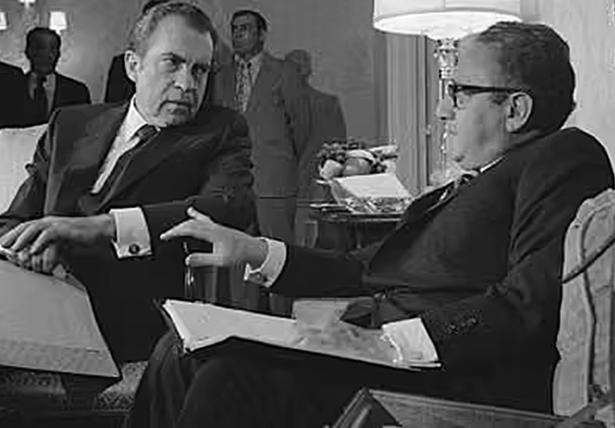
Evil Thoughts in the Oval Office (1971)
JUNE 17 IS THE 55TH ANNIVERSARY of President Richard Nixon venting his anger to Henry Kissinger in the Oval Office, where the conversation was recorded on one of the famous Watergate-era White House tapes.
Nixon, who was furious because the New York Times had just started publishing the top-secret official study of the Vietnam War known as the Pentagon Papers, told Kissinger that he wanted to “kill” the newspaper. After quoting an old saying, “Never strike a king unless you kill him,” Nixon continued, “They [meaning the New York Times’ staff] struck and did not kill. And now we’re going to kill them. That is what I will do, if it’s the last thing I do in this office. I don’t care what it costs. They’re going to be killed. If I can kill ’em."
Despite Nixon’s determination, the New York Times is still with us, which is more than you can say for Richard Nixon. In fact, thanks in part to circulation boosts driven by the public’s fascination with the Times’ reporting about the dramatic events that led up to Nixon’s meltdown, the newspaper’s profits more than doubled over the years that resulted in Nixon’s becoming the first (and only, so far) president to resign from office. https://millercenter.org/the-presidency/educational-resources/pentagon-papers-view-oval-office
The Senate Smears the People’s Bicentennial (1976)
JUNE 18 IS THE 50TH ANNIVERSARY of a right-wing attack from the U.S. Senate on the efforts of progressive organizations to criticize the super-patriotic events being organized to celebrate the upcoming bicentennial of the U.S. revolution.
One of the targets of the Senate’s wrath was the People’s Bicentennial Commission, which had, starting in 1971, been using the bicentennial as a peg for public education and the promotion of social, economic, and political change.
The People’s Bicentennial Commission was a liberal organization trying to focus the attention of middle America on the “un-American character of our economic and political leaders and the institutions they represent.” It called for major reforms because a new breed of “corporate monarchs” had taken the country over.
But even calls for political and economic reform were too much for the Senate Internal Security Committee, which held a June 18 hearing, where it issued a report calling the People's Bicentennial Commission “a propaganda and organizing tool for a small group of New Left political extremists,” and warned of possible acts of terrorism at Fourth of July events Philadelphia and Washington, D.C. https://jacobin.com/2025/07/independence-day-constitution-democracy-bicentennial
Free At Last, Free At Last! (1865)
JUNE 19 IS THE 161st ANNIVERSARY of the day that has come to be known as Juneteenth, when all enslaved people in Texas were formally emancipated.
In theory all enslaved people in Texas had been freed on 10 weeks earlier, when Ulysses Grant accepted the surrender of rebel commander (and traitor) Robert Lee, bringing the bloody Civil War to an end, but as a practical matter, emancipation was only realized where there were Union troops to enforce it.
On June 19, 1865, Union Gen. Gordon Granger and a company of Union infantry arrived at the port of Galveston, Texas, on a troopship. On the same day Granger issued General Order No. 3, declaring all enslaved people in Texas to be free.
For more than a century, Juneteenth was a folk holiday celebrated for the most part by people residing in the states of the former Confederacy. In 1980, Texas was the first state to make it an official holiday; more and more states followed suit until five years ago it became a national, federal, holiday for the first time. https://portside.org/2021-06-18/hidden-history-juneteenth
Arthur Miller Schools the House Un-American Activities Committee (1956)
JUNE 21 IS THE 70TH ANNIVERSARY of playwright Arthur Miller’s refusal to play the role of stoolpigeon in front of the House Un-American Activities Committee, at a time when the committee was doing its terroristic best to blacklist every progressive they could identify.
When the committee asked Miller about himself, he answered all their questions. No, he said, he had never been a member of the Communist Party. Yes, he said, he had been acquainted with many people who he thought might have been Communists or close to the Communist Party. Yes, he said, he had signed many petitions in support of causes that had the backing of the Communist Party. But when he was asked for the names of people who he thought were or might be Communists, he said the First Amendment gave him the right to refuse to answer.
When Miller made it clear he was not going to give the committee the name of anyone else, the committee excused him. Later, both the committee and then the whole House voted to charge him with contempt of Congress for his refusals to answer.
If a federal court found him guilty of contempt, Miller could have been imprisoned for up to a year and fined up to $1000 (the equivalent of $12,000 today). When Miller’s contempt case reached the U.S. Court of Appeals, the court determined that the contempt charge was invalid, because the committee had never made clear to Miller that his refusal to identify any of his acquaintances put him in danger of a contempt citation. Case dismissed. https://todayinclh.com/?event=playwright-arthur-miller-testifies-before-huac
A Musical Colossus (1956)
JULY 22 IS THE 70TH ANNIVERSARY of the recording of the album Saxophone Colossus by Sonny Rollins on tenor saxophone, Tommy Flanagan, piano, Doug Watkins, bass and Max Roach, drums, which was released by Prestige about a year later.
The album’s five tracks are among Rollins’ finest work, but his solo in Blue Seven is beyond comparison. You can listen to the entire album here: https://youtu.be/1BBcGemV9mY?si=Iufq8TV6rzuWgGuq
The Truth Helped End the Vietnam War (1971)
JUNE 23 IS THE 55TH ANNIVERSARY of the airing of a 30-minute CBS News interview with Daniel Ellsberg, the government contractor who had absconded with the Pentagon Papers and gave them to the media. At the time of the interview, Ellsberg was a fugitive who had so far avoided arrest. He turned himself in to the authorities a week after he spoke to CBS.
Ellsberg used the interview to emphasize that his reason for making the Pentagon Papers public was his belief that the papers showed the United States government was solely responsible for the war in Vietnam, that the war would never have begun if the U.S. had not started it, and that the war could not possibly continue without the continuous supply of U.S. money, war material, and soldiers.
He had reached what he believed to be the inescapable conclusion that the U.S. had complete power to bring the war to an end at any time it chose to do so.
One of the corollaries to his understanding that the U.S. was solely responsible for the war was that the U.S. was also responsible for every one of the deaths that the war had caused “and that’s one million to two million people,” he said.
Ellsberg told CBS that he thought there was a great risk that if he did not make the papers public, the Nixon administration might choose to escalate the war, as the Johnson administration had done in 1964. He said that making the papers public made it much less likely that the U.S. would attempt such an escalation.
He also told CBS that he expected that once the U.S. public understood what the U.S. government had been doing in Vietnam, the public would demand that the war be brought to a speedy conclusion.
The release of the documents had the effect that Ellsberg had anticipated. The undeniable proof that multiple presidential administrations had secretly escalated the conflict while publicly downplaying U.S. involvement greatly strengthened opposition to the war and demands that it be brought to an end. https://news.gallup.com/vault/350477/gallup-vault-backing-press-freedom-government-secrecy.aspx
For more People's History, visit
https://www.facebook.com/jonathan.bennett.7771/
Spread the word