
-
Francesca Hong: "Our Movement Is Strong, and the Work Isn't Done"
-
Wisconsin Outcome Hands Dems a Surprise Weapon Against MAGA
Francesca Hong: “Our Movement Is Strong, and the Work Isn’t Done”
by John Nichols
The Nation / August 13, 2026
This week, Francesca Hong won one of the highest vote totals ever recorded for a Wisconsin Democrat in a seriously contested primary for the party’s gubernatorial nomination. Her tally—around 312,000 votes—was almost 90,000 votes more than Democratic Governor Tony Evers won when he was first nominated in 2018.
Evers chose not to seek reelection this year. He remained aloof from a chaotic multi-candidate campaign to replace him, before finally endorsing a last-minute bid by Milwaukee County Executive David Crowley, who on Tuesday finished a little over 3,000 votes ahead of Hong.
Election analysis is often an exercise in managing expectations, and that it certainly the case in Wisconsin, where pre-primary polls put Hong in the lead. When she didn’t prevail, pundits and political insiders rushed to declare a definitional victory for the Democratic Party’s embattled centrist wing.
“Democrat establishment strikes back as socialist candidate downed in battleground primary,” read the Fox News headline, while CNBC announced, “Hong’s defeat in Wisconsin deals blow to rising Democratic socialists.” And, of course, The New York Times presumed that “A Stunning Loss in Wisconsin Shows the Limits of the Left.”
Seriously? A little-known legislator with a scant campaign treasury, whose candidacy was actively opposed by the sitting governor and faced a hair-on-fire national media onslaught, finished in a virtual tie for the Democratic gubernatorial nomination in the ultimate swing state. And we’re supposed to believe that the result has defined the limits of the left?
History suggests differently.
Movements are built over time. Robert M. La Follette, the great progressive governor of Wisconsin in the early 20th century, lost repeated bids for his Republican Party’s gubernatorial nomination. He was labeled as too radical, too unprepared, and too unfit to govern. And then he won. The transformational figure in the modern Democratic Party of Wisconsin, William Proxmire, was dismissed as a gadfly. He lost bids for governor in 1952, 1954, and 1956. Then, in 1957, he won a special election for what had been Joe McCarthy’s US Senate seat and ushered in a new kind of politics in a once rigidly Republican state.
In the heat of an election season, results are measured in raw vote totals. But they should also be measured by the potential they reveal. That is what Hong did on election night. “We have built something that will change politics forever,” she told a cheering crowd of young supporters. “What we have done will be remembered. I don’t even know how the final results will end. But what I do know is that we are ready to keep fighting, and I feel confident. More importantly, I am so deeply, deeply grateful.”
Hong had every right to be grateful, and every right to be confident about the future.
With an outsider campaign that defied expectations and conventional wisdom, she came within a whisker of winning one of the highest-profile contests of a volatile election year. And, despite a frenzied final debate about her “electability,” public polls and internal Democratic surveys suggested that she could be a viable contender in November against the extremely right-wing Republican nominee, Tom Tiffany.
Even as she promised to fully support Crowley, Hong reflected, appropriately, on what her own run had accomplished. “This campaign was not about getting one person into office,” she said. “It is about building a movement and a government that puts working people first. Our movement is strong, and the work isn’t done.”
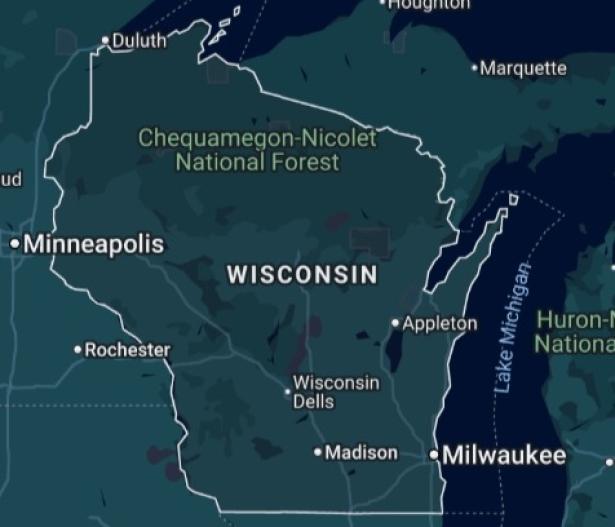
The map of Wisconsin confirms that assessment. Hong’s support was not narrowly defined, nor regionally constricted. She won 20 of Wisconsin’s 72 counties, carrying wide swaths of northwest and western Wisconsin, as well as much of the industrial Fox Valley. She won Green Bay and surrounding Brown County, as well as Democratic strongholds such as Eau Claire and La Crosse. She carried Menominee County, the home of the state’s Menominee Indian Reservation. Her highest percentage of the vote came not from liberal Madison’s Dane County but from Ashland County on the far shores of Lake Superior. She even came within 2,400 votes of winning Crowley’s Milwaukee County.
While much of the national coverage of the Wisconsin campaign had focused on Hong’s democratic socialism and her old tweets about Thanksgiving and the best place to sample cheese curds, the secret to her statewide viability was not a novel new approach developed by strategists in New York or Washington.
Rather, Hong practiced an old-school version of Wisconsin Democratic politics—recognizing the importance of building a coalition rooted in the progressive heartlands of Madison, the diverse precincts of Milwaukee, and the rural regions that Democrats have so frequently neglected. In building that coalition, Hong did something that is so rare in politics that it confused many of the national reporters who began following her as her campaign as it surged in the polls: She engaged in real conversations with Wisconsinites, joking with them, showing off her Milwaukee Bucks tattoo, and paying close attention when they talked about things like their concerns about AI data centers.
Long before most Democrats nationally took an interest in the issue, Hong called for a moratorium on construction of major data centers. But she did not stop there. She recognized that the widespread opposition to data centers is just one expression of a deeper anxiety over the threat that artificial intelligence poses to jobs, privacy and the frameworks of our lives. So—in addition to plans to tax the rich and fully fund public education, break up agribusiness monopolies, establish public banking, and strengthen unions—she proposed a detailed agenda that promised “no tax breaks or state funding for AI layoffs” and said that, when it came to AI regulation, “Wisconsin will step in to protect workers if the federal government won’t.”
Hong’s determination to build a campaign based on her interactions with voters—as opposed to demands from campaign donors and talking points from out-of-state consultants—set her apart. And it built a loyalty that saw her through the turbulent close of a campaign in which candidates with more money and name recognition stumbled and, in many cases, dropped out. Even amid claims that Hong could not beat a Republican “culture wars” crusade that would attack her as a holiday-hating Marxist, hundreds of thousands of Democratic primary voters stuck with the 37-year-old progressive, who proudly identified herself as “a mom, service worker, chef, and community organizer”
Just as Hong stuck with them. While most of the media’s attention to the last days of the campaign focused on some ill-advised appearances on national cable shows—where the commentariat could talk about nothing but old tweets on police funding and Thanksgiving—the candidate spent most of her time on the road, traveling along blue highways and county roads from Viroqua (population 4,504) to Siren (population 1,554) and to historic manufacturing centers such as Kenosha, and, of course, to Green Bay. She frequently mentioned the latter city in response to questions about her supposedly “radical” ideology: “When people ask about my style of progressive politics, I always start with the three Ps: fixing potholes, fully funding our public schools, and our community-owned Green Bay Packers.”
“At some stops,” Hong noted, “we’ve even had to change venues because so many people [were] showing up.” They wanted pictures with the former chef and restaurant owner from Madison whom so many national commentators portrayed as “too radical” or “too woke” to connect with voters in a swing state such as Wisconsin. In fact, Francesca Hong connected with more than 300,000 of them, as she laid the foundations for a movement that is far from finished.
John Nichols is the executive editor of The Nation. He previously served as the magazine’s national affairs correspondent and Washington correspondent. Nichols has written, cowritten, or edited over a dozen books on topics ranging from histories of American socialism and the Democratic Party to analyses of US and global media systems. His latest, cowritten with Senator Bernie Sanders, is the New York Times bestseller It's OK to Be Angry About Capitalism.
Copyright c 2026 The Nation. Reprinted with permission. May not be reprinted without permission. Distributed by PARS International Corp.
Founded by abolitionists in 1865, The Nation has chronicled the breadth and depth of political and cultural life, from the debut of the telegraph to the rise of Twitter, serving as a critical, independent, and progressive voice in American journalism.
Please support progressive journalism. Get a digital subscription to The Nation for just $24.95!
Wisconsin Outcome Hands Dems a Surprise Weapon Against MAGA
by Greg Sargent
The New Republic / August 12, 2026
Ben Wikler, who heroically rebuilt the Wisconsin Democratic Party as its chair from 2019 to 2025, is fond of describing our election system as akin to an “electric grid.” The idea is that local elections are interconnected in obscure ways. Just as losing one substation can wreak havoc on electric power in nearby areas, local electoral outcomes can have ripple effects that are not immediately obvious but nonetheless prove hugely consequential.
Case in point: David Crowley’s upset victory over democratic socialist Francisca Hong in Tuesday’s Wisconsin gubernatorial primary. Crowley, the candidate of the Democratic “establishment,” defeated Hong by half a point. Yet this extraordinarily narrow win could have hidden, surprising implications that benefit the party more broadly, perhaps impacting Democrats’ ability to combat MAGA-GOP tactics in the 2028 presidential race and in the longer-term House redistricting wars.
Let’s connect the dots. Most obviously, a Crowley win in the primary probably makes it more likely that a Democrat will take over the Wisconsin governorship next year from incumbent Democrat Tony Evers. Republicans spent millions to boost Hong for exactly that reason. But that’s not all: With Crowley at the top of the ticket, Democratic strategists believe, wins in many down-ballot state legislative races in Wisconsin are now more likely.
On that front, the stakes are very high. Another top Democratic goal this year is flipping control of the Wisconsin state legislature, which is notoriously far more right wing than the state itself. To do so, they’re targeting 14 GOP-controlled legislative seats—10 in the State Assembly and four in the State Senate. Winning those seats would have been harder with Hong as the gubernatorial candidate, Democratic strategists say.
“Crowley’s path to victory runs through suburban Wisconsin and through holding down Republican margins in rural communities,” Joe Zepecki, a veteran Democratic strategist in the state, told me. “That overlaps with exactly where Democrats need to win state legislative seats to get the trifecta next year.”
By contrast, Zepecki said, Hong’s path would have run through boosting youth turnout in Wisconsin’s urban centers and around college campuses. “That does not map on to where the competitive legislative races are,” Zepecki noted.
A Democratic trifecta in Wisconsin will be hard to pull off with Republicans enjoying a three-seat edge in the State Senate and nine-seat edge in the Assembly. But with Trump’s approval in the state stuck at around 40 percent, a very good year is certainly plausible. The large number of GOP state legislators who retired this cycle shows that Republicans very much agree.
And a trifecta suddenly makes possible big progressive legislative changes, Zepecki pointed out, like ending the state’s right-to-work status, restoring collective bargaining for public employees, a minimum wage hike, legalizing cannabis, and more. These have had “zero chance of passing since 2011,” Zepecki said, referring to when Republican Scott Walker was elected governor and lurched the state in a reactionary direction. “That’s a long time.”
Now note that the GOP gubernatorial nominee, Representative Tom Tiffany, is an election denier who voted against certifying Joe Biden’s 2020 electors. There’s no telling what he’d do to sabotage the electoral count in the 2028 presidential election. Same with a GOP-controlled legislature. If Democrats can win the governorship—and even better, both legislative chambers—it would cut off that option, too.
Want more? Recall that Wisconsin’s congressional seats remain hideously gerrymandered due to the last decade of GOP redistricting: Right now, Republicans control six House seats and Democrats control two. That’s ludicrous in a state where Evers was elected governor in 2022 and in 2018 by very slim margins, not to mention where Donald Trump won in 2024 by less than a point after losing to Biden in 2020 by—you guessed it—less than a point.
That extreme gerrymander gives Democrats a big opening—if they can flip the state legislature. Republicans have unleashed the gerrymandering hounds nationally—the party has long gerrymandered, but Trump and MAGA supercharged it this year by demanding mid-decade chicanery across the country—and most Democrats grasp that they now must do the same.
But in this cycle they were hamstrung by structural obstacles. More redistricting opportunities will soon open up, and a big one could be in Wisconsin: As a recent Fair Fight Action analysis found, Democrats could potentially squeeze three additional House seats out of the state.
It’s not clear when this might be doable: The state constitution probably precludes a redistricting next year (though a Democratic trifecta could try). But if Democrats can assemble and keep this trifecta through 2031, then they can redraw the House maps to gain those three seats into the next decade. As Fair Fight Action’s Max Flugrath put it: “Flipping the Wisconsin legislature is critical to countering the GOP’s war on fair representation.”
There’s still more! The gubernatorial outcome could also impact the hugely contested House race in Wisconsin’s third congressional district, which could figure in a new Democratic majority. The party’s preferred candidate, Rebecca Cooke, just won her primary there. A source familiar with internal Democratic polling tells me Crowley’s victory makes it more likely that Cooke can compete against hard-core MAGA GOP Representative Derrick Van Orden with male independents, a key demographic in the district.
“That wasn’t going to happen with Hong at the top of the ticket,” the source said.
Admittedly, these sorts of calculations—the slicing and dicing of the electorate, the notion that long-term policy and redistricting advances live or die on such infinitesimal shifts—are not a particularly inspiring way to think about politics.
Yet this is how our system is constructed. The reversal of the GOP rigging of democracy in Wisconsin has been incredibly painstaking. It depended on hard-won victories like recapturing the State Supreme Court in 2025 in the face of $20 million in spending by Elon Musk. It has relied on arduous, unglamorous organizing, and on grinding victories akin to tiny movements in trench warfare.
As Wikler has put it, unrigging the GOP capture of democracy in Wisconsin taught him something about how power ebbs and flows—how seemingly isolated victories enable other gains elsewhere down the road. “I compare it to an electrical grid where if you short out one substation, the lights flicker in the next neighborhood,” Wikler recently told Ezra Klein. “American political power is like that.”
Over time, in short, every little victory here and there adds up to something much bigger than the sum of its parts. In Wisconsin, the long-term unrigging of the GOP hammerlock on democracy still hangs in the balance—but it’s certainly more plausible now than it was only 24 hours ago.
Greg Sargent is a staff writer at The New Republic and the host of the podcast The Daily Blast. A seasoned political commentator with over two decades of experience, he was a prominent columnist and blogger at The Washington Post from 2010 to 2023 and has worked at Talking Points Memo, New York magazine, and the New York Observer. Greg is also the author of the critically acclaimed book An Uncivil War: Taking Back Our Democracy in an Age of Disinformation and Thunderdome Politics.
The New Republic was founded in 1914 to bring liberalism into the modern era. The founders understood that the challenges facing a nation transformed by the Industrial Revolution and mass immigration required bold new thinking.
Today’s New Republic is wrestling with the same fundamental questions: how to build a more inclusive and democratic civil society, and how to fight for a fairer political economy in an age of rampaging inequality. We also face challenges that belong entirely to this age, from the climate crisis to Republicans hell-bent on subverting democratic governance.
We’re determined to continue building on our founding mission.
Sign up for a TNR newsletter on politics, climate, culture and more.
Spread the word